Jon Stewart Challenges Kamala Harris on VP Snub, Calling It “Reverse Affirmative Action”
In the turbulent world of American politics, authenticity is often touted as the ultimate currency. Voters and pundits alike claim to crave genuine candidates who speak from the heart, yet the inner workings of political campaigns often reveal a starkly different reality—one driven by careful calculations, demographic chess, and strategic compromises. This deep-seated disconnect between public rhetoric and private decision-making was recently thrown into the spotlight by none other than Jon Stewart, who seized upon a startling admission from Vice President Kamala Harris’s new memoir. In a candid discussion on his podcast, the comedian and political commentator dissected Harris’s reasoning for not choosing Pete Buttigieg as her running mate, a decision she attributed to his sexual orientation. The raw exchange between Jon Stewart and Kamala Harris’s written words has ignited a firestorm, forcing a national conversation about trust, identity, and the very nature of political authenticity in a deeply divided nation. The revelation, detailed in her book “107 Days,” provides a rare and unsettling glimpse behind the political curtain, and Stewart was quick to label the logic as something akin to “reverse affirmative action,” exposing a paradox at the heart of the Democratic party’s platform.
A Stunning Revelation from “107 Days”
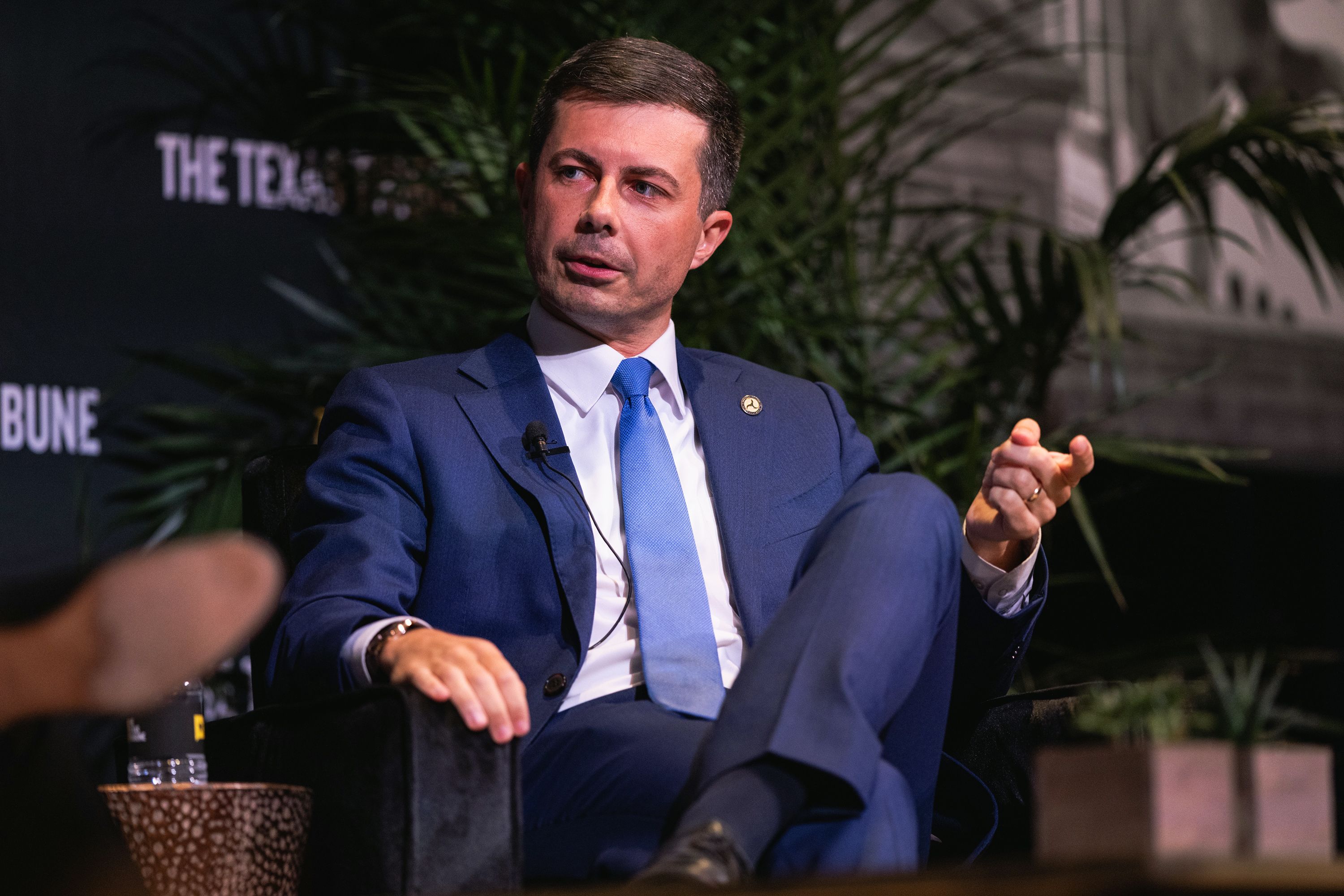
The political landscape was already seismically shifted when President Biden withdrew from the 2024 presidential race, thrusting Kamala Harris into the spotlight with just 107 days to mount a full-scale campaign. Her memoir, aptly titled “107 Days,” chronicles this whirlwind period. However, one of its most explosive revelations concerns the complex process of selecting a vice-presidential candidate. Harris writes with surprising frankness that Pete Buttigieg, the Secretary of Transportation, was her first choice for the role. She believed “he would have been an ideal partner.” Yet, a significant hurdle stood in the way—not his qualifications or political alignment, but his identity. In a passage that has since reverberated across the media, Harris explained her hesitation, stating she passed on him because she was already asking a lot of America. “We were already asking a lot of America: to accept a woman, a Black woman, a Black woman married to a Jewish man,” she wrote. Adding a gay man to the ticket, she concluded, was simply “too big of a risk.” This admission confirmed what many have long suspected: that identity politics, in its most calculated form, plays a crucial role in shaping the highest echelons of power.
Jon Stewart and Kamala Harris: A Clash Over Political Calculations
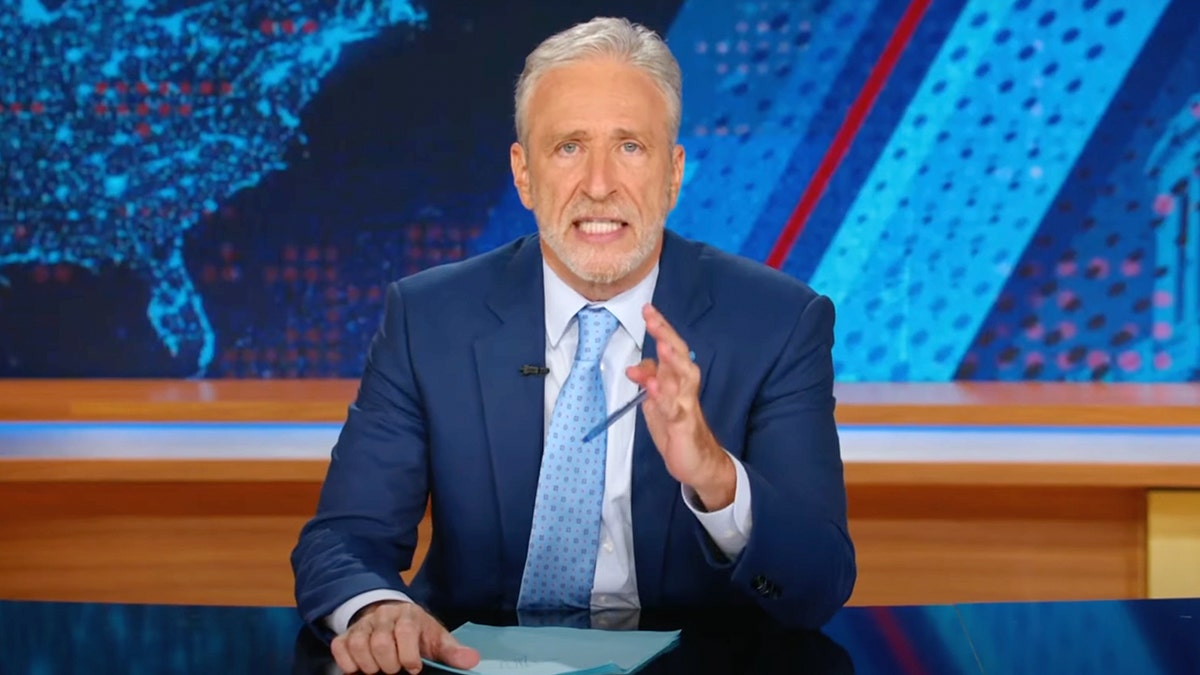
It was this very calculation that Jon Stewart found so problematic. On a recent episode of his podcast, “The Weekly Show With Jon Stewart,” he sat down with Democratic National Committee Chairman Ken Martin to discuss the erosion of trust in modern politics. Stewart argued that Harris’s book, perhaps unintentionally, “does a real service” by exposing the conversations that politicians publicly deny are happening. He pointed directly to her reasoning about Pete Buttigieg. “In the book when she says, ‘I didn’t go with Pete Buttigieg cause he’s gay. And that’d be too far.’ And you’re like, ‘Oh my God, it’s actually reverse affirmative action,’” Stewart exclaimed, capturing the shocking nature of the admission. “It’s like, ‘What!?’” For Stewart, the issue wasn’t just the decision itself, but the chasm it revealed between the party’s professed ideals of inclusivity and the pragmatic, risk-averse strategies employed behind the scenes. He argued that this is a “fundamental foundational problem of erosion of trust,” where voters are told that choices are based on merit and vision, while in reality, they are heavily influenced by demographic polling and perceived societal biases.
The Fraught Debate on Political Authenticity
The DNC Chairman, Ken Martin, attempted to steer the conversation toward the importance of genuine connection with voters. “This is where authenticity matters,” he offered, suggesting that the Democratic party’s challenge lies in proving its sincerity. However, Stewart immediately pushed back, dismissing “authenticity” as a hollow “buzzword” co-opted by campaign strategists. He contended that the problem isn’t a lack of authentic-sounding rhetoric, but a fundamental disbelief that politicians mean what they say. Martin conceded the point, adding, “The reason we’ve lost trust is because people don’t believe that we actually believe the sh-t we’re selling them. That we’re telling them what they want to hear.” Stewart’s interjection about Harris’s memoir served as his primary exhibit. Her confession, in his view, was a moment of accidental authenticity that proved the public’s cynicism is justified. It showed that even as the party champions progress and breaking barriers, its leaders are simultaneously making decisions based on the fear that the electorate is not as progressive as they claim. This paradox, Stewart implies, is at the core of the trust deficit plaguing American politics.
The Unintended Consequences of the ‘107 Days’ Memoir
While Stewart applauded Harris for her candor, he also highlighted the damaging implications of her revelation. By pulling back the curtain, the 107 Days memoir exposed the often-uncomfortable mechanics of political strategy. It revealed that a candidate as qualified and popular as Pete Buttigieg could be sidelined not for his policy positions or capabilities, but for an identity marker that was deemed a political liability. This has sparked a difficult conversation within the Democratic party and among voters. On one hand, some may see Harris’s decision as a pragmatic and necessary choice in a high-stakes election where every vote counts. From this perspective, she was making a tough call to maximize her chances of winning against a formidable opponent. On the other hand, many view it as a betrayal of the very principles of equality and meritocracy the party purports to represent. It raises troubling questions about whether the goal is to lead public opinion or simply to reflect its perceived limitations. Stewart’s critique perfectly encapsulates this dilemma, framing it not just as a political misstep but as a symptom of a much larger crisis of faith in the system itself.
In conclusion, the discourse sparked by Jon Stewart and Kamala Harris’s memoir serves as a critical moment of reflection for the American electorate. The controversy over the Pete Buttigieg decision transcends the individuals involved, touching upon the foundational issues of trust, identity, and political authenticity. Harris’s admission, though perhaps intended to convey the immense pressures she faced, has inadvertently validated the public’s deepest suspicions about how the political game is played. Stewart’s incisive commentary, labeling the move “reverse affirmative action,” has given a powerful name to a complex and disquieting reality. As the nation barrels toward another contentious election, this episode serves as a potent reminder that the chasm between what politicians say and what they do remains a vast and treacherous terrain. The path to rebuilding public trust is not paved with curated messaging or focus-grouped buzzwords, but with a genuine alignment of principles and actions, a standard that many feel is increasingly out of reach.
News

The gavel fell, sealing the one-armed veteran’s fate. But from the back of the courtroom, a single, mournful howl became the first shot in a new war—one fought by a dog who remembered everything they buried.
Courtroom 3 of the Hamilton District Court was a vessel of held breath. The morning light, strained through tall, dusty windows, seemed to congeal in the air, thick and heavy as the silence itself. On the polished wooden benches, people…

He went to an Alaskan cabin to silence the echoes of war. But in the heart of a blizzard, his dog sensed a secret the storm was sent to bury—a secret that would force him into one last fight.
The wilderness beyond Anchorage doesn’t ask for permission; it simply takes. It swallows roads, erases landmarks, and devours the faint, tinny signal of a cell phone until the only voice left is the wind. It was in this vast, unforgiving…

He told the quiet woman she didn’t belong on his elite sniper range. But when her backpack split open, a single photo fell out that made every decorated Marine in the room snap to a salute in shame.
The crack of a rifle shot was the only sound that made sense anymore. It split the dry California air over Marine Corps Base Camp Pendleton, a clean, percussive thunder that echoed off the brown hills and settled in your…

As the young officer moved to detain the 89-year-old man, she was blind to the truth. The very name of the warship she guarded was a whisper of the 70-year-old secret hidden on his faded patch.
The voice sliced through the humid air of the naval pier, a sharp tool meant to carve out immediate compliance. “Sir, I’m going to have to ask you to step away from the gangway. This area is for authorized personnel…

They chose a desolate mountain to be her grave, thinking a thousand-foot drop was the perfect, silent crime. But as she fell into the void, they made a fatal miscalculation about the kind of woman they just betrayed.
The mountain didn’t make a sound when it happened. There was no grand echo to mark the moment, no sympathetic rumble from the ancient stone. There was only the sharp, scattering kick of gravel, a sudden, violent silence where a…

In a circle of 282 elite soldiers, two men decided to humiliate the quiet medic during a demonstration. They intended to break her spirit. Instead, in seven brutal seconds, they discovered a truth that broke them completely.
The wind that came off the Atlantic that morning had teeth. It wasn’t a breeze; it was a hard, scouring force that snapped across the open-air corridors of Naval Special Warfare Command Unit 7, carrying the briny scent of the…
End of content
No more pages to load