
How a Simple Piece of Clothing Became a Weapon in a Political Showdown

In the grand chessboard of international relations and domestic politics, battles are typically fought with policy debates, economic sanctions, and carefully worded diplomatic statements. Yet, in the modern digital age, a new front has opened—one that is far more personal, unpredictable, and potent. It is a form of asymmetric warfare where the weapon of choice is not a tariff or a treaty, but a consumer good. The recent firestorm surrounding White House Press Secretary Karoline Leavitt and a red dress serves as a masterclass in this new kind of conflict, demonstrating how the simple act of getting dressed can be weaponized into a full-scale political assault.

The incident began on an otherwise unremarkable day. Leavitt, a prominent voice for the “America First” agenda, stood at the White House podium to address the press. Her attire, a professional red dress, was of little consequence until a Chinese diplomat decided to make it the centerpiece of his own message. In a shrewd social media post, he juxtaposed an image of Leavitt with a similar-looking dress from a Chinese retail site, implying her outfit was made in China. His caption was a surgical strike: “Accusing China is business. Buying in China is life.” With those few words, he transformed an article of clothing into a powerful symbol of alleged hypocrisy.

Who Is Karoline Leavitt, White House Press Secretary?

This was not a random act of trolling; it was a calculated move in the ongoing information war between nations. By targeting Leavitt’s personal choice, the diplomat bypassed the traditional filters of media and diplomacy. He didn’t need to write an op-ed or issue a formal complaint. Instead, he crafted a simple, visual narrative that was perfectly optimized for social media virality. The message was clear and devastatingly effective: the very people who decry Chinese manufacturing are themselves participants in the system they condemn. It was an attack not on policy, but on authenticity—a far more valuable and fragile commodity in politics.

The concept of “weaponized consumerism” lies at the heart of this episode. In an era where political identity is increasingly intertwined with lifestyle and purchasing habits, our choices as consumers become statements. For public figures, this is magnified a thousandfold. Every car they drive, every vacation they take, and every piece of clothing they wear is subject to scrutiny. This creates a fertile ground for opponents to find and exploit inconsistencies between a person’s professed ideals and their personal practices. The diplomat’s attack was successful because it tapped into a deep-seated public cynicism about politicians, feeding the belief that they say one thing while doing another.

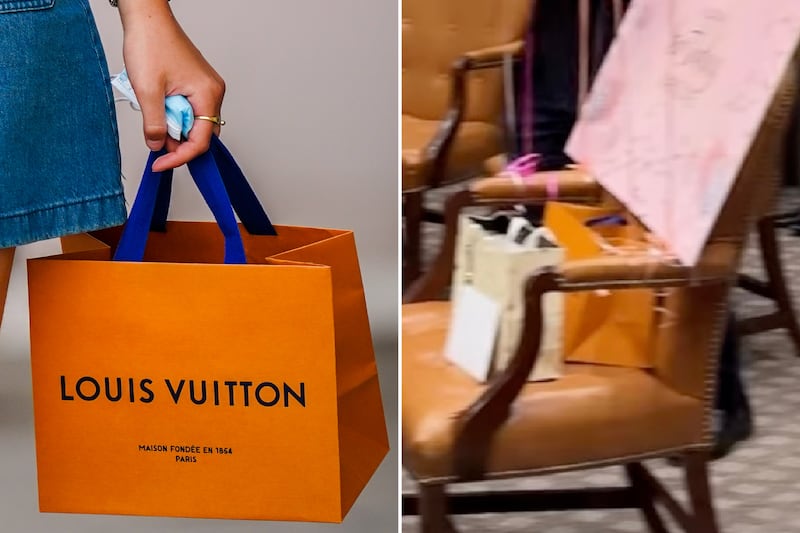
Louis Vuitton bag—easily recognizable by its saffron-colored paper and dark blue handles.

The resulting online explosion was a testament to the strategy’s effectiveness. The story was not just about a dress; it was about trust. Critics of the administration saw their beliefs confirmed, while supporters found themselves in the difficult position of defending against a charge that was both personal and politically damaging. The debate quickly moved beyond the facts of where the dress was made—a point that was itself contested—and into the realm of symbolism. The red dress became a shorthand for perceived hypocrisy, a meme that communicated a complex political argument in a single image.

This tactic is particularly potent in the context of populist movements like “America First,” which are built on a foundation of authenticity and a connection to the “common person.” Such movements often define themselves in opposition to a perceived globalist elite that is out of touch with the lives of ordinary citizens. An incident like this, where a key figure appears to be indulging in the very global consumerism they criticize, strikes at the very heart of that narrative. It creates a crack in the facade, an “authenticity gap” that can be difficult to repair.

Furthermore, the episode highlights the unique pressures placed on women in public life. While any political figure’s choices are subject to review, the focus on the appearance and wardrobe of women is disproportionately intense. This gendered scrutiny provides an additional surface area for political attacks. A male politician’s suit is largely anonymous; a woman’s outfit is often seen as a collection of choices, each one laden with potential meaning and, therefore, potential vulnerability.

In conclusion, the controversy surrounding Karoline Leavitt’s dress was far more than a fleeting social media drama or a simple “gotcha” moment. It was a clear demonstration of a new and evolving form of political combat. It showed how personal choices can be ripped from their context and weaponized, how state actors are adapting their strategies for the digital age, and how the battle for hearts and minds is now being fought in the most unexpected of places—not just in the halls of power, but in our closets and shopping carts. It serves as a stark warning that in the 21st century, every consumer is a potential soldier, and every purchase can become a political statement, whether we intend for it to be or not.

Related Posts

Our Privacy policy

https://topnewsaz.com - © 2025 News