WNBA and Players Association Face Critical Deadline in Tense CBA Negotiations
The Women’s National Basketball Association and its players are facing a high-stakes showdown as negotiations for a new Collective Bargaining Agreement (CBA) approach a critical deadline. With the current agreement set to expire, the league and the Women’s National Basketball Players Association (WNBPA) remain at an impasse over key financial terms, raising the possibility of the league’s first-ever work stoppage. The ongoing dispute is underscored by players’ demands for a greater share of the league’s booming revenue, a sentiment publicly amplified by Minnesota Lynx star Napheesa Collier at the end of the season.
The Core Financial Dispute
At the heart of the disagreement is the players’ conviction that their compensation has not kept pace with the WNBA’s explosive financial growth. Players are seeking a more robust revenue-sharing structure and substantial salary increases, citing several indicators of the league’s prosperity. These include recent expansion fees totaling $250 million, a new media rights deal valued at $2.2 billion, and skyrocketing franchise valuations, with some teams now estimated to be worth over $400 million. This financial success is coupled with record-breaking attendance and television viewership figures.
However, the league’s most recent proposal has not bridged the gap. According to a report from Front Office Sports, the WNBA’s offer includes a supermax salary approaching $850,000 and a veteran minimum of around $300,000 in the first year. While these figures represent a substantial increase from the current CBA’s supermax of $249,244 and veteran minimum of $78,831, players feel the numbers still downplay their value in a rapidly expanding market.
Furthermore, the proposal reportedly retains a revenue-sharing model similar to the current one, where bonuses are triggered only if league revenue surpasses specific targets. The players are advocating for a structure akin to the NBA’s, where the salary cap is directly tied to basketball-related income (BRI), which includes revenue from TV deals, sponsorships, and ticket sales. Other priorities for the players in the negotiations include a softer salary cap and enhanced benefits for mothers and former players.

A Season of Strained Negotiations
The path to the current impasse began when the players opted out of the existing CBA at the conclusion of the 2024 season. The move was intended to provide ample time for both sides to negotiate a new deal. WNBPA executive director Terri Carmichael Jackson expressed optimism in May, stating she hoped to see “significant progress” by the All-Star break in July.
That milestone passed without a breakthrough. Instead, tensions escalated following a key meeting between league officials, including commissioner Cathy Engelbert, and a group of over 40 players. The players left the session feeling it was a “wasted opportunity,” a sentiment that fueled a public protest during the All-Star Game warmups, where players wore T-shirts emblazoned with the message “Pay Us What You Owe Us.” Despite continued meetings throughout the remainder of the season, the two parties have been unable to find common ground. The league’s ownership model has also been cited as a snag in the talks.
A Shift in Bargaining Power
This round of negotiations is fundamentally different from previous ones due to the players’ unprecedented leverage. In the past, concerns about the league’s long-term stability or the potential withdrawal of owner support tempered player demands. Those fears have largely subsided, replaced by a recognition that the players are indispensable to the league’s success.
The recent surge in the WNBA’s popularity has been significantly driven by a new generation of stars, including Caitlin Clark, Angel Reese, and Paige Bueckers, who have brought massive followings to the professional level. The league itself has acknowledged the need for improved conditions, as evidenced by its decision to institute a league-wide charter flights program ahead of the 2024 season. This move, long sought by players, removed what could have been a major bargaining chip for the WNBA. The issue of charter flights was previously a point of contention, highlighted when the New York Liberty were fined $500,000 in May 2022 for chartering flights in violation of league rules. With their value clearer than ever, the players are determined to use their newfound power.
The October 31 Deadline and Potential Outcomes
As the October 31 deadline approaches, three primary scenarios are possible. The most desirable, though seemingly least likely outcome, is the ratification of a new CBA. Given the significant distance between the two sides, a more probable result is either a mutual agreement to extend the deadline to continue negotiations or a work stoppage.
There is precedent for an extension. During the last CBA negotiation in 2019, the parties extended their deadline and reached an agreement in January 2020. However, players have indicated they have been bracing for a work stoppage all season. Such an event could take the form of a lockout, initiated by the owners, or a strike, initiated by the players’ union. A strike appears more likely, as the current contract is widely seen as favoring the owners. Though the WNBPA has avoided using the term “strike,” it remains a distinct possibility.
A work stoppage would halt all offseason activities, including the draft lottery, two expansion drafts, free agency, and the college draft, until a new deal is finalized. Both the league and the players hope to avoid any actions that would delay the start of the 2026 season and lead to missed games.
News

The gavel fell, sealing the one-armed veteran’s fate. But from the back of the courtroom, a single, mournful howl became the first shot in a new war—one fought by a dog who remembered everything they buried.
Courtroom 3 of the Hamilton District Court was a vessel of held breath. The morning light, strained through tall, dusty windows, seemed to congeal in the air, thick and heavy as the silence itself. On the polished wooden benches, people…

He went to an Alaskan cabin to silence the echoes of war. But in the heart of a blizzard, his dog sensed a secret the storm was sent to bury—a secret that would force him into one last fight.
The wilderness beyond Anchorage doesn’t ask for permission; it simply takes. It swallows roads, erases landmarks, and devours the faint, tinny signal of a cell phone until the only voice left is the wind. It was in this vast, unforgiving…

He told the quiet woman she didn’t belong on his elite sniper range. But when her backpack split open, a single photo fell out that made every decorated Marine in the room snap to a salute in shame.
The crack of a rifle shot was the only sound that made sense anymore. It split the dry California air over Marine Corps Base Camp Pendleton, a clean, percussive thunder that echoed off the brown hills and settled in your…
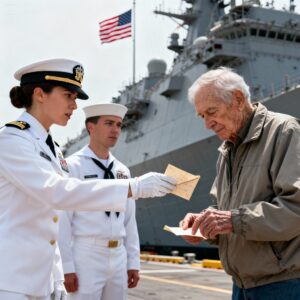
As the young officer moved to detain the 89-year-old man, she was blind to the truth. The very name of the warship she guarded was a whisper of the 70-year-old secret hidden on his faded patch.
The voice sliced through the humid air of the naval pier, a sharp tool meant to carve out immediate compliance. “Sir, I’m going to have to ask you to step away from the gangway. This area is for authorized personnel…

They chose a desolate mountain to be her grave, thinking a thousand-foot drop was the perfect, silent crime. But as she fell into the void, they made a fatal miscalculation about the kind of woman they just betrayed.
The mountain didn’t make a sound when it happened. There was no grand echo to mark the moment, no sympathetic rumble from the ancient stone. There was only the sharp, scattering kick of gravel, a sudden, violent silence where a…

In a circle of 282 elite soldiers, two men decided to humiliate the quiet medic during a demonstration. They intended to break her spirit. Instead, in seven brutal seconds, they discovered a truth that broke them completely.
The wind that came off the Atlantic that morning had teeth. It wasn’t a breeze; it was a hard, scouring force that snapped across the open-air corridors of Naval Special Warfare Command Unit 7, carrying the briny scent of the…
End of content
No more pages to load