“Excuse me, are you Elias?”
The words cut through the frigid Chicago air. Elias Harrison froze, his grip tightening on the strap of his worn messenger bag. It was pushing eleven o’clock, and the Ashland Avenue bus stop was a lonely island of light, occupied only by him and the woman huddled on the bench. He turned with the practiced caution of a Southside resident.
She was hunched against the cold, but it was her head that seized his attention. It was completely bare, her pale scalp gleaming under the stuttering fluorescent lamp. Dark, bruised circles were carved beneath her eyes, and though she couldn’t have been older than twenty-five, she looked ancient. In her arms, she cradled a bundle of blankets.
“I’m sorry, do I know you?” Elias asked, his voice carefully neutral as he took an instinctive step back.
“No, but I know you,” she answered, her voice a raw, hoarse whisper. She pushed herself unsteadily to her feet, and the movement revealed what was wrapped in the blankets. It wasn’t just a bundle. It was a baby. A tiny, perfect face, eyes sealed in sleep, peeked out from the folds. “You volunteer at the Haven Community Shelter. Tuesdays, Thursdays, Saturdays. You’ve been doing it for four months.”

Elias’s pulse jumped. “How do you—”
“Please.” She took a faltering step toward him, and he could see the tracks of fresh tears glistening on her gaunt cheeks. “Please, I need you to take her.”
The request hung between them, surreal and impossible. “I think you’re confused,” Elias said slowly, his mind scrambling for an explanation. Was she unwell? A threat? He scanned the empty street, but there was no one. “If you need help, the shelter has resources. I can call someone for you.”
“I’m not confused.” The desperation in her tone was a physical force, stopping him cold. “I know exactly who you are, Elias Harrison. You have a seven-year-old daughter, Ivy. You lost your wife three years ago. You work in IT, but you spend your evenings volunteering because Ivy’s teacher said they needed help. You read stories to the kids in the family room, and you do all the voices. You make them laugh.”
A prickle of unease traced its way up his spine. This woman had been observing him, studying him. “You need to tell me what’s going on,” he said, his voice firm but gentle. “Right now.”
She swayed, and instinct overrode his caution. He reached out, his hand closing around her elbow to steady her. Up close, the details were even more alarming. Her skin had a brittle, papery texture that spoke of more than just exhaustion. This was a body at war with itself.
“My name is Cora. Cora Winters.” Her gaze fell to the baby, her trembling fingers adjusting the blanket. “And this is Clara. I named her Clara because… because it means ‘bright’ and ‘clear.’ I wanted her to have a name that meant hope, that meant light. Because right now, that’s all I have left to give her.”
Elias guided her back to the bench and sat beside her. The bus was due any minute, but the thought of leaving felt wrong. This moment, whatever it was, was more important than getting home. “Cora, why are you asking me this? Why me?”
She drew a shuddering breath. Clara let out a soft, mewling sound, and Cora’s face seemed to shatter. “Because I’ve been watching you for three months,” she confessed, the words tumbling out. “I know that sounds creepy, like a stalker, but please, just listen. I’ve been staying at the shelter, on and off. That’s where I saw you first. You were in the family room, reading Where the Wild Things Are to a group of kids. You did the monster voices, and you made them roar with you. They were laughing so hard.”
Elias remembered that night in early September.
“Your phone rang,” she continued. “It was Ivy, upset you weren’t home. I heard you tell her you loved her, that you’d be home soon, but right now you were helping other kids who needed a bedtime story, too. And the way you said it…” She swiped at her eyes with the back of her hand. “There was no annoyance, just… patience. Just love. Then you went right back to reading and making those silly voices, giving those kids a reason to smile.”
He remained silent, letting her speak.
“I started asking about you. The other volunteers, they told me your story. About losing your wife in a car accident. About drowning in grief but never letting Ivy see it. About starting at the shelter because you wanted to teach her that helping others matters, even when your own heart is broken.” Cora’s voice dropped to a near-whisper. “You proved that good people still exist. I needed to know that, because my whole life has taught me the opposite.”
“What happened to you, Cora?” Elias asked softly.
She let out a hollow, bitter laugh. “You want the whole story? Fine. Maybe then you’ll understand why I’m begging a stranger to take my baby on a bus stop bench.” Clara stirred again, and Cora rocked her with a mechanical gentleness that spoke of two weeks of constant practice. “I grew up in foster care. Bounced around from age four until I aged out at eighteen. Some homes were okay. Most were not. I learned early on the only person you can count on is yourself.”
She paused, her gaze fixed on something far away. “I worked two jobs to get through community college, studied to be a medical assistant. It wasn’t a glamorous life, but it was mine. My degree, my accomplishment, my future.”
Elias nodded, a silent encouragement.
“When I was twenty-three, I met Trevor at the clinic. He was a pharma rep—charming, successful, expensive car, expensive suits. He pursued me relentlessly. Said he’d never met anyone so determined, so strong.” Her jaw tightened. “I was an idiot. I believed him.”
“You weren’t an idiot,” Elias said quietly. “You were hopeful.”
Her eyes flicked to his, surprised, before she looked away again. “He moved me into his apartment after six months. Told me to quit my job, that he would take care of me. I thought it meant he loved me, that I’d finally found someone who wanted me. For two years, I thought we were building a future.” Her hands clenched around the baby. “Then I found the messages on his phone. Dating apps. Dozens of women. He’d been cheating on me the entire time.”
When she confronted him, he laughed. Elias felt a surge of protective anger.
“He said I was convenient,” Cora continued, her voice flat and devoid of emotion. “An orphan with no family to ask questions. Perfect for when he needed a dinner date for a work event. But marriage? A real commitment? He said he needed someone from his own social class, someone with a family and connections. A proper background.”
“He’s a monster,” Elias said, the word tasting like ash.
“He’s a realist. That’s what he called himself as he threw me out. I left with a single suitcase and two hundred dollars.” She winced as she shifted Clara in her arms. “I was too proud for a shelter, so I slept in laundromats, hospital waiting rooms—anywhere with light and heat. A couple of months later, I got a night-shift cleaning job. That’s when I started to feel… wrong. I was exhausted all the time, but I blamed it on stress and sleeping on floors. Then the headaches started. Blinding, nauseating headaches. My vision would double, or I’d lose my peripheral sight.”
Elias’s stomach sank. He knew this story.
“The free clinic sent me to the ER. They did a CT scan.” She took a ragged breath. “Stage two brain cancer. Glioblastoma. Aggressive, but treatable with immediate chemo, surgery, radiation. But highly dangerous to treat while pregnant.”
The pieces clicked into place. “You were already pregnant,” Elias said, the realization dawning.
“Four months. I didn’t even know. My cycles were always irregular…” she trailed off. “The doctors were blunt. Continuing the pregnancy was a massive risk. The hormones could accelerate the tumor’s growth. The physical toll could kill me. They strongly recommended I terminate.”
Elias looked at Clara’s sleeping face, so peaceful amidst the chaos.
“But I couldn’t,” Cora whispered. “For twenty-five years, I’ve had no one. No blood relatives, no family. No one who was truly mine. This baby…” She choked on a sob. “This baby was the only family I would ever have. The only person in the world who would ever be completely, truly mine. How could I give that up?”
“So you refused treatment,” Elias finished for her.
Cora nodded. “They thought I was crazy. Maybe I was. The headaches got worse. I lost weight everywhere but my stomach. My hair fell out in clumps—from the cancer, not chemo. Eventually, I just shaved it off. The shelter became my only refuge. That’s where I started timing my visits to see you. Just to watch someone good, someone kind. At eight months pregnant and sick as a dog, you were the only proof I had that maybe Clara would be born into a world that wasn’t entirely cruel.”
Clara began to fuss, making tiny, hungry noises. Cora fumbled with her coat, trying to position the baby to nurse, but her hands were shaking too violently. “Here,” Elias said gently, his own hands moving with a forgotten muscle memory from Ivy’s infancy as he helped adjust the baby.
Cora latched her on, tears still streaming down her face. “I made it to thirty-seven weeks. A miracle, the doctors called it. Clara was born small but healthy. Five pounds, two ounces. Perfect fingers, perfect toes.” Her voice broke. “But I’m not perfect. The cancer spread during the pregnancy, just like they warned me it would. Without treatment, they give me three months, maybe less. With treatment, if it works… maybe years.”
“So start treatment now. Tonight,” Elias urged.
“With what?” Her laugh was a sharp, painful sound. “I have no insurance, no money, no home. The hospital social workers are already pushing for Clara to go into foster care. They say it’s the only way. But I know that system, Elias. I lived it. I know what happens to babies with sick mothers who might not make it. She’ll be adopted out, or worse, stuck in limbo while I fight. Either way, I lose her.”
She finally looked at him directly, her brown eyes a vortex of pleading and terror. “So I watched you. I watched you be kind and patient and exactly the father every child deserves. And I thought… maybe. Maybe there’s another way.” Her voice was barely audible. “I’m not asking you to adopt her. I’m not asking for forever. Just… take her while I get treatment. Keep her safe. Let her be loved. And if I don’t make it…” She couldn’t say the words.
Elias sat in stunned silence. The bus had come and gone, its taillights swallowed by the night. Around them, the city hummed its restless song of sirens and distant traffic. This was insane. He had Ivy, his job, a life that had only just started to feel stable after three years of suffocating grief.
But then he looked at Cora, twenty-five and dying and fighting for the chance to be a mother. He looked at Clara, so innocent and perfect, nursing peacefully. He thought of the night the police knocked on his door to tell him Caroline was gone. He thought of the neighbors who brought casseroles, the colleagues who covered his shifts, the strangers from church who watched Ivy while he fell apart—the network of hands that had held him up when he couldn’t stand.
“My neighbor, Mrs. Feldman, is going to think I’ve lost my mind,” he said softly.
Cora’s head snapped up, her eyes wide with disbelief.
“But I was raised to believe that sometimes life puts you exactly where you’re needed,” he continued, pulling out his phone. “I’m calling a cab. You and Clara are coming home with me. Tomorrow, we figure out the treatment. We figure out the legal stuff. We make a plan. But tonight… you’re not alone anymore.”
“I can’t ask you to—” Cora began.
“You’re not asking. I’m offering,” Elias said, his gaze serious. “You need to start treatment immediately. Clara needs care while you’re getting better. I have a spare room. Ivy’s been begging for a sibling since she could talk.” He paused, a memory of Caroline surfacing—her insistence on helping strangers, her belief that everyone was just one bad break away from needing a hand. “And I know what it’s like to face the impossible by yourself. You shouldn’t have to.”
Cora’s face crumpled. “Why? Why would you do this for a stranger?”
Elias searched for the right words and landed on the simple truth. “Because three years ago, strangers became my family when I needed one most. Maybe it’s my turn to be that for someone else.”
The cab ride was a quiet, surreal journey. Cora sat rigidly in the back, clutching her daughter as if she might vanish. When they arrived at Elias’s modest brick house in Bridgeport, a light was on in the living room. Before they could even reach the porch, the front door opened, and Mrs. Feldman stood there, her face a mask of concern.
“Elias, it’s nearly midnight! I was about to—” She stopped short, her eyes falling on Cora and the baby.
“They need help, Mrs. Feldman,” Elias said simply.
Her sharp eyes took in everything—the bald head, the exhaustion, the newborn. “Cancer,” she stated, not asked. Cora nodded, stunned. “My sister fought it. Beat it, too.” Mrs. Feldman stepped aside. “Come in, both of you. You look ready to collapse, dear. Elias, put them in the spare room. I’ll make tea.”
In that moment, Cora began to believe it might be real. The spare room hadn’t been used since Caroline’s death. While Elias quickly changed the sheets, Ivy, woken by the noise, appeared at the top of the stairs.
“Daddy, why is there a baby?” she asked, her seven-year-old eyes wide with curiosity.
“Ivy, sweetie, this is Cora and her daughter, Clara. They’re going to stay with us for a while. Cora is sick and needs our help.”
Ivy descended slowly, her gaze fixed on Clara. “She’s really small. Can I hold her?”
“Maybe tomorrow, pug. Right now, they need to rest.”
“Okay. Is she going to be my sister?”
The innocent question made Cora’s breath catch in her throat.
“She’s going to be our guest,” Elias answered carefully. “We’re going to help take care of her while Cora gets better.”
Ivy thought about this. “Like when Mrs. Amy brought soup when I had the flu?”
“Exactly like that.”
“Okay.” Ivy nodded, satisfied. She looked at Clara. “I’m really good at being quiet when people are sick. And I can read her stories if she gets sad.”
Tears started down Cora’s cheeks again. This kind, pure-hearted child. “Thank you, Ivy,” she whispered.
That night, Elias lay awake, staring at the ceiling, trying to process what he had done. Next door, Cora was probably awake, too, holding Clara, grappling with the fact that a stranger had just turned his life inside out for her. Have you ever made a decision that terrified you, but in your bones, felt absolutely right? That’s where they were. Two broken souls, brought together by desperation, on the verge of a journey neither could imagine.
The next morning, Elias called his boss and took emergency family leave. By ten a.m., they were at Northwestern Memorial Hospital, with Clara tucked into a car seat borrowed from Mrs. Feldman. The oncology team, shocked that Cora had survived the pregnancy, moved with astonishing speed. An aggressive six-to-eight-month chemotherapy regimen would start immediately, followed by radiation.
Dr. Patel, the lead oncologist, was direct. “The pregnancy allowed the cancer to progress. The next few months will be brutal. You’ll need constant support. Do you have family?”
Cora glanced at Elias. “I do now.”
The first chemo session was the following Monday. Elias drove them to the cancer center at dawn. The infusion room was a cold, sterile space filled with reclining chairs and IV poles, each occupied by someone fighting a private war. Cora was terrified.
“Six hours for the first infusion,” explained a nurse named Diane, a woman with kind eyes and steady hands. “The side effects can hit hard.”
“I’ll be here,” Elias said, settling into the visitor’s chair with Clara in his arms and his laptop on his knees.
The chemicals dripped into Cora’s port, a poison designed to kill cancer but indiscriminate in its attack. For two hours, she seemed fine, even managing to nurse Clara one last time. Then the nausea hit like a tidal wave.
She barely made it to the bathroom. Elias rocked Clara, murmuring softly, while Cora was violently ill. When she emerged, pale and shaking, he handed her a cold washcloth. “I’m sorry,” she whispered, humiliated. “This is disgusting.”
“Stop apologizing,” Elias said firmly. “You’re fighting for your life. For Clara. There is nothing to be sorry for.”
The drive home was agony. The next three days were a blur of violent nausea and crushing fatigue. Elias learned on the fly: which medications helped, how to prepare bottles when Cora was too weak, how to soothe a newborn while caring for a desperately ill woman and keeping Ivy’s world from spinning off its axis.
The second week brought a brief respite. Cora could sit up, eat a little, hold Clara. Ivy left crayon drawings of sunshine and flowers by her bed. But the second round of chemo brought a new kind of cruelty: peripheral neuropathy. A tingling numbness in her hands made holding things impossible. One afternoon, she dropped a bottle, shattering it. She broke down completely.
“I can’t even hold my own daughter,” she sobbed as Elias cleaned the mess. “What kind of mother can’t hold her baby?”
“The kind who’s being poisoned to stay alive,” Elias said gently, placing Clara in her arms but supporting the baby’s weight himself. “The kind who’s fighting. That’s the kind you are.”
If you’ve ever watched someone you love suffer, you know that feeling of helpless rage, the desperate wish to absorb their pain. Elias felt it every day. But he also saw Cora’s grit—the way she forced down food that tasted like metal, smiled at Clara through her tears, and always asked about Ivy’s day.
The weeks bled into one another. Mondays were chemo. Tuesdays through Thursdays were hell. Fridays brought a fragile recovery. They cherished Fridays.
Then, in month three, her white blood cell count crashed. Neutropenic fever. Any infection could be fatal. She was hospitalized, placed in isolation. Elias’s life became an exhausting marathon of hospital visits, childcare, work calls, and laundry. Ivy made a banner that read, “Get Well Soon, Aunt Cora.” The name had stuck.
One night in the hospital, Cora looked at him through a tangle of IV lines. “I can’t do this to you anymore,” she whispered. “This isn’t fair. You should put Clara in foster care. Let me do this alone.”
“Stop,” Elias interrupted. “We’re a team now. All four of us. Ivy asked me yesterday if you were going to be okay. You know what I told her?” Cora shook her head. “I told her families don’t give up on each other. And somewhere along the way, that’s what we became.” He took her hand. “So, no. You don’t get to push us away now. We’re in this together.”
Her tears soaked the pillow, but for the first time, they weren’t just tears of despair.
The fourth month brought the first scan. Elias and Cora barely breathed as Dr. Patel pulled up the images. “The tumor has shrunk by thirty percent,” he announced, a rare smile on his face. Cora sobbed with relief. Elias held her tight. It was working. For the first time, hope felt tangible.
The fight was far from over. Month five brought painful mouth sores. Elias made protein smoothies, the only thing she could tolerate. “You’re going to turn me into a health nut,” she joked weakly.
“If it keeps you alive, I’ll turn you into whatever you need to be,” he replied.
Somewhere in the endless cycle of sickness and care, something shifted. A lingering touch on her shoulder. The way their eyes would meet across the room. A brush of hands as they both reached for Clara. They didn’t acknowledge it. How could they? But feelings don’t wait for permission.
Month six: another scan. A fifty-percent reduction. Cora was winning. Two more months of chemo, then radiation.
The final chemotherapy session fell on a Thursday in August, eight months after that night at the bus stop. As Cora rang the ceremonial bell in the infusion room, the entire ward applauded. Ivy presented her with a construction paper crown that read, “Champion.” Elias just smiled, a look of profound pride and relief on his face.
Radiation was a six-week grind of daily trips to the hospital. By October, Cora’s hair was growing back in soft, dark ringlets she called her “chemo curls.” Clara’s first birthday fell on a cold November day, exactly one year after their first meeting. They celebrated with a small party: the four of them and Mrs. Feldman. Watching Ivy help her “baby sister” smear cake everywhere, Cora sat beside Elias and felt a sense of peace she hadn’t known in years. Home.
“Thank you,” she whispered.
“Stop thanking me,” he replied, a familiar refrain.
“I’m serious. None of this—Clara, me being alive—it wouldn’t have happened without you.”
Elias turned to look at her. The color had returned to her cheeks. She was beautiful. “We did it together,” he said quietly. “All of us.”
The final scan was in early December. In Dr. Patel’s office, Elias held Cora’s hand while Ivy fidgeted and Clara played on the floor.
“No evidence of disease,” the doctor announced. “Complete response. The cancer is gone.”
The room exploded. Ivy shrieked with joy. Cora collapsed against Elias, sobbing with the force of a year’s worth of terror finally being released. “You did it,” he whispered into her hair.
“We survived,” she corrected him through her tears. “All of us.”
That evening, after the girls were asleep, Cora found Elias in the kitchen. It was time. Time to talk about moving out, about letting him have his life back.
“Elias, I need to talk to you,” she began, her heart pounding.
“Actually, I need to talk to you, too,” he said, his own hands shaking slightly. “I’ve been trying to figure out how to say this for weeks.”
“Let me go first,” she insisted. “I need to start looking for my own place. You’ve done more than anyone could ever ask, but—”
“I don’t want you to move out,” he cut in. Cora froze. “What?”
“I don’t want you to move out,” he repeated, his voice thick with emotion. “I was hoping you’d stay. Not as a guest, but as… more.”
The air in the kitchen crackled. “More?” she echoed.
“This past year,” Elias began, “watching you fight, seeing you with the girls, just… being together. Somewhere along the way, Cora, I fell in love with you.”
“You can’t,” she whispered. “You saved my life. You just feel obligated.”
He laughed, a genuine, warm sound. “Obligated? Cora, you brought light back into this house. You showed Ivy what real strength is. You showed me that my heart wasn’t buried with Caroline. It was just waiting.” Tears streamed down her face. “I don’t know how to be in a family. I don’t know how to be loved.”
“Then let me teach you,” he said softly, stepping closer. “Let me show you what it looks like when someone chooses you. Not out of convenience, but because you’re extraordinary. Because watching you survive made me want to live again.”
She kissed him then—a kiss that tasted of tears and hope and the start of everything.
Two years later, they married in their backyard. Ivy, now ten, served as a very serious maid of honor. Three-year-old Clara was the flower girl, scattering petals with joyful abandon. Kora, her dark curls reaching her shoulders, wore a simple white dress. The cancer remained in remission. She had enrolled in nursing school, determined to help others the way she had been helped.
As Elias watched his wife dance with their two daughters, their laughter mingling with the afternoon sun, he thought of that cold night at the bus stop. Love doesn’t always arrive the way you expect. Sometimes it shows up bald and terrified, asking for the impossible. Sometimes it grows in the quiet spaces between chemo and midnight feedings. Sometimes, two broken people realize they’ve somehow made each other whole.
On the bench at the Ashland Avenue bus stop, there is a small, unassuming plaque. Most people never notice it. It reads, “Hope Begins Here.” Because it did. It began when one desperate mother trusted a stranger, and it flourished when they all chose to build a family not from blood, but from love. They were proof that family isn’t about perfection. It’s about showing up. It’s about saying yes when logic says no. It’s about transforming desperation into devotion, and strangers into everything.
News

The gavel fell, sealing the one-armed veteran’s fate. But from the back of the courtroom, a single, mournful howl became the first shot in a new war—one fought by a dog who remembered everything they buried.
Courtroom 3 of the Hamilton District Court was a vessel of held breath. The morning light, strained through tall, dusty windows, seemed to congeal in the air, thick and heavy as the silence itself. On the polished wooden benches, people…

He went to an Alaskan cabin to silence the echoes of war. But in the heart of a blizzard, his dog sensed a secret the storm was sent to bury—a secret that would force him into one last fight.
The wilderness beyond Anchorage doesn’t ask for permission; it simply takes. It swallows roads, erases landmarks, and devours the faint, tinny signal of a cell phone until the only voice left is the wind. It was in this vast, unforgiving…

He told the quiet woman she didn’t belong on his elite sniper range. But when her backpack split open, a single photo fell out that made every decorated Marine in the room snap to a salute in shame.
The crack of a rifle shot was the only sound that made sense anymore. It split the dry California air over Marine Corps Base Camp Pendleton, a clean, percussive thunder that echoed off the brown hills and settled in your…
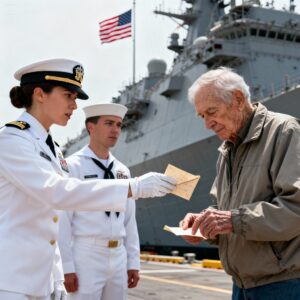
As the young officer moved to detain the 89-year-old man, she was blind to the truth. The very name of the warship she guarded was a whisper of the 70-year-old secret hidden on his faded patch.
The voice sliced through the humid air of the naval pier, a sharp tool meant to carve out immediate compliance. “Sir, I’m going to have to ask you to step away from the gangway. This area is for authorized personnel…

They chose a desolate mountain to be her grave, thinking a thousand-foot drop was the perfect, silent crime. But as she fell into the void, they made a fatal miscalculation about the kind of woman they just betrayed.
The mountain didn’t make a sound when it happened. There was no grand echo to mark the moment, no sympathetic rumble from the ancient stone. There was only the sharp, scattering kick of gravel, a sudden, violent silence where a…

In a circle of 282 elite soldiers, two men decided to humiliate the quiet medic during a demonstration. They intended to break her spirit. Instead, in seven brutal seconds, they discovered a truth that broke them completely.
The wind that came off the Atlantic that morning had teeth. It wasn’t a breeze; it was a hard, scouring force that snapped across the open-air corridors of Naval Special Warfare Command Unit 7, carrying the briny scent of the…
End of content
No more pages to load