“You need a wife and I need a dad!” The words, small but clear, carried across the dusty street, cupped in the tiny echo chamber of a child’s hands. He was halfway down the boardwalk, his long shadow spilling over the watering trough. He was not a man one could easily overlook. In Sage Brush Crossing, folks called him the giant cowboy, because the first thing you registered was his height, and then his hands, which looked like they could shovel coal or rock.
He wore a coat that draped like a theater curtain and a hat that seemed too small for him, though it would have swallowed another man whole. His name was Boon Mercer, a name people made a point of remembering once they met him. He possessed a kind of quiet that made you curious for its source. He turned at the sound of the little girl’s call. The light was the soft, forgiving kind that arrives just before the sun dips below the horizon, when the world seems willing to pardon anything.
Her dress was neatly mended, the way careful hands can make old things new again. A gap between her front teeth showed when she smiled, and freckles were scattered across her nose like a flick of cinnamon. She stood in the doorway of the dry goods store beside a woman whose posture was a study in deliberate grace, as if she held herself upright by sheer force of will. That woman, though Boon did not know it yet, was Norah Albright.

All he knew were the child’s words, and the feeling in his chest like a sudden knock on a long-unopened door. “May,” the woman said, her voice low and soft. “Hush, now.” The girl, May, did not hush. Children rarely do when they have stumbled upon a truth. She took a step off the stoop, then another, before the woman’s hand came to rest on her shoulder, a gentle anchor. May tilted her chin up to see Boon’s face, her hair the color of wheat ready for harvest.
“Mama says I talk too much,” she declared. “But I think sometimes you have to say the thing nobody else is saying.” Boon remained perfectly still. A pack roll was slung over one shoulder, and a coil of rope hung from his saddle horn near the post where his horse, a large dun with a black mane, breathed in a slow, steady rhythm. Boon placed a palm on the horse’s neck, as if to steady them both.
“Do you?” he said, his voice a low rumble in the quiet street. “What’s your name, little truth-sayer?”
“May Albright,” she replied. “I’m six.”
“Six,” he repeated, as though the number were a foreign word he was trying to pronounce correctly. His gaze shifted to the woman, a silent request for permission to continue the conversation. Her eyes met his for only a second before returning to May. Boon recognized the swift calculation in her glance, the way a person measures a stranger. It wasn’t suspicion, but rather the ingrained habit of someone who had learned what the world was capable of taking.
“Norah Albright, sir,” the woman said at last.
Boon touched the brim of his hat. “Ma’am. I meant no harm. Just passing through.”
May considered this with the gravity of a judge. “You look like a man who can lift a wagon,” she said. “Mama can’t lift a wagon. We could use one of those.”
“May,” Norah murmured again.
A corner of Boon’s mouth turned up. “It so happens I can lift some things,” he said. If the moment had been built of humor alone, he might have tried to lift the stoop just to hear the girl laugh. But this was not a day for jokes. The stagecoach had delivered a letter. That letter now rested in Norah Albright’s apron pocket, creased just so, as if the sharp folds might somehow soften the words inside. Boon knew nothing of this. He saw only the way Norah’s hand rested unconsciously on that pocket, as if it held a great weight.
“Mr. Mercer!” the liveryman called from down the street. “Staying a night or two? I can put your dun up.”
“A night?” Boon said. He had intended to ride on. Nights were more bearable when you didn’t stop long enough to truly feel them. But the girl’s proposition had lodged itself under his ribs like a poorly thrown horseshoe. “Maybe two. Depends.”
“On what?” May asked, as if the world’s complexities could be unraveled simply by naming them.
“On whether a wagon needs lifting,” Boon replied, and May let out the clear, bright laugh of a six-year-old who has just made a friend. Norah’s expression softened, just at the edges.
“We thank you,” she said, “but we don’t accept charity. We get on.”
“Getting on is a hard job,” Boon observed, the words escaping before he could call them back. “Harder than lifting.” He saw the sentence land, saw the flicker of surprise on Norah’s mouth—the look of someone who had just been handed a truth she needed but never expected to hear from a stranger.
“Where are you headed?” she asked, steering the conversation back to safer waters.
“South, for now,” he said. “I heard the river’s low. Men will be pushing cattle to higher ground soon. After that, wherever the work is. There’s always a fence somewhere that needs mending.”
“A fence always needs mending,” Norah echoed, and it sounded like a truth she already knew intimately. A boy ran past, chasing a hoop with a stick. The light deepened, slipping further toward gold. Across the street, Colt Brangan rode in with two of his men, hitching his horse at the saloon. He dismounted with the casual authority of a man who owned the very ground he stood on. His gaze swept over Norah, registering her presence before dismissing her, like a piece on a chessboard he planned to capture later. Boon saw the look and filed it away.
May leaned forward, her expression earnest. “Are you hungry?” she asked. Hospitality is a language children are born speaking.
“Always,” Boon said. “But I pay my way.”
“We serve stew at the boarding house,” Norah offered. “It’s not much, but it’s hot and it’s honest.” She paused, then added, “There’s a pump handle that sticks on the back well. I’ve tried oil and patience. Patience gets you far, but it doesn’t get you water.”
Boon glanced toward the long yard behind the boarding house. A handle, a stubborn bolt, old iron. He could see the mechanics of it in his mind. “I have a wrench,” he said.
“Then we have stew,” Norah answered. And just like that, a bargain was struck—one that went beyond tools and soup, measured in the quiet currency of a small town. Boon looped his reins, spoke a low word to the dun, and followed the woman and her daughter toward the yard. He didn’t know yet that a child’s sentence had set him on a path he would have taken anyway, if he were honest with himself, a road that would demand more of him than any trail he had ever meant to ride.
They reached the pump. Boon crouched, his large frame folding with care, and ran a thumb along the bolt head. He worked in the focused silence some jobs require. May crouched beside him, mimicking his posture, and passed him the wrench when he gestured for it. Her small palm against the steel handle looked like a bird perched on a fence rail.
“Who taught you to fix things?” she asked.
“My father,” Boon said, steadying the pipe. “He said the world breaks because the world is alive. If you love it, you put it back together.”
“Do you love the world?” May asked.
Boon paused. He hadn’t considered the question in years. “Sometimes,” he said. “When it lets me.”
Norah watched him then. She saw the way his big hands performed such gentle work. The way he didn’t curse when the wrench slipped. The way he spoke to the rusted iron as if it were a tired horse that might respond to kindness. She noticed the scar that ran along his wrist and the small nick in his earlobe. She saw that his eyes were not the hard color one might expect from a man built like him. They were a soft gray, like smoke contemplating rain. The bolt finally gave way with a groan like old wood. Boon worked the handle up and down. Water trickled out, then came faster, spilling into the bucket with a sound like relief. May clapped her hands.
Norah looked up to thank him, but the words caught in her throat. Gratitude felt like too small a coin for the simple gift of hearing water when you needed it most. “Stew,” she said instead.
“Stew,” he agreed.
They ate at a little table near the back door. May spun tales about a cat that wasn’t theirs but paid regular visits. Boon listened like a man dying of thirst. Norah ate in silence, her attention fixed more on her child than on the stranger. When her bowl was empty, she set her spoon down carefully and said, “We had a husband and a father once. He drowned in the spring thaw, two years ago. We’ve done as we can since.”
Boon inclined his head slightly. “I’m sorry for your loss.”
“I am too,” she said, and then, almost as a warning, “We are not asking for anything.”
“I didn’t think you were,” he replied. He could have told her about the woman he’d known once, who wore a yellow ribbon in her hair and laughed like creek water. He could have said that he had left to make himself a man worthy of marrying her, only to return too late, finding that ribbon tied to another man’s bedpost. He didn’t say any of that. The past was best carried like a canteen: near enough to drink from, but not so close you could drown in it.
After supper, he stood. “I’ll stay two nights,” he said. “There’s enough work in that pump handle to keep me honest.” He touched his hat to Norah. As he started to leave, May threw her arms around his leg without warning. He froze, afraid he might knock her over. She looked up at him, not letting go. “You would be a good dad,” she said.
He swallowed hard. “Would I?”
“Yes,” she affirmed. “You fix the water. Dads fix water.”
Norah gently reached for her. “May.”

Boon eased the girl’s arms from his leg and set her back on her feet as if she were a bundle of precious laundry. He gave her a solemn nod and walked away, because some sentences are too heavy to carry all at once. He would have to pick that one up in pieces. He didn’t know that starting that night, he would begin to bend under its weight in a way that felt remarkably like standing tall.
From the saloon steps, Colt Brangan watched him go, one boot propped on a packing crate, a toothpick moving thoughtfully in his mouth. He spat, then smiled—the kind of smile a man wears when he sees a clear path to something that isn’t his yet.
Boon worked small miracles for two days and never called them that. He patched the boarding house fence so the paint peeled straight instead of in curls that snagged a dress. He planed a sticking door. He fixed the wobbly back step Norah had learned to skip over. He oiled the bell above the store so it sang instead of shrieked when customers entered. He didn’t ask for payment until Norah pressed three dollars into his palm, saying, “I sleep easier when accounts are even.”
He slept in the livery loft, where the straw smelled sweet. Lying on his back, he could look through a crack in the boards and see the yellow light of May’s window across the yard, a small, private sun. Sometimes he saw her shadow move as Norah read to her. He told himself he was watching to know when the light went out, to be sure the town was safe. It was the kind of lie a man tells himself when he needs permission for something he is already doing: caring.
Sage Brush Crossing wasn’t much, but it had the essentials: a church that handled weddings and funerals with equal gravity, a schoolhouse with a bell as bright as a new penny, a blacksmith who could shoe a tricky hoof, a doctor with a bad leg and a good hand, and a saloon that kept more secrets than its tarnished mirror could hold.
It also had water, in a place where water was king. The Albright lot sat on the edge of the common spring line, a natural channel that wound through a thin ribbon of willows before snaking off toward the Brangan spread. Water had made the Brangan name out here. Colt Brangan ran cattle, and men, and conversations.
On the second afternoon, Boon walked May to the schoolhouse while Norah tallied her ledgers. May skipped beside him, chattering about everything and nothing. “You have to come to the Thursday pie social,” she said. “Mrs. Kenny makes apple and leaves the peel on. Mama says it’s rustic. I think that’s a fancy word for lazy.” Boon bit the inside of his cheek to keep from laughing. “And your mother?”
“She brings rhubarb,” May said solemnly, as if naming a hymn. “She says people need tart to remember sweet.” The girl looked up at him, her expression serious. “Do you like rhubarb?”
“I like what your mother makes,” he said, and the truth of it was too sharp, too fast. He slowed his pace to soften the words. “Your mother works hard.”
“She doesn’t sleep much,” May confided, slinging her satchel over her shoulder like a soldier. “But sometimes she sings to herself, and I hear it through the wall. She thinks I’m sleeping. I’m good at pretending.”
Boon’s chest felt that familiar knock again. “Your father… what was his name?”
“Thomas,” she said easily, as if the word were a smooth bead she could roll in her palm without getting cut. “He had a laugh that filled all the rooms. I keep some of it for us.” She nodded, satisfied. “I save it.”
“You keep and you save,” Boon said. “You’re six and you hold a lot.”
“I’m big inside,” she said. “Like you, but the other way.”
He laughed, and the sound of it surprised him, like a creek finding a new path around a rock. At the school steps, he knelt to fix a strap on her satchel, tying a knot that would slip free easily for a small hand. He looked up, and May placed her palm on his cheek with the simple ownership of a child who has made a decision. “You would be a good dad,” she said again, softly this time, as if stating a truth she no longer needed to shout.
He stood and walked back toward town, his long stride not feeling quite his own. At the corner, he ran into Colt Brangan. Colt tipped his hat at a crooked angle. “Mercer. You look like a man with time on his hands. My fence line’s down at the East Fork. Got hands on it, but they drink while they work. I prefer a sober nail.”
“I’m tied up,” Boon said.
“With what? The widow’s pump?” Colt’s teeth showed, a friendly display from a dog that might bite. “Making yourself useful for soup?”
“I’m making myself useful,” Boon replied.
Colt lowered his voice. “Be careful where you spend that usefulness. The Albright place has land on the water’s bend. Pretty spot. Wasted on laundry and children pulling tadpoles from the mud. I buy sensible. Make her an offer the day after tomorrow, and she’ll say yes.”
“You’re buying her?” Boon asked, his tone flat.
“I’m buying the town,” Colt said. “A town comes with people. And people come with men who think being tall makes them strong. Strength is knowing which way the water flows and helping it along.”
Boon looked past him, down the road where the willows marked the wet earth. He could feel the pull of it, even from here. “Sometimes water goes where it wants,” he said.
“Not if you dig a better ditch,” Colt countered. He spat and smiled. “I’ll see you Thursday. I like tart pie. Reminds me of certain women.”
Boon watched Colt’s back as he walked away. A heavy knowing settled in him like lead shot. Colt meant to take the Albright lot, by law or by pressure. Men like that preferred the law when it wore their coat; they used force only when the law was sleeping.
That evening, Boon ate stew again at the back table. When May had gone inside to wash up, he said, “Colt Brangan is sniffing around your land.”
“I know,” Norah said. “He came two weeks ago with a man who writes on paper. He told me I could sell for a good price before a bad year made it a worse one.”
“What did you say?”
“I said no.”
Boon nodded. “He’ll push.”
“I will harden,” she answered. “This is the place where my husband’s hands are. I cannot sell his fingerprints.”
Boon looked at her with a respect that had nothing to do with a stuck pump or a pretty face. “You’re not afraid.”
“I am,” she said, her gaze steady. “I’m afraid all the time. But fear doesn’t get a vote.”
A boy burst into the yard, panting, a Brangan handkerchief tied around his throat. “Paper for Mrs. Albright,” he said, thrusting a folded letter at her. Norah took it calmly, though Boon saw her fingertips tremble. The boy waited, as if for a coin, then ran off. Norah stood with the letter unopened.
Boon rose. “Do you need—?”
She shook her head. No. She opened it. She read. Boon watched the air leave her lungs slowly. He couldn’t see the words, but he didn’t need to. Some letters carry a scent. “What is it?” he asked gently.
She folded it precisely along its creases and slid it into her apron pocket. “Back taxes, recalculated,” she said. “A mistake found, a fee added, a deadline tightened. The kind of things that make a person generous to the man who can fix them.”
“Colt,” Boon stated.
“Colt,” she agreed. They stood together in the kitchen, the fading light striping the floor like prison bars. Boon’s hands itched to fix something a wrench could handle, a nail, a board. But this trouble was as soft as paper and as sharp as the law.
“May’s father had a brother,” Norah said suddenly. “He lives up north. He wrote after Thomas died, said a woman alone is a woman calamity finds. He was kind for a while. Then he wrote again and said a child is a heavy thing for one set of arms, and perhaps his wife would take her for a season.” She said the word ‘season’ as if it meant forever.
Boon waited.
“I said no,” Norah finished. “He hasn’t written since.” She looked toward the doorway where May had disappeared. “I will not let a man take what one kind storm left me.”
“You won’t be alone,” Boon said, then felt the weight of those words. He made them plainer. “This town has more good in it than bad. People will stand with you. I will stand with you.”
“You’re leaving,” she said, not unkindly, simply stating a fact in case he’d forgotten it.
“Not yet,” he said.
He slept poorly, dreaming of a small hand on his cheek and a river changing course. Before dawn, he rose and walked down to the willows, standing and listening. Water talks, if you let it. He heard its whisper and tried to understand what it was saying. Some men hear numbers; Boon heard levers.
Thursday brought pies and a crowd. The schoolhouse yard filled with folding tables as people served each other. Boon lifted a barrel by himself and saw three men laugh, then look away from the ease of it. He tried to make himself smaller. Large men learn to do this, though it never really helps. A thing’s size is measured in more than inches.
May dragged him by the hand to a jar of cloth ribbons where children voted for their favorite dessert. “You can only vote once,” she explained. “But if you cough while you point, it counts twice.” She coughed delicately and pointed at the rhubarb pie. Boon coughed, too. Norah looked away to hide a smile, not wanting to forge a path where one shouldn’t yet exist.
Colt Brangan, of course, made a speech near the end of the day. He bought a whole pie and handed out slices to people who hadn’t asked. He used the words ‘community’ and ‘future’ the way a banker says ‘collateral.’ He announced he had hired a new foreman, a man named Pike, who had no family in town, a fact that only fueled rumor. Pike had a mustache trimmed with a straight razor and eyes that counted things. He didn’t drink, which was the most dangerous thing about him. He stood behind Colt during the speech, just over his shoulder, like a shadow that had learned to hold a pen.
When Colt finished, Pike stepped forward and read, in a slow, even voice, a notice from the county office. The notice said what Norah already knew: back tax recalculation, deadline, lien. The words were dressed in clean clothes, but their meaning was stark: you will move when we say. When he was done, people shifted their feet. Good people don’t know where to look when a neighbor is laid bare by a piece of paper. Norah stood straight, nodded once, and did not cry. May slipped her hand into Boon’s, as if it belonged there, and he let it.
After the speech, the day tried to become normal again. But words, once heard, cannot be unheard. Boon helped stack tables while Norah tied bundles of plates in a way that kept them from chipping. May lay in the grass, making pictures from the clouds. “That one’s a horse,” she said. “That one’s a hat. That one looks like a letter that says ‘no, thank you.’” Boon lay down beside her, staring at the sky until the blue made him think of a long-ago river and a girl with a yellow ribbon. He sat up too fast, his head spinning. Norah glanced over, saw a man recovering from a private stumble, and looked away to give him back his dignity.
Pike strolled up just then, hands in his pockets. “Mercer,” he said, his voice pleasant as weak tea. “Colt says you have a good back and a cool head. We pay for useful.”
Boon brushed grass from his coat as he stood. “I have a back,” he said. “My head isn’t always what I’d call it.”
Pike’s smile widened. “We could use you on the east line for two weeks.” He named a fair wage, enough to plug a hole. Boon felt Norah’s attention on him. He understood gifts that came with strings. “I’m working local,” he said.
Pike’s eyes flicked from Norah to May and back to Boon. He nodded, entirely unsurprised. “Suit yourself. Some men tie their own rope and call it freedom.”
When he was gone, Norah said, “You don’t owe me a refusal.”
“I didn’t refuse you,” Boon replied. “I refused a man whose hand would be in my pocket when I went to spend.”
That night, Boon sat on a hay bale in the livery and looked at his hands. He felt he had put on weight since coming to town, not in his body, but somewhere deeper. Work had felt like nourishment. He was not afraid of hunger. He was afraid of wanting. The doctor came by and sat with him.
“You’ll get crosswise with Colt,” the doctor said without preamble.
Boon nodded. “Likely. Crosswise with Colt is like crosswise with the weather. You can stand in it, but you’ll get wet.”
“I’ve been wet,” Boon said.
The doctor looked at him. “You have the look of a man who left something behind.”
“Who doesn’t?”
“You might build something here,” the doctor said. “But if you do, you’ll have to do it in the open, where a man like Colt can count your boards.”
Boon thought of a small palm on his cheek, of Norah setting her shoulders against a paper wind. “I can count,” he said. “And I can stand.”
Two mornings later, the deputy rode up with Pike and two other men. They pinned a notice to Norah’s front post with a neat nail. It said, “Pay or be paid a visit,” but with dates and sections, the way men make a threat without dirtying their mouths.
Norah read it, her face set. “I’ll pay,” she said. “Give me a week.”
Pike shook his head. “The county gives you three days.”
“The county,” Norah said, “has never been in my kitchen when the roof leaks. It doesn’t know how far three days is from town when you have a girl and a store to run.”
Pike’s smile was unwavering. “Three days.”
After they left, Boon sat with Norah at the back table. He placed a small cloth bag between them. She looked at it, then at him. “No,” she said immediately.
“It’s a loan.”
“Paid back when?” she asked.
“When you can,” he said.
“That means never.”
“It means when you can,” he repeated. “And if you can’t, then you cook me stew some nights and we’ll call it settled.”
She shook her head. “I don’t like owing.”
“I know,” he said. “But you like moving even less.” She looked out at May, who was inspecting a beetle with tender focus. She closed her eyes.
“I could marry a man,” she said, the words plain as water.
“Yes,” he said. He didn’t move.
She opened her eyes. “I could marry you.”
He let the words hang between them for a heartbeat. Then he set two fingers on the cloth bag and slid it back toward himself. “Not like that,” he said gently. “Not because of a paper chase. Not because of a man like Colt. If you marry, let it be because you want to carry his name when no one is looking.”
She exhaled, a sound of profound relief. “I had to say it,” she whispered.
“I know,” he said again. “Sometimes you have to say the thing nobody says.”
A small memory bent her mouth into a smile. “That’s my daughter’s line.”
“I learned it from her,” he said. She covered his hand with hers.
“I don’t know how to be saved,” she said.
“You save yourself daily,” he told her. “This is just a hand to steady you while you do it.” She nodded, her eyes bright.
“Three days,” she said. “We will make them four.”
They took the train at dawn. Boon went along because sometimes courage needs a second pair of shoulders to rest on, so it can pretend it did all the lifting alone. May came, too, because you cannot leave behind a child who has appointed herself deputy of your heart. The county office smelled of ink and floor wax. A man behind a window explained things in a slow, kind voice that did not change when Norah pleaded. When he was finished not helping, Norah set the cloth bag on the counter. “I will pay these,” she said, naming the sum.
The man counted it, stamped a form, then frowned. “There is a processing fee,” he said, “and a late recording fee.”
Norah’s jaw flexed. “How much?” He told her. It was a small number that landed like a safe. Boon reached for his coat, but Norah placed a hand on his forearm, light but firm. She took two coins from her own purse and set them down. “There,” she said. “Record me.”
The man recorded. He wrote a receipt with careful letters and slid it under the glass. Norah folded it and turned to Boon and May. “We are done,” she said. “We will go home.” On the train, she stared out at the passing fields, seeing only a ledger line turn from red to black.
When they reached Sage Brush Crossing, Pike was waiting on the platform with the deputy. “Mrs. Albright,” he said politely. “I have good news and bad news. The county accepted your payment. However, the lien remains in effect pending a hearing on the revaluation.”
“What hearing?” Norah asked.
“The one scheduled for tomorrow,” Pike said blandly, holding up a paper she had never seen. “It seems you weren’t home.”
“We were at the county office,” Norah said softly. May took her hand.
Pike smiled at the girl. “Hello, little one.” May pressed closer to Boon’s coat and whispered into his sleeve, “This man smells like pennies.” Boon coughed to hide a laugh.
“Tomorrow,” Pike said. “At ten.”
That night, Boon asked, “Do you want me there?”
“Yes,” she said.
“Do you want me to speak?”
“No,” she replied. “But stand near.”
“I will,” he said.
The hearing took place in the town hall. A traveling judge explained that the revaluation was for the good of all. Norah stood and spoke of the leaking roof, the broken fence, and her ledger. “I do not cook two sets of numbers,” she said. “I cook one stew.”
The judge smiled. “Charming. But this is an unfortunate mistake. The lien must stand until the next term. It is the law.”
“The law,” Norah said quietly, “has never swept my floor.”
Boon watched the faces in the room, saw the deputy’s mouth twitch, saw Colt Brangan in the back, listed as an ‘interested party.’ When it was over, people filed out. Outside, Colt approached them. “Mrs. Albright, I can take this weight right off you. Sell to me, and I’ll see the lien is paid and your name cleared.”
“Looked after,” Norah repeated. “It is a good phrase for a cage.” Colt knew a lost sale when he heard one. He tipped his hat and walked away.
Pike, however, lingered. “There is another matter,” he said, folding his hands. “A letter from the north. Mr. Thomas Albright’s brother has written to the county expressing concern for his niece’s well-being. He has asked the court to appoint a guardian to oversee the child’s interests. He names himself.”
Norah didn’t move. “May has a mother,” she said.
“Of course,” Pike said. “This is only to ensure balance. A guardian can apply for temporary relocation of the child.”
Boon stepped forward then, because a person can only be a guest for so long before they become a wall. “No,” he said.
Pike looked at him as if he’d forgotten he was there. “This is not your concern, Mr. Mercer.”
“It is now,” Boon said.
Pike’s gaze flicked to Norah. “Is this your fiancé?”
Norah’s face flushed then paled. She opened her mouth to speak the honest truth, but Boon raised a hand. “I will be,” he said. Time held its breath. The word hung in the air, a lariat he had thrown without knowing what it would catch.
Pike smiled slowly. “Then I will look forward to the announcement.” He turned and left.
Boon turned to Norah, whose eyes were a storm of shock, anger, relief, and fear. “I’m sorry,” he said, his voice low. “I didn’t mean to take your choice.”
She swallowed. “The choice already had hands on it. Better yours.”
“Only if you want it,” he said.
She held his gaze. “I don’t know what I want,” she admitted. “I only know what I don’t want. I do not want to lose my child.”
“Then let me stand here,” he said. “Let me be a wall while you think.”
She gave a single, sharp nod that felt like an oath. “All right,” she whispered.
They set a date for a week out, enough time to keep an uncle and an officer at bay. The town digested the news. Mrs. Kenny cried. The doctor shook Boon’s hand. The liveryman called him a fool, then grinned. The week was long and thick as mud. Word came that May’s uncle was on the road. Colt held a barbecue and didn’t invite them. A storm gathered.
That evening, May tugged on Boon’s coat. “Walk with me,” she said. They went to the willow bend. “Are you scared?” she asked.
“Yes,” he admitted.
“Of what?”
“Of breaking something that takes a long time to fix.”
She nodded. “Mama says the same.”
Boon crouched to her height. “May,” he said carefully, “if I become your mother’s husband, I will try to be a good father in your house. I will not be your real dad. I will be the man who comes next. And I want to do it right. That means asking you first.”
She creased her brow in thought. “You already feel like a dad,” she said simply. “You bend down so I can reach your ear. That’s all it is.”
“It’s more,” he said, but offered his palm. She placed her small hand in it. “All right,” he whispered. “We’ll try.”
Lightning stitched the sky. The wind turned cold. “We should go,” he said. They hurried back to find Norah on the stoop, her face turned to the ridge.
“Fire?” Boon asked.
“Worse,” she said. “Run.”
They ran toward the bend in the road. A wagon had rolled, its axle cracked. A second had tipped into a ditch behind it. The road was a chaos of wood, leather, and panicked noise. Pike was in the middle of it, directing things. And pinned in the wreckage of the first wagon was May’s schoolmate, Netty Kenny.
There is a moment when the body moves before the mind can object. Boon was there. He slid under the wagon, set his shoulder beneath the beam, found purchase in the mud, and lifted. The beam rose with a terrible scream of splintering wood. The world narrowed to weight and pressure and the small shape of a child crawling free. Hands pulled Netty out. Boon held on for three more heartbeats, then rolled out and lay on his back in the road as the rain began to fall. He sat up, swayed to his feet.
Norah was there, her hands on his forearms. “You stubborn, beautiful fool,” she said, for anyone to hear.
He grinned, feeling drunk on adrenaline. “Better than stew.”
“Different,” she said, half-laughing, half-crying. And that is how you know love: it cannot decide what to do with its face.
The storm broke. They walked home soaked and shaken. As they reached the yard, a rider clattered in, his coat black as a storm cloud. He swung down, holding up a dripping paper. “Mrs. Albright! By order of the court, the child May Albright is placed under the temporary guardianship of Mr. Edgar Albright. I am here to remove her.”
Norah went still, then stepped in front of May. Boon stepped in front of Norah. The rider blinked, not having planned for a wall in a hat.
“You can’t,” Norah said, her voice soft and terrible.
Pike rode up slowly behind him and took the paper. “The law doesn’t care if your shoes are dry,” he said. “Hand over the child.”
Boon settled his weight, as if growing roots. “No,” he said.
Pike’s smile vanished. “You spoke vows in public? You wear a ring?”
“We marry in three days,” Boon said.
“Then you aren’t married today,” Pike said reasonably. “Step aside.”
Lightning cracked overhead. Boon reached into his pocket, took out a small object wrapped in cloth, and slipped it onto Norah’s finger. It was his mother’s wedding band, a simple circle of dull gold. He held her hand up as if swearing an oath. “This woman is my wife,” he declared to the sky and the men. “This child is my daughter.”
“Words,” Pike scoffed.
“Words are where law begins,” Boon replied, meeting the deputy’s eyes. The deputy looked down.
“Then I suppose we must do this by force,” Pike said coldly. The rider reached forward. Boon moved, not with his fists, but with his body. He gently took the paper from the rider’s hand and held it out. The rain blurred the ink, turning the law into a wound. He handed it back.
“Arrest him,” Pike ordered. The deputy didn’t move. “Arrest him!” Pike repeated. The deputy looked from Norah’s hand to May’s eyes, to the flooded road. He chose his side.
“Not tonight,” he said.
Pike breathed in through his teeth. “Tomorrow, then. Enjoy your borrowed hours.” They rode away.
The three of them stood in the yard, holding hands. “Marry me tomorrow,” Boon said to Norah. “Not because of him. Because of us. Because a little girl spoke a sentence that was the right shape, and I want to live inside it.”
“Yes,” Norah said, as simple as a door opening. “Yes.”
May let out a breath she’d been holding all week. “I told you,” she said, satisfied. “Sometimes you have to say the thing nobody says.”
They married under a cottonwood tree by the pump Boon had fixed. The preacher wore his weekday coat. The doctor stood with Boon; Mrs. Kenny stood with Norah and cried. The whole town came, or pretended to be passing by. Boon said the words and felt them drive home like honest nails. Norah said them and felt a door close on a storm and open onto a warm kitchen. May put her palms on both their faces. “Now kiss, or the law won’t know what to do.” They laughed and kissed.
The celebration was the kind that lives in a memory box. The deputy stood guard at the gate. As the sun leaned low, dust rose on the road. It was Colt, Pike, and two riders. Boon set May behind him and stepped into the road.
“Congratulations,” Colt said. “I always admire a man who makes a play when the table’s empty.” Pike held another paper, sealed in wax.
“You’re late,” Boon said. “We’re married.”
Pike’s smile didn’t waver. “Guardianship exists alongside marriage. We’re here for the child.”
“She is my child,” Boon stated.
“By mouth and ring,” Pike said. “Not by time.”
“Time is a kind of ring,” Boon replied. “We’re wearing it now.”
Pike nodded to a rider, who moved toward the gate. Boon stepped to fill the space. He didn’t wear a gun. “Don’t,” he said, not loudly. The rider hesitated, then reached. Boon took his wrist and turned it gently. The paper fell, and Boon put his boot on it. “This is enough.”
It should have ended there, but pride is a poor loser. Colt stepped close. “You’re a large man. You think the world owes you the room you take up.”
“The world owes a man what he can buy,” Boon said, “and what he can lift.”
Colt’s fist moved in a blur, catching Boon on the jaw. Boon didn’t fall. He didn’t swing back. He looked at Colt like a bull looks at a fence post. “May is inside that gate,” he said. “Stop.” When you stop being afraid of taking a hit, you become dangerous in a different way. He simply named a line and stood on it. Pike glanced at the deputy, who shook his head once. Colt’s face turned ugly. He spat near Boon’s boot. “You’ve made an enemy.”
“I didn’t make you,” Boon answered. Colt and his men wheeled their horses and left.
That night, Boon lay awake and listened to Norah breathe. The house that had been hers was now theirs. He reached for her hand. “Are you sorry?” she whispered.
“No,” he said. “I’m tired, like a man who has carried something a long way and set it down in the right place.”
Near dawn, he heard a sound and found May at the pump, filling a cup. “I was thirsty,” she said. “And scared a little. I dreamed the paper walked on legs and tried to climb into my bed.” He held out his arms, and she climbed into them. He sat with his back to the wall, the child in his lap, the sound of his wife’s breathing in his ear, and thought, this is a fortress, made of nothing but people.
At first light, he rode to the willow line. He measured with his eyes and rope, marking a place where a ditch could be dug to shift a small arm of water onto their land. It would be work. It would be an argument. It would be a way to build a house that could not be moved. He was kneeling in the mud when the shot came, hitting him clean in the shoulder. He fell, vision whitening, and rolled behind a willow as a second shot splintered the bark. Then a shout, and the doctor was there, limping like a saint, firing an old pistol. The rifleman fled.
“You are an idiot,” the doctor said with affection as he slid into the mud beside him. Norah reached him minutes later, breathless, pressing her hand to the wound, kissing his mouth.
“Not deep,” the doctor announced. “He’ll live.”
Boon held Norah’s gaze. “I will live,” he said through his teeth. “I will build that ditch. I will stay.”
“Stay,” she said, and the word wrapped around him.
Healing taught Boon patience. Colt stayed away. Pike sent letters. The uncle arrived, found no room at the boarding house, and decided a Christmas visit would be better. Boon built the ditch by inches, walking every foot with his neighbors to prove he wasn’t stealing their water. He heard men say his name with less suspicion. He heard women say Norah was lucky, as if luck were something you could earn.
One autumn morning, he finished. He cut the final bank, and the small arm of the river slid into the path he had made, curving into their lot like a child into a lap. He went to the house and stood in the doorway, watching Norah and May baking, both dusted with flour. Norah looked up. “It runs?” she asked.
“It runs,” he said. May clapped, and he caught her with his good arm, lifting her high.
Life does not tie clean knots. Winter passed, and spring, and summer. One evening, Boon took May fishing at the willow bend. “Do you remember?” she asked. “When I said you needed a wife and I needed a dad?”
“I remember everything about that day,” he said.
“You turned,” she said. “When I called out, you turned. That was the important part.”
“Yes,” Boon said, looking at his reflection in the water. “That was the important part.”
A day came when Colt Brangan died in a far pasture, his horse having stumbled in a hole. Pike stopped writing letters. The uncle sent a book about trains for Christmas. Boon’s shoulder healed to a pale scar. In early fall, a fever struck the town. Boon and Norah sat with families, boiled water, changed linens. One night, Boon held the hand of a sick boy and sang a quiet song his mother used to sing. The boy lived. The town carried each other through.
On the eleventh anniversary of their meeting, Boon hitched the wagon and drove Norah and May to the ridge. May was not a child anymore, but she looked at him with the same clear eyes. “You did it,” she said suddenly.
“What did I do?” Boon asked.
“You turned,” she said. “You kept turning. That’s all marriage is. Turning when the other one calls.”
He thought of the little girl with a gap in her teeth and a lasso in her mouth. He reached for her hand, and for Norah’s, and their three hands made a chain. “Thank you,” he said, to both of them, and to the river and the sky.
They rode home in the comfortable silence of people who know how to speak without words. As the sun slipped behind the hills, the road turned gold. Boon pulled the team to a halt. He looked at their house in the distance, small and sturdy as a prayer. You need a wife and I need a dad. The voice wasn’t in the air, but inside him, carved into the beams of his chest. He smiled, not at anything in front of him, but at a sentence that had become the shape of his life. He clicked his tongue. The horses leaned into their harnesses, and the wagon rolled on, down the road to the house that water had made, and words had built, the house where a giant cowboy kept turning, again and again.
News
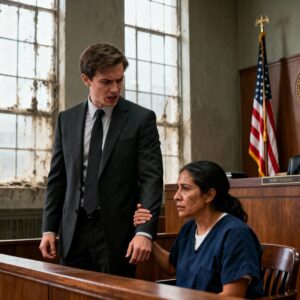
The gavel fell, sealing the one-armed veteran’s fate. But from the back of the courtroom, a single, mournful howl became the first shot in a new war—one fought by a dog who remembered everything they buried.
Courtroom 3 of the Hamilton District Court was a vessel of held breath. The morning light, strained through tall, dusty windows, seemed to congeal in the air, thick and heavy as the silence itself. On the polished wooden benches, people…
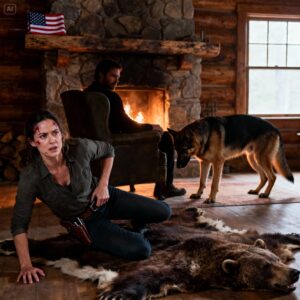
He went to an Alaskan cabin to silence the echoes of war. But in the heart of a blizzard, his dog sensed a secret the storm was sent to bury—a secret that would force him into one last fight.
The wilderness beyond Anchorage doesn’t ask for permission; it simply takes. It swallows roads, erases landmarks, and devours the faint, tinny signal of a cell phone until the only voice left is the wind. It was in this vast, unforgiving…
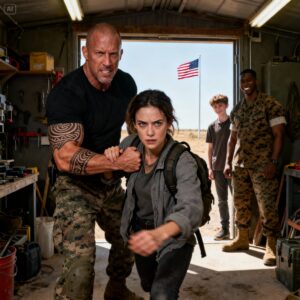
He told the quiet woman she didn’t belong on his elite sniper range. But when her backpack split open, a single photo fell out that made every decorated Marine in the room snap to a salute in shame.
The crack of a rifle shot was the only sound that made sense anymore. It split the dry California air over Marine Corps Base Camp Pendleton, a clean, percussive thunder that echoed off the brown hills and settled in your…
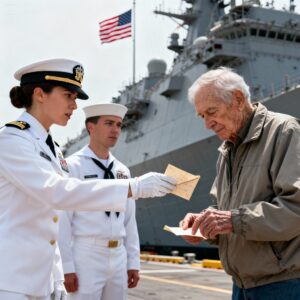
As the young officer moved to detain the 89-year-old man, she was blind to the truth. The very name of the warship she guarded was a whisper of the 70-year-old secret hidden on his faded patch.
The voice sliced through the humid air of the naval pier, a sharp tool meant to carve out immediate compliance. “Sir, I’m going to have to ask you to step away from the gangway. This area is for authorized personnel…

They chose a desolate mountain to be her grave, thinking a thousand-foot drop was the perfect, silent crime. But as she fell into the void, they made a fatal miscalculation about the kind of woman they just betrayed.
The mountain didn’t make a sound when it happened. There was no grand echo to mark the moment, no sympathetic rumble from the ancient stone. There was only the sharp, scattering kick of gravel, a sudden, violent silence where a…

In a circle of 282 elite soldiers, two men decided to humiliate the quiet medic during a demonstration. They intended to break her spirit. Instead, in seven brutal seconds, they discovered a truth that broke them completely.
The wind that came off the Atlantic that morning had teeth. It wasn’t a breeze; it was a hard, scouring force that snapped across the open-air corridors of Naval Special Warfare Command Unit 7, carrying the briny scent of the…
End of content
No more pages to load