The hum was the first thing you noticed. A low, persistent drone from the fluorescent lights that bled a sterile, colorless glow onto the polished linoleum. It was the sound of 6:15 in the morning at St. Jude’s Community Hospital, the hollow moment when the exhaustion of the night shift dissolves into the fragile hope of a new day. For most, it was a transition. For Kellen Hale, it was an ending.
He wrung the last of the gray, soapy water from the mop head, the fibers twisting tight under the pressure of his hands. He leaned it against the stainless-steel utility cart, the movement deliberate and unhurried. His hands were steady, too steady for a man who had just lost his job. But inside his chest, a familiar weight had settled, a leaden stillness he had learned to carry like a second heart. Calm on the surface, turbulence underneath. It was the only way he knew how to be.
The hallway door behind him sighed open, its pneumatic hinge releasing a soft hiss.
“Kellen,” a gentle voice called. “Mr. Dalton wants to see you again.”
It was Mrs. Parker, a charge nurse whose sixty-odd years had softened the corners of her eyes but not the steel in her spine. Her voice was apologetic, laced with a sympathy she clearly wished she didn’t have to offer.
He gave a small, tired nod. “Figured.”
She lingered for a moment, her gaze searching his face. “You did the right thing, you know. Anyone would have.”
Kellen didn’t reply. There was nothing to say. He wiped his hands on a clean rag tucked into the waistband of his gray work pants and started down the long, silent corridor. He didn’t need to be told what this second meeting was about. The hospital’s position had been made brutally clear a few hours earlier, in that same suffocatingly neat office.
He had been outside the emergency entrance, taking a five-minute break, when it happened. An elderly man, walking slowly toward the doors, had suddenly staggered, his face a mask of confusion before his eyes rolled back and he crumpled to the pavement. A heart attack. Kellen hadn’t thought; he had reacted. Instinct, sharp and absolute, had taken over. He was on his knees beside the man before the first scream had even registered, his hands finding the correct position on the man’s chest as if guided by a phantom force.
Chest compressions. Airway. Rhythm. Stabilize.
It was muscle memory, buried under eight years of quiet anonymity but never truly gone. The man had survived. The paramedics, arriving minutes later, had stared at him with a mixture of shock and respect. The man’s family had wept and called him a hero.
And then he’d been called into the administrator’s office.
“You’re a janitor, Mr. Hale,” Dalton had said, his voice as cold and sterile as the hospital walls. “You are not authorized to perform medical intervention. This is a liability.”
Now, standing before that same polished wooden door, Kellen knocked lightly on the frame. Mr. Dalton, a man whose tailored suit seemed to hold him perpetually rigid, looked up from his desk.
“Kellen,” Dalton said, lacing his fingers together in a gesture that was meant to look thoughtful but only looked strained. “I just need to formalize the paperwork.”
“It’s fine,” Kellen replied, his voice even, betraying none of the storm inside him. “I understand.”
Dalton exhaled, a small puff of air that spoke of relief. He had been expecting a fight, anger, a lawsuit. Kellen’s placid acceptance unnerved him. “It’s not personal,” the administrator added, as if that made it better. “It’s policy.”
Sure. Policy. Kellen forced a faint, polite smile that didn’t reach his eyes. He took the pen offered to him and signed the termination notice. The ink flowed, black and final.
“If you need a reference…” Dalton began, trailing off.
“I don’t,” Kellen said, his tone gentle but absolute.
Dalton blinked, utterly bewildered by the man before him—a man who refused anger, refused bitterness, refused to be anything other than what he was in that moment: finished. But Kellen had learned long ago that anger was a luxury, an indulgence he couldn’t afford. Not with a six-year-old daughter who depended on his steadiness, whose world was built on the foundation of his calm. She needed a father, not a fighter.
He walked out of the office, the sterile air giving way to the crisp, damp chill of a New Mexico morning. The hospital parking lot glistened, the asphalt dark from an early drizzle. He took a deep breath, letting the cold air fill his lungs, hoping it would ground him, anchor the spinning compass in his soul. It was over. The job was gone. Now what?
Behind him, the automatic glass doors slid open with a soft whir.
“Daddy!”
A small voice, clear as a bell, cut through the morning quiet. Tate bounded toward him, her small backpack—a bright pink explosion of unicorns and stars—bouncing with every excited step. She was a tiny thing with his late wife’s warm brown eyes, eyes that saw far too much for a six-year-old. A nurse from the daycare wing had walked her out the back entrance, just as they’d arranged.
Kellen’s carefully constructed composure fractured. He knelt, opening his arms, and caught her as she launched herself into him. Her small body was a solid, warm reality against his chest.
“There’s my girl,” he murmured into her hair, which smelled faintly of crayons and apple juice. He allowed himself this one moment of softness, a single, unguarded breath before the walls went back up.
Tate pulled back, her small hands on his shoulders, and studied his face with an unnerving intensity. Children always knew. They sensed the cracks in the foundations adults worked so hard to plaster over.
“Did you finish work early today?” she asked, tilting her head.
He brushed a stray strand of brown hair behind her ear. “Something like that, sweetie.”
“Are you okay?”
He managed a smile. Not a big one, but a real one. It was impossible to fake a smile for Tate. “Better now.”
Her hand, tiny and trusting, slipped into his. The warmth of it was an anchor. “Can we get pancakes before school? The big ones? With whipped cream?”
A genuine chuckle escaped him, a rare and rusty sound. “Yeah,” he said, his voice thick. “Yeah, we can do that.”
They began the long walk toward the far corner of the lot where his aging Ford F-150 waited, its paint faded by the relentless sun. The clouds were beginning to break apart, and thin, golden lines of light cut across the wet pavement. A new day, a fresh direction, even if the road ahead was a terrifying, empty map.
He opened the passenger door for Tate, the metal groaning in protest. As he lifted her into the high seat, a tremor ran through the ground. It wasn’t gentle. It was a deep, violent shudder, as if the earth itself had flinched. The truck rocked on its worn suspension.
Tate clutched his shoulder, her eyes wide. “Daddy, what is that?”
Kellen’s head snapped up. His senses, long dormant, flared to life, years of training kicking in before conscious thought could form. He knew that sound. It was a sound woven into the very fabric of his nightmares. The percussive thump-thump-thump of rotor blades, heavy and concussive. Military grade.
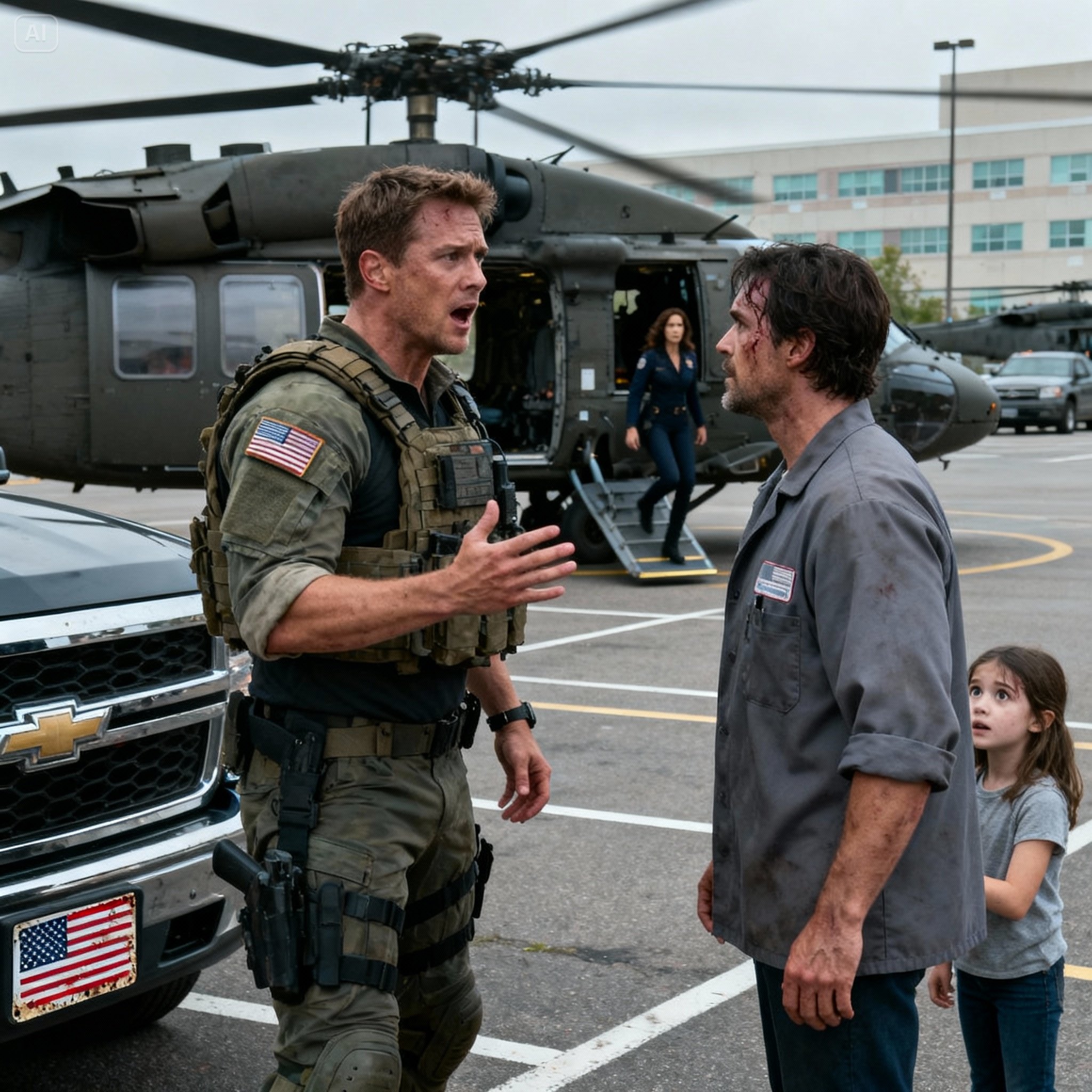
Three immense shadows tore across the sky, dark wings slicing through the morning fog. Blackhawk helicopters, flying low and fast—too low for civilian airspace, too aggressive for any routine maneuver. They were coming in hot.
A hurricane of wind ripped through the parking lot. Discarded paper cups, leaves, and dust swirled into chaotic spirals. Nurses and patients huddled near the hospital entrance, shielding their faces, their shouts lost in the deafening roar. Kellen instinctively pulled Tate close, turning his body to shield her small frame from the violent downdraft.
The helicopters descended, one after another, their landing skids slamming onto the wet asphalt with brutal, military precision. The thunderous blades had barely begun to slow before the side doors were thrown open. Men in full combat gear spilled out, their boots splashing in the shallow puddles. There was nothing casual about their movements. This wasn’t a patrol. This was an invasion. This was a hunt.
They sprinted toward the hospital entrance, their eyes scanning, sweeping across the small crowd of onlookers like predators seeking a target.
Tate trembled in his arms. “Daddy, why are they here? Are they mad?”
Kellen didn’t answer. Not because he didn’t want to, but because a cold, terrible certainty was already tightening in his chest. A dread he had lived with for eight years had just found his address.
The soldiers stopped twenty feet from him. Their leader, a tall sergeant with a jaw set like granite, cupped his hands around his mouth. His voice, raw and desperate, cut through the dying roar of the engines.
“IRON FALCON!”
The world went silent for Kellen. The wind, the confused murmurs, the distant sirens—it all vanished. There was only the name.
“IRON FALCON! WE NEED IRON FALCON IMMEDIATELY!”
People turned to each other, their faces blank with confusion. No one moved. No one spoke. The name meant nothing to them.
But it meant everything to him.
Kellen’s heart clenched so tight he thought it might stop. He hadn’t heard that call sign in 2,922 days. Not since the day he walked away from the life that had stolen his sleep, stained his hands, and left him a ghost in his own home. He had buried that man, buried him deep under a janitor’s uniform and the quiet rhythm of a small-town life.
He swallowed, the sound loud in his own ears.
Tate looked up at him, her small face etched with a fear that mirrored his own. Her voice was barely a whisper. “Daddy… that’s you, isn’t it?”
He closed his eyes for a fraction of a second, a silent prayer for an escape that wasn’t coming. Then he opened them and looked down at his daughter, the only thing in his life that was truly real.
He exhaled slowly, a surrender. “Yes,” he said, his voice soft and broken. “It is.”
The soldiers’ eyes found him. Recognition flared across their faces like a struck match. The sergeant’s arm shot out, his finger pointing directly at Kellen.
“There!” he shouted, his voice cracking with relief. “Iron Falcon! Sir, we need you. Now!”
Kellen held Tate closer, a useless but necessary gesture, as the three soldiers broke into a full run, their boots pounding a frantic rhythm on the asphalt. Whatever he had feared, whatever he had tried to outrun, whatever ghost he had sworn was dead and buried, had just landed in his daughter’s school parking lot. And it was coming for him.
The wind howled, a physical force that seemed to want to tear the world apart. The rotor wash from the three Blackhawks carved violent, invisible circles in the damp morning air, kicking up a storm of grit and gravel. The hospital parking lot, a place of quiet arrivals and departures, had become a war zone of noise and confusion. Nurses clutched at their scrubs as if to hold themselves together. A few patients, frail and bewildered, covered their ears against the percussive blast. A Styrofoam cup of coffee, dropped in the initial chaos, trembled on the pavement, its dark contents rippling with each thundering vibration.
But for Kellen Hale, it wasn’t just noise. It was a symphony of a life he had forsaken. It was the sound of midnight extractions from hostile territory, the sound of sand and shrapnel hitting the fuselage, the sound of his own heart hammering against his ribs as he flew into situations no sane pilot would attempt. It was a sound he once lived by, a sound he had bled for. A sound he had sworn to God he would never answer again.
Tate clung to his shoulder, her small fingers digging into the worn fabric of his work jacket. The tremor in her voice was a knife in his gut. “Daddy, why are they calling you that name?”
He forced his own breathing to remain steady, an old discipline kicking in even as his pulse pounded a frantic drum against his ribs. “I’ll explain later, sweetie,” he whispered, his voice a low rumble meant only for her. “But not yet.”
Boots splashed through the puddles as the three soldiers closed the distance, their movements driven by an urgency that was now palpable to everyone, an invisible current of desperation that only Kellen truly understood.
The leader, the broad-shouldered sergeant with a tense jaw and eyes that seemed permanently fixed in a marksman’s squint, skidded to a halt just a few feet away. His breath came in sharp, ragged bursts.
“Sir! Iron Falcon! We’ve been searching for you for six weeks.”
Kellen instinctively raised a hand, a gesture that was both a halt and a plea, as he shifted Tate further behind him. “Don’t call me that,” he said, his voice low and tight. “Not here.”
The sergeant’s mouth worked for a moment, caught between the rigid lines of military duty and the clear shock of seeing his legend—a man spoken of in hushed, reverent tones in barracks and ready rooms—dressed in a janitor’s gray uniform and clutching a little girl. “But sir… this is an emergency. A priority one directive.”
Just then, a door on the second helicopter slammed open, and more soldiers spilled out. They didn’t rush forward. They moved with the cold, practiced precision of a security detail, forming a perimeter around the landing zone. They weren’t here for a show. They weren’t here by accident. This was real.
The hospital staff, clustered at the entrance, stared in open-mouthed shock. Phones were already being lifted, their small screens aimed at the impossible scene unfolding before them. Whispers spread like wildfire.
“Is he military? The janitor?”
“What’s ‘Iron Falcon’?”
“Why would the army send three helicopters for him?”
Kellen kept his head down, his jaw tight. This was it. This was the exposure he had dreaded, the collision of two worlds he had kept violently separate. The quiet, simple life he had built for his daughter was shattering like glass.
The sergeant took another cautious step forward. “Sir, with all due respect, we need you to come with us. Immediately. Commander Thorne is inbound. She insisted we fly you out personally.”
That name. It hit him like a physical blow, a punch he never saw coming. Harper Thorne. A name he had locked away in the most fortified corner of his mind, along with the scent of desert rain and the memory of a shared canteen of water under a star-dusted Afghan sky. A name that had once meant partnership, trust, and something more—something he had been too broken and too afraid to give a name to.
Kellen forced his voice to remain steady, a monumental act of will. “She’s here?”
The sergeant nodded, his expression grim. “Landing now.” He pointed toward the third helicopter, which had remained slightly apart from the others. As he spoke, its side door slid fully open. A figure stepped out onto the landing skid, silhouetted against the gray morning light. The figure was poised, controlled, and utterly composed, even in the heart of the chaos. Her dark hair was whipped back by the storm of the rotor wash, but she moved with an unshakeable confidence as her boots hit the ground.
Harper Thorne.
The moment her eyes locked onto Kellen, she stopped. For a single, breathtaking second, the iron mask of her command presence cracked. Shock flashed across her stern features, followed by a wave of something so fragile and warm it felt entirely out of place on a battlefield, or in a hospital parking lot.
“Kellen,” she breathed, the word almost lost in the fading roar of the engines. “My God. It really is you.”
She crossed the distance with purposeful strides, but there was a vulnerability shimmering at the edges of her steely posture, a slight tremor in her hands that no one else would have noticed. She didn’t hesitate. She didn’t salute. She didn’t bark orders. She simply stopped in front of him and looked at him with a mixture of disbelief and profound relief that eight years had failed to erase.
“You disappeared,” she said softly, her voice thin with an emotion she rarely allowed herself. “No trace. No contact. We thought…” Her voice faltered. “We thought you were gone.”
He met her gaze, his own expression shielded by the same cautious calm he had worn like armor since the day he’d left. “I had my reasons, Harper.”
Her eyes flicked down to the small head peeking out from behind her father’s shoulder, to the wide, curious eyes of the child watching them. “And this must be one of them,” Harper said, her voice softening instantly.
“My daughter, Tate.”
A genuine, unguarded warmth bloomed on Harper’s face. “She’s beautiful, Kellen.”
Tate, still unsure of the stranger but sensing no threat, whispered to her father, “Daddy, is she your friend?”
Harper swallowed, a flicker of old pain and new emotion crossing her face before she brought it back under control. “Yes, sweetheart,” she said, her voice tightening just enough to sound professional again. “I’m a friend. A very old one.”
But the tenderness was fleeting. The urgency of her mission surged back, and she shifted into the commander she had become. Her shoulders squared, her jaw firmed. “Kellen,” she said, her voice low and direct. “We have a situation.”
He exhaled slowly. “I’m not military anymore, Harper. I’m not him.”
“You’re the only one who can do this,” she insisted, and her eyes shimmered, not with fear, but with a desperate, unwavering trust that felt heavier than any order. “Commander Tristan Rafe is dying. He was hit during a raid. He won’t last the day unless someone performs the Iron Falcon procedure.”
Kellen’s expression hardened. Old wounds, deep and septic, pulsed awake. “That technique was experimental. It was unstable. It was banned.”
“It was your creation,” Harper cut in, her voice sharp with desperation. “And he survived the first time because of you. Because you were there.”
Kellen shook his head, a visceral, gut-level refusal. “I walked away for a reason.”
Harper stepped closer, her voice dropping to an urgent plea. “I know you did. I know. But this isn’t just about military protocol, Kellen. It’s about Tristan. He’s asking for you. With what little consciousness he has left, he’s asking for Iron Falcon.”
Kellen looked away, his jaw working as he stared at the cracked asphalt, at the line where his old life was crashing into his new one. Tate tugged lightly on his sleeve, her touch a small, grounding pressure.
“Daddy,” she said, her voice clear and innocent. “Are you going to help someone?”
He closed his eyes. This was the moment. The choice he had been running from since the day he became a father. The moment when the past refused to stay buried and demanded its due. He crouched down to her height, his gaze meeting hers. He brushed his thumb across her soft cheek.
“I might have to, sweetie,” he murmured, his voice thick. “Someone’s life depends on it.”
Tate blinked up at him, her expression a mixture of childlike innocence and a profound, intuitive understanding that belonged to someone much older. “Then you should go, Daddy.”
Her tiny voice held a conviction so pure and absolute it pierced him deeper than any battlefield order ever had.
Harper watched them, her breath catching in her throat.
Kellen rose slowly, the weight of a thousand impossible choices settling on his shoulders. He turned back to Harper, his decision made. “If I go, Tate stays safe. Protected. No press, no questions. No exceptions.”
Harper nodded instantly, her relief visible, real, and completely unmasked. “I’ll assign my best personnel to her myself. She won’t be out of my sight.” She took another step, her voice dropping to a whisper. “This isn’t a recall to service, Kellen. This is a recall to humanity.”
He stood there for a long, silent moment, the world holding its breath around him. Then, finally, he let out a long, shuddering exhale.
“All right,” he said. “I’ll go.”
The soldiers snapped into motion as if a switch had been flipped. And as Kellen turned to climb into the waiting Blackhawk, cradling Tate’s last look of unwavering trust in his heart, one truth sank in like a stone in deep water. No matter how far you run, no matter how deep you bury your ghosts, some call signs always find their way back to you.
The belly of the Blackhawk was a roaring, vibrating cage of steel and wire. As the rotors bit into the air, lifting them skyward, the hospital shrank into a gray-and-white miniature below, a toy building on a patch of asphalt. The sprawling high desert of New Mexico stretched out in every direction, a landscape of ochre and pale green under a vast, indifferent sky. The noise was deafening, a constant, concussive force that made conversation impossible for the soldiers strapped in beside him. But for Kellen and Harper Thorne, sitting across from each other, the silence was even louder.
Her eyes were fixed on him, an intense, searching gaze, as if she were trying to reconcile the man in the janitor’s uniform with the legend she had chased across the globe. As if she were afraid he might dematerialize, a ghost fading back into the eight years he’d been gone.
The sun cut a sharp, bright line through the open side hatch, illuminating the dust motes dancing in the turbulent air. It sliced across Kellen’s face, highlighting the new lines etched around his eyes, the subtle silver at his temples. He sat with his hands resting loosely on his knees, a man who looked utterly out of place, yet completely at ease with the violent motion of the aircraft. He looked like someone who had lived unanchored for a very long time.
Harper leaned forward, her voice raised just enough to cut through the mechanical roar. “Kellen!”
He glanced up, his gaze steady and unreadable.
“I didn’t think I’d ever see you again,” she shouted, a tremor of emotion breaking through the disciplined tone of her command voice.
A small, tired smile touched the corner of his mouth. It was a ghost of a smile, full of weariness and irony. “I didn’t think I’d ever hear that call sign again.”
“Iron Falcon,” she said, the name softer on her lips now, almost a memory. “It was never just a call sign, Kellen. It was who you were.”
“Harper,” he interrupted gently, his voice firm but not unkind. “I’m not him anymore.”
Her jaw tightened, but she didn’t argue. Not yet. She shifted in her harness, scooting a little closer, the space between them shrinking from professional to personal. She lowered her voice, forcing him to lean in to hear her. “You should know why I insisted on coming myself.”
He waited, his eyes giving nothing away.
“Tristan Rafe… he’s not just any commanding officer. You saved him once before. In Kandahar. He never forgot it. He trusts you, Kellen. Only you.”
He let out a slow, controlled breath, the memory rising unbidden. The searing heat, the screams, the smell of blood and cordite. “The Medevac was shot down. We were stranded. I had no equipment. No surgical suite.” He looked down at his hands, as if seeing them back then, covered in sand and blood. “What I did… it wasn’t a procedure. It wasn’t a technique. It was desperation. A one-in-a-million shot in the dark. We shouldn’t be trying it again.”
Harper’s voice softened, losing its commander’s edge and finding a different register—the voice of the woman who had once known him better than anyone. “But you did it. You saved him. And you saved everyone else on that mission. You flew them out yourself in a crippled bird through a sandstorm.”
He looked away, out the open hatch at the blur of the desert floor rushing by. Silence stretched between them, thick and heavy, broken only by the rhythmic chop of the blades.
“You just disappeared,” Harper finally said, the accusation and the hurt rising in her voice despite her discipline. “One morning, you were there. Leading the briefing, fixing the unfixable, flying into hell and pulling us out again. And the next morning, your bunk was empty. Your locker was cleared out. You were just… gone.”
Kellen closed his eyes for a moment, bracing against the memory. “My wife had died the year before,” he said, his voice quiet, stripped bare. “And Tate… she was just a baby. The army offered condolences. They sent a neatly folded flag. They gave me medals. But they couldn’t give my daughter a father. Only I could do that.”
Harper swallowed, the hard lines of her face softening with a pain that was not her own, but that she had clearly felt. “I never blamed you,” she whispered. “I just… I missed you.”
A dry, breathy laugh escaped him, devoid of humor. “Missed me? Commander Thorne doesn’t miss anyone.”
A faint, sad curve touched Harper’s lips. “I wasn’t Commander Thorne back then. I was just Harper.”
He looked at her then. Really looked at her. The unguarded softness in her gaze was something he hadn’t seen in years, a vulnerability she had long ago buried under rank and responsibility. The air between them crackled with unspoken history—shared rations, late-night mission planning, conversations that always stopped just short of becoming something more.
The moment was shattered as turbulence jolted the cabin. A young soldier instinctively steadied a case of medical equipment. The radio crackled to life, a disembodied voice barking through the static.
“ETA four minutes. Patient status declining. Repeat, status is critical and declining.”
Instantly, Harper transformed. Her spine straightened. Her voice sharpened. The commander was back. “We’ll be landing at the forward operating point. They’ve got a surgical team standing by, but they can’t stop the internal bleeding. He’s losing consciousness faster than they expected.”
Kellen nodded, his own mind already shifting into a different mode, the fog of the past burning away to reveal the cold, analytical focus of the medic. “What are his vitals?”
“BP is crashing. Ventilation is unstable. They suspect multiple organ failure is imminent.”
Kellen’s brow furrowed. “And you waited this long to find me?”
“We tried sooner,” Harper said, a flash of frustration in her eyes. “Your records were wiped. Erased. Your civilian identity was buried under so many layers of classified confidentiality codes, it was like you never existed. No one could find you. Not even your old unit.”
One of the other soldiers, a young corporal with freckles and wide, awe-filled eyes, leaned forward hesitantly. “Sir… if I may?”
Kellen glanced at him.
“You were… you’re a legend to us new guys. Iron Falcon. The pilot-medic who flew through sandstorms to pull wounded out of hot zones. The guy who invented combat medical techniques on the fly that they’re still trying to replicate in training. We… we didn’t think you were even real.”
Kellen let out a dry, weary exhale. “Trust me, Corporal. I’m very real.”
The young soldier flushed, embarrassed but sincere. “Well… it’s an honor, sir.”
Harper watched the exchange with a strange mix of pride and sorrow, like someone seeing a magnificent, wounded animal forced back into a cage it had escaped. Kellen didn’t bask in the admiration. He never had. His gaze drifted to the vibrating floor of the helicopter, his thoughts a thousand miles away. “I left that world behind,” he murmured, more to himself than to anyone else.
Harper leaned closer again, her voice intense. “But the world didn’t leave you behind.”
Another jolt struck the cabin as the helicopter began its final, aggressive descent. Clouds of dust and sand rushed past the open hatch. Below them, a sprawling temporary military base scarred the desert landscape—a chaotic, urgent city of canvas, concrete, and steel.
Harper unbuckled her harness and moved to the hatch, her body braced against the wind. She turned back to him, her eyes burning with intensity. “Kellen, whatever happened in the past, whatever pain made you leave, none of that changes one thing.”
“What truth is that?”
“That some people are born to save others,” she said, her voice clear and absolute above the roar. “And you’re one of them.”
The helicopter thudded onto the landing pad, the impact jarring through the fuselage. Before the blades had even stopped spinning, a medical team was sprinting toward them, shouting updates over the deafening noise.
Harper held out a hand to him, not as a commander to a subordinate, but as a person reaching across eight years of silence. “You ready, Iron Falcon?”
He hesitated for a fraction of a second, the weight of the name pulling at him—the lives attached to it, the ghosts tied to it, the choices that had both defined and broken him.
Then he took her hand. Her grip was firm, real.
“Let’s go,” he said.
Together, they leaped from the Blackhawk into the swirling storm of dust and desperation, stepping back into a world Kellen had sworn he would never enter again. But fate, like an old call sign, has a way of tracking down those who try to outrun it.
The air on the ground was a suffocating cocktail of diesel fumes, scorched dust, and the metallic tang of adrenaline. The forward operating base was a maelstrom of controlled chaos. Medics sprinted with IV bags held high, soldiers jogged from tent to tent with purpose, and the sharp bark of orders cut through the constant hum of generators and vehicle engines. It had been eight years since Kellen had set foot on a battlefield, but the rhythm of it was instantly, dreadfully familiar. His body remembered this language, even if his heart had forgotten how to speak it.
Harper moved ahead of him, her presence a parting of the seas. Personnel, no matter their rank, instinctively made way for her. She never once looked back to see if he was following. She didn’t have to. She knew him. He always followed when a life was on the line.
They reached the entrance to the main medical command tent, a sprawling canvas structure humming with the frantic energy of a losing battle. Harper stopped, placing a hand on his arm. The touch was brief, grounding. Human.
“Kellen,” she said, her voice low. “Before we go in. You don’t owe the army a damn thing. Not after what they did to you, erasing you like you were some clerical error.” She paused, her eyes, normally sharp as forged steel, softening. “But the man inside that tent… he’s one of the few who fought for you when you left. He tried to stop them from burying your record.”
Kellen’s jaw tensed. “That was a long time ago.”
“And he’s dying now.”
As if on cue, a nurse threw back the tent flap, his face pale with stress. “Commander Thorne, he’s crashing again! We’re losing his pressure!”
Harper’s commander persona snapped back into place. “We’re coming!”
But as she turned, Kellen’s hand shot out, his fingers closing around her wrist. It wasn’t a harsh grip, but it stopped her cold. “Harper.”
His voice was low, intense, demanding a truth beyond the mission. “Before I go in there. Before I pick up a weapon I put down eight years ago… you tell me straight. Why me? Why go to these lengths?”
She looked at him, her gaze holding his, and for a moment, she wasn’t a commander. She was the woman who had watched him walk away. Finally, she answered, her voice stripped of all pretense. “Because you’re the only person I’ve ever met who creates hope where there isn’t any.”
For a single, suspended heartbeat, the world fell away. The noise, the wind, the chaos—it all vanished, leaving only the heavy thud of Kellen’s pulse in his ears.
Then he let go of her wrist and stepped inside the tent.
It was a vision from his past nightmares. The makeshift M.A.S.H. unit was a storm of beeping monitors, clattering surgical trays, and sweat-soaked medics scrambling around the still, pale form of Commander Tristan Rafe. His face was ashen, his chest rising in shallow, mechanically assisted breaths. A pool of blood was darkening the floor beneath the gurney.
Kellen’s breath caught. The last time he’d seen Tristan Rafe, the man had been standing tall in a desert storm, shrapnel in his shoulder, calmly directing the evacuation of his men. He was a leader who led from the front. A good man. A rare man. A man worth saving.
The lead surgeon, a major with exhausted eyes, looked up sharply. “Who the hell are you? This is a restricted area!”
“He’s the one I told you about,” Harper cut in, her voice leaving no room for argument. “Let him through.”
Recognition, followed by a wave of half-disbelief and half-desperate hope, dawned on the surgeon’s face. “You’re… you’re Iron Falcon?” he stammered.
Kellen ignored the name. He went straight to the gurney, his eyes scanning the monitors, absorbing the data with a speed that baffled the surrounding team. “Vitals.”
“BP is 60 over 40 and dropping,” a nurse rattled off. “We’ve pushed three units of O-neg. The internal bleeding… we can’t locate the primary source. His old scar tissue from the Kandahar incident is complicating the scans.”
Kellen peeled off his jacket, dropping it to the floor. In that simple motion, he was transforming. His posture straightened. His focus narrowed to a pinpoint. The quiet, world-weary janitor was gone, replaced by something older, sharper, and far more dangerous. The reluctant healer was stepping into the role he was born to fill.
“Give me the scans,” he demanded.
The surgeon handed him a tablet. Kellen’s eyes darted across the grainy images, his mind a supercomputer—calculating, assembling possibilities, rejecting theories, and reassembling new ones. A three-dimensional map of the injury was building itself in his head.
“It’s not the new wound,” he said softly, his voice calm amidst the panic. “It’s a cascading failure originating from the old one. The ventricular wall is collapsing. This isn’t just bleeding; it’s structural.”
The medical team froze. A young medic whispered, “How can you possibly tell that from this?”
Kellen pointed to a faint, irregular shadow on the scan, a ghostly anomaly no one else had seen. “Because I’ve seen it before,” he said, his voice dropping. “Eight years ago. In Kandahar.”
Harper stepped closer, her breath catching. “The mission where you saved him.”
He nodded, his eyes never leaving the screen. “And the same reason I left,” he added, so quietly only she could hear.
The room stilled, the unspoken question hanging in the air. But before Harper could ask, a shrill, piercing alarm shrieked from the heart monitor. A flat line.
“We’re losing him!” the surgeon yelled.
Harper’s face tightened. “Kellen!”
“I know,” he said.
In a single, fluid motion, Kellen stripped off the surgeon’s gloves, tossed them aside, and pulled on a fresh pair. He stepped into the primary position at the side of the gurney and began issuing orders with the calm, absolute authority of a man who had done this under mortar fire, in blinding sandstorms, with nothing but a pocketknife and raw instinct.
“Scalpel. Clamp here, now. Increase the fluid drip rate. Prep for manual compression modification.”
The surgeon blanched. “But that technique… it’s not approved. It’s…”
“It’s the one I invented,” Kellen snapped, his voice like cracking ice. “Move.”
His hands moved with a speed and precision that was mesmerizing. He was a master craftsman at his work, combining traditional surgical methods with the kind of brutal, elegant improvisation that could never be taught in a medical school. It was knowledge bought with blood and stress, learned in the heart of chaos.
Harper was at his shoulder, a seamless extension of his will. She handed him instruments before he asked for them, her focus absolute. They moved in perfect sync, a deadly and life-giving dance, eight years of separation melting away as if they had never been apart.
He worked, fighting against the tide, against the failing body, against time itself. And then, like a miracle taking a ragged breath, a rhythm flickered back onto the monitor. A weak, struggling beat, but it was there.
The room exhaled as one. Nurses choked back sobs. The lead surgeon leaned against a supply cart, his face buried in his hands, utterly stunned. Harper’s eyes glistened with unshed tears, but she held herself ramrod straight.
Kellen slowly withdrew his hands. “He’s not out of the woods,” he said, his voice raspy. “But he’s not dying today.”
He stepped back from the table, a profound tremor running through him. The adrenaline began to recede, leaving behind a deep, aching exhaustion. The room watched him with an awe he didn’t want and couldn’t accept. He wasn’t a hero. He was just a father who had made a promise. A promise he was beginning to fear he could no longer keep.
A medic quietly escorted him out of the main tent to a wash station. As he stood over a metal basin, rinsing the blood from his hands—hands that had saved dozens, hands that knew how to destroy just as easily—he caught his reflection in the polished steel. The face staring back was a stranger, the eyes haunted by a ghost he thought he’d killed. This was why he’d left. This feeling. This terrible, crushing weight of responsibility for the lives of others. He wasn’t sure he could bear it again.
A small voice pulled him from the spiral. “Daddy?”
He spun around. Tate stood at the entrance of a neighboring tent, clutching a stuffed rabbit some kind-hearted soldier had clearly given her. Her eyes were wide and worried.
“You were gone a long time,” she said, her voice small.
He knelt, the movement stiff and pained, and pulled her into a fierce hug. “I know, sweetie. I’m sorry.”
She hugged him back, her arms tight around his neck. “Did you help him?”
“Yes,” he whispered into her hair. “I did.”
She pulled back and looked at him, her expression serious. “I knew you would.”
He closed his eyes, overwhelmed by the purity of her faith in him.
Harper approached quietly, stopping a few feet away, giving them their space. Her voice, when she spoke, was gentle. “Kellen. Thank you.”
He didn’t answer. He couldn’t. Because deep down, a terrifying truth he wasn’t ready to face was beginning to whisper through his veins. This wasn’t over. Saving Rafe wasn’t the end. It was just the beginning.
The desert night settled over the base like a heavy, star-pricked blanket, cooling the sand but doing nothing to soothe the tension that still simmered in the air. A single, bare bulb swung gently from a pole outside the medical tent, its light casting long, trembling shadows that danced on the canvas walls. The air smelled of antiseptic, dust, and the lingering ghost of adrenaline, a perfume Kellen knew all too well.
Inside the surgical bay, Commander Tristan Rafe lay unconscious but stable. Alive. A single word that had felt impossibly distant just hours before. Around him, medics moved with a quiet, newfound reverence, checking IV lines and whispering updates as if speaking too loudly might break the spell. They were all witnesses to a miracle, and the miracle-worker was now sitting alone on an overturned supply crate, just outside the glow of the light.
Kellen had his elbows on his knees, his head bowed. His hands, scrubbed raw, were still trembling slightly. It wasn’t from fatigue, not physical fatigue anyway. It was the aftershock. Every dormant instinct, every hard-learned lesson from his past life had risen to the surface, and he had answered the call. He had won an impossible fight. But victory felt like a defeat. He had crossed a line he’d sworn to never cross again. He had let the ghost out.
Footsteps crunched softly on the gravel. “Kellen.”
He didn’t look up. He knew the voice. He knew the cadence of her walk. Harper moved closer, stopping just in front of him, her boots inches from his.
“You should be resting,” he murmured, his voice rough.
“I am,” she replied. He felt more than saw her lower herself to the ground, sitting on the dusty earth beside him, her back against the same crate. She wasn’t his commander now. She was just Harper.
She studied his profile in the dim light. The sharp angles of his face seemed carved from stone, etched with a weariness that went bone-deep. “You saved him,” she said softly.
Kellen shook his head, a small, tired gesture. “Not yet. He’s hanging by a thread. If any part of that maneuver fails…”
She leaned a shoulder lightly against his, a simple, solid point of contact in the vast, dark desert. “It won’t fail.”
“You don’t know that.”
“I know you,” she said.
The three simple words hit him with an unexpected force. He finally lifted his head and met her eyes. The intensity he saw there startled him, not because it was harsh, but because it was so utterly vulnerable. And Harper Thorne was never vulnerable.
“I watched you in there today,” she said, her voice barely a whisper. “You were… extraordinary.”
“That’s the problem,” he rasped.
“No,” she whispered back. “That’s the truth.”
He looked away, his gaze drifting toward the softly lit tent where Rafe lay fighting for his life. “I didn’t want this life back, Harper. Not the pressure. Not the impossible choices. Not the version of me that only exists when everything is falling apart.”
She nodded slowly. “I know.”
He rubbed his palms together, trying to generate some friction, some heat, some feeling of being grounded. “I made a promise,” he said, his voice thick with unshed emotion. “I promised myself that Tate would never have to see me in that world. Never see me covered in blood, surrounded by chaos, walking into danger.”
Harper’s voice softened even more. “She didn’t see that today, Kellen. She saw her father save a man’s life. She saw a hero. There’s nothing to hide from in that.”
He didn’t respond, because the truth was a tangled knot of guilt and fear, love and regret, and memories that still had teeth.
The flap of the medical tent rustled open. The lead surgeon stepped out, the yellow light from within silhouetting his exhausted frame. “Hale,” he called out, his voice hoarse. “He’s conscious. Barely.”
Harper sucked in a breath. “He woke up?”
“Yeah. And he’s asking for you.”
Kellen’s stomach twisted. He hadn’t spoken to Tristan Rafe in eight years, not since the commander had quietly intervened to shield him from the bureaucratic backlash of his sudden, unceremonious departure. It was a debt Kellen had never been able to repay. Until today.
Harper nudged his arm gently. “Go. He wants to see you.”
Kellen rose, every muscle protesting, every step feeling heavier than the last. As he followed the surgeon back into the tent, the familiar smells and sounds enveloped him, pulling him back in time. He stepped beside the gurney.
Rafe’s eyes fluttered open, his pupils slow to focus. His breathing was shallow, but when he saw Kellen, a faint, pained smile touched his lips.
“You… you came,” he rasped, his voice a dry whisper.
Kellen swallowed the lump in his throat. “I did what I could, Tristan.”
The commander’s hand, trembling and weak, lifted slightly from the sheet. Kellen instinctively took it, his grip gentle.
“You did more than that… Iron Falcon,” Rafe whispered.
Kellen stiffened at the name. “Don’t.”
“You earned it,” Rafe insisted, his grip surprisingly firm for a moment. “Twice over.”
Kellen looked down at their joined hands. “Let’s just focus on getting you stable.”
A weak, rattling sound that might have been a laugh escaped Rafe’s throat, turning into a cough. “Always… so damn humble. Some things never change.”
Kellen looked him in the eye. “Some things have to.”
Rafe’s gaze held his, and there was an urgency in it, a need to say something important. “You saved my life again,” he said. “But that’s not why I called for you.”
Kellen’s brow furrowed. “Then why?”
The commander’s voice thinned, becoming strained with effort. “Because… they owe you. The military. They owe you more than medals, more than silence… more than the disappearance they forced on you.”
Kellen’s jaw tightened. “I didn’t ask for any of that.”
“I know,” Rafe said, his eyes beginning to drift shut, the morphine and exhaustion pulling him back under. “But you deserve the truth.”
Before Kellen could ask what he meant, Rafe’s eyes closed, and his breathing evened out into a fragile, healing sleep. The surgeon touched Kellen’s shoulder. “He needs to rest. He’s stable for now, thanks to you.”
Kellen stepped back, only then becoming aware of the deep tremor in his own hands. He had come here to save a life, but Rafe’s words had opened a new wound. Harper was waiting for him just outside, her presence a steady, unwavering anchor in the swirling currents of his emotions.
“He’s alive because of you,” she said, her voice full of a relief so profound it was almost tangible. “Whatever he wanted to tell you, it can wait.”
But Kellen shook his head slowly, his eyes dark with a dawning, terrible understanding. “No,” he said. “It’s only just beginning.”
Harper paused, confused. “What do you mean?”
He turned to face her, his gaze clear and sharp. “You don’t send three Blackhawk helicopters for a janitor whose record was erased eight years ago just to perform one surgery, Harper. Even for a commander. Rafe knows something. He brought me here for more than one reason.”
Harper fell silent, the implications of his words settling heavily between them. Kellen looked back at the tent, at the fragile life he had just pulled back from the brink. The impossible had happened. A miracle had been performed.
But miracles always have a price. And he could feel the bill coming due.
The morning sun crept over the horizon, painting the desert in muted golds and soft purples that did little to soften the hard edges of the base. A new day had brought a new currency: rumor. It spread through the mess lines, the briefing halls, the quiet moments between shifts.
Iron Falcon is back.
They sent a fleet of birds for a janitor from some nowhere town.
I heard he’s not just anyone. He saved the Commander with a technique no one’s ever seen.
Why was his record erased in the first place? Who ordered it?
By the time Kellen Hale stepped out of the medical tent, blinking in the strengthening light, it felt as if the entire base had paused its breathing to watch him. Eyes followed him—some filled with awe, others with confusion, a few with outright disbelief. He didn’t notice. His mind was a locked room, replaying Rafe’s last, cryptic words: You deserve the truth.
His hands were raw, his muscles ached, and deep inside, the man he had buried was stirring, unsettling the quiet peace he had fought so hard to build for himself and his daughter.
Harper met him near the communications tent, a tablet tucked under her arm. Her expression was all business, but her eyes softened the moment they met his. “You look like you haven’t slept in a week.”
“I haven’t,” he replied simply.
She handed him a bottle of water. He took it without a word. “Hydrate,” she ordered.
He almost smiled. “Still bossy.”
“Still right,” she countered, a flicker of their old banter returning.
They walked in silence for a moment, leaving the controlled chaos of the medical bay behind. The desert wind carried the distant drone of a cargo plane and the faint crackle of radios—the constant, restless heartbeat of a base that never slept.
Harper stopped. “The Joint Command wants to see you.”
He stiffened. “Why?”
“Because they owe you answers,” she said, her tone firm.
Kellen shook his head. “They owe Rafe answers. I’m just a civilian who got pulled into something. I’m done with that world.”
Her eyes softened. “You’re not done, Kellen. Not until you hear it.” She stepped closer, lowering her voice. “I fought them on this. Hard. They wanted to debrief you like you were still enlisted, an asset to be managed. I told them absolutely not.”
He raised an eyebrow, surprised by the fierce protectiveness in her voice. “You did?”
“Yes,” she said, her tone a mix of steel and fire. “They don’t get to erase you and then claim you when it’s convenient. You hold all the cards here.” She paused. “You saved a commander’s life. You saved my team from losing their leader. If anyone deserves the unvarnished truth, it’s you.”
He exhaled, a long, slow surrender. “Fine. Let’s get this over with.”
The briefing room was exactly as he remembered them: cold, sterile, and lit by humming fluorescent lights that made everyone look tired. A heavy metal table dominated the center of the room, surrounded by a gallery of high-ranking officers. Men and women with chests full of ribbons and the weight of national security etched into the lines on their faces.
When Kellen walked in, followed by Harper, every single one of them stood up. It wasn’t protocol. It was respect.
“Mr. Hale,” a three-star general with kind but weary eyes said, motioning to a chair. “Thank you for coming.”
Kellen didn’t sit. “Say what you need to say.”
The general exchanged a look with the other officers, then stepped forward. “First, on behalf of the United States Armed Forces, we owe you an apology. A profound one.”
Kellen’s face remained an unreadable mask.
“It was not Commander Rafe who ordered the erasure of your service record,” the general continued, his voice grave. “The directive came from a highly classified multi-agency task force. It was intended to contain the operational details of certain missions you were a part of. Your identity was deemed… a liability to that containment. You were collateral damage in a decision made far above your pay grade.”
Kellen stared, the silence stretching. Finally, he spoke. “My career was erased because I saved lives.”
“It was erased because you did things no one else could,” the general corrected quietly. “And because certain people in power wanted to ensure those methods, and the missions they were used on, remained buried. It was a gross injustice.”
Harper stepped forward slightly, her arms crossed. “He deserved a Medal of Honor, General. Not to be wiped from the system like a ghost.”
Several of the officers nodded in solemn agreement.
“We want to make it right,” the general said. “We are prepared to immediately reinstate your rank, restore all honors and commendations, and offer you a newly created position: lead civilian advisor for our combat medical innovation program.”
Kellen blinked, not with amazement, but with a kind of weary disbelief. He let the silence hang for a moment before he finally spoke, his voice low but carrying to every corner of the room. “I’m not coming back.”
“Kellen…” Harper murmured, but he raised a hand, gently stopping her.
He addressed the room. “I left this life for a reason. I left because my daughter needed a father more than the military needed another field medic. I left because this system… your system… it takes and takes until you have nothing left to give.”
The room was utterly still.
“I appreciate the apology,” Kellen continued, his voice steady. “But I will not put my daughter through that life again. She deserves a home. Stability. A dad who comes home at night and stays there.”
The general bowed his head slightly. “We understand. And we respect your decision.”
Another officer, a colonel with silver hair, stepped forward. “Then allow us to do this, at the very least. A formal, written, and public clearing of your name. And full compensation and back pay owed for eight years of erased service.”
Harper’s eyes widened. Even she hadn’t expected that.
Kellen took a deep breath. “I’ll accept that. For Tate.”
“And we would like to publicly recognize your actions in saving Commander Rafe,” the officer added.
Kellen shook his head. “No ceremonies. No press. Just the paperwork.”
The officers looked defeated, but they nodded. Kellen turned to leave.
“Mr. Hale,” the old colonel said softly, stopping him at the door. “You may have walked away from us. But the lives you saved never forgot you.”
For the first time in hours, something tight in Kellen’s chest began to loosen.
Harper walked with him out of the building, the sun now high and fierce.
“You handled that well,” she said, a note of deep admiration in her voice.
He gave a dry, humorless chuckle. “A room full of generals is still easier than a toddler with a fever.”
She laughed, a genuine, warm sound that surprised even herself. As they reached the open yard, Kellen stopped. “Thank you, Harper.”
“For what?”
“For standing up for me in there. For fighting for me. For being here.”
Her expression gentled, the commander melting away again. “I’d do it again. Every time.”
Something unspoken passed between them, a fragile acknowledgment of a connection that had survived eight years of silence. But before either of them could give it a name, a young private came sprinting toward them, kicking up dust.
“Commander Thorne! Mr. Hale!” he panted, breathless. “There’s an urgent request at the medical bay!”
Both of them stiffened. “Is it Rafe?” Harper asked sharply.
“No, ma’am. Not the commander.” The private swallowed, looking confused. “It’s the hospital director. From Mr. Hale’s civilian job. He’s… he’s here. On the base.”
Kellen froze.
Harper’s eyes narrowed into dangerous slits. “What the hell is he doing here?”
“He’s asking to speak with Mr. Hale,” the runner said. “Privately.”
Harper glanced at Kellen, her face hardening with a protective fire. Kellen exhaled slowly, a long, weary sigh. The past had found him in more ways than one. And it clearly wasn’t finished with him yet.
The high desert sun beat down, fierce and unrelenting, making the air shimmer above the asphalt. Soldiers moved with practiced efficiency, but their disciplined gazes kept drifting toward the bizarre tableau unfolding near the medical bay. There, standing stiffly in a crisp button-down shirt now wilting in the heat, was a man who was so obviously out of place he might as well have been wearing a neon sign.
Director Marcus Dalton. The administrator who had fired Kellen. The man who had reduced his heroism to a liability. He stood there, twisting the handle of a leather briefcase, his face a pale mask of anxiety. This was not the confident, detached bureaucrat Kellen had faced across a polished mahogany desk. This was a man who knew he had made a catastrophic mistake and had flown into a military zone to try to fix it.
Kellen slowed his steps, Harper’s presence a solid, reassuring weight beside him.
“That’s him,” she murmured, her voice a low growl.
“Yes,” Kellen replied, his own voice quiet and calm.
Dalton saw them approaching and pasted on a smile that was a miserable failure. “Mr. Hale! Kellen! Thank God, I heard… I saw the news… I had to come.”
Harper crossed her arms, every inch the formidable commander. “He’s fine. No thanks to you.”
Dalton winced as if she’d struck him. “Commander Thorne, I… I understand how this looks.”
“No,” Harper said, her voice dropping to a dangerously cold register. “I don’t think you do.” She took a step toward him, her movements smooth and predatory. “You fired a man for saving a life. You humiliated him in front of his colleagues. And now you show up, uninvited, on a secure U.S. military base. Give me one good reason why I shouldn’t have you escorted out of here under armed guard.”
Dalton looked as if he might actually faint. “I came… I came to apologize.”
Harper raised a single, skeptical eyebrow. “To him?” She nodded toward Kellen. “Or to your board of directors to save your own job?”
A dark flush crept up Dalton’s neck. “I didn’t know who he was,” he stammered. “I didn’t know about his service record.”
“You knew he was a human being trying to save another dying human being,” Harper cut in sharply. “That should have been enough.”
Dalton flinched. “I deserved that,” he conceded, his voice weak. He fumbled with his briefcase, pulling out a thick file folder. “Kellen… please. Let me speak with you. Alone.”
Kellen studied him for a long, silent moment. He felt no anger. The anger had burned out long ago, leaving behind only a quiet, heavy sadness. “Whatever you have to say to me, Marcus,” Kellen said calmly, “you can say in front of her.”
Harper’s lips curved into the faintest of smirks. Dalton looked between the two of them—the disgraced janitor and the powerful commander who stood beside him like a guardian—and visibly deflated.
“All right,” he croaked. “Kellen… I didn’t come here to make excuses. I came because I was wrong. Categorically, profoundly wrong.” He swallowed, the effort visible. “When I fired you, I saw a procedural violation. I saw a lawsuit. I didn’t see the man. I didn’t know your background, what you were capable of.”
“I’m offering you your job back,” Dalton rushed on, opening the folder. “No, not your old job. A new one. We’ve had an emergency board meeting. I’m authorized to offer you the position of Chief of Emergency Medicine. A full department under your direct supervision. Full autonomy. Name your salary.”
Harper blinked, genuinely surprised. “You’re offering him the top medical role at your hospital?”
“Yes,” Dalton breathed, his desperation palpable. “Because we need him. And because I owe him this.”
Silence settled for a moment, the only sound the distant hum of the base. Kellen didn’t look at the folder. He didn’t look at the offer. He looked at the man.
“Marcus,” he said, his voice quiet but unyielding. “When I performed CPR outside your emergency room, I didn’t do it for a promotion. I didn’t expect a thank you. But I did expect a basic level of human decency.”
Dalton’s gaze dropped to the ground. “I know.”
“You humiliated me,” Kellen continued, his voice even, without a trace of accusation, which only made the words land harder. “You made an example out of me because you were worried about insurance, about liability, about paperwork.”
“I’m sorry,” Dalton whispered. “Truly.”
Kellen’s expression softened, just a fraction. “I’m not angry with you, Marcus. But I won’t come back.”
Dalton’s head snapped up. “Kellen, please! We need doctors like you!”
“You need to recognize people like me,” Kellen corrected gently, “before they have to save a commander on national television to prove their worth. You didn’t want me when I was sweeping your floors. You don’t get me now that I have the approval of generals.”
The truth of it, delivered so calmly, was devastating. Dalton’s shoulders slumped in defeat. He slowly closed the folder. “I hope… I hope one day you’ll reconsider.”
Kellen nodded once, a gesture of respectful finality. “I accept your apology. But I’m not returning.”
As Dalton turned and walked away, a man swallowed by the vastness of the military machine he had so foolishly entered, Harper let out a long, slow breath.
She waited until he was out of earshot. “Well,” she said, a small, proud smile playing on her lips. “That was one hell of a moral victory.”
Kellen exhaled, the last of the tension leaving his body. “He’s not a bad man. Just a blind one.”
“Most of them are,” Harper replied. She nudged him lightly. “You know, eight years ago, you would have torn him apart.”
Kellen allowed himself a small, wry chuckle. “Eight years ago, I was a different man.”
Harper met his eyes, her gaze direct and full of a warmth that was just for him. “He was a man worth fighting for, too.”
The words, so simple and sincere, caught him off guard. He looked away, a raw emotion tightening his throat.
“Come on,” Harper said gently, sensing his discomfort. “Tate’s waiting for you.”
He nodded, grateful for the change of subject. Together, they walked across the sunbaked dirt, away from the ghosts of his past and toward the small, bright light of his future. He was no longer running from the shadows. He was finally learning to walk beside them.
The morning air was cool and clean, a welcome respite after the stale, recycled air of the barracks. Kellen walked across the compound, the rising sun at his back. Near the steps of a low administrative building, Tate was deeply engrossed in a game with two young Military Police officers who had been assigned to watch over her. They had given her a tiny, high-powered flashlight and were showing her how to flash Morse code signals against a shaded wall. Her face was a study in fierce concentration.
When she saw her father approaching, she beamed, her serious expression melting away. “Daddy, look! They said I could be a Junior Security Officer!”
Kellen knelt, his heart swelling with a love so fierce it almost hurt. He brushed a stray piece of hair from her forehead. “I see that. You look very official.”
Tate held up the flashlight like it was a scepter. “I helped them check the perimeter. No bad guys.”
“Good job, sweetheart,” he said, his voice thick. Her arms wrapped around his neck in a hug that was both a greeting and an anchor. He lifted her easily, settling her on his hip. She felt so solid, so real, a stark contrast to the ghosts he’d been wrestling with.
A throat cleared gently behind him. Harper Thorne stood a few feet away, a tablet in her hand, the morning sun catching the copper glints in her dark hair. She wasn’t in uniform. She wore a simple dark jacket and jeans, a civilian look that made her seem more approachable, more open. More… Harper.
“Sorry to interrupt,” she said. “I wanted to catch you before the final briefing.”
Kellen set Tate down gently. “Go finish your patrol, Officer.”
“Yes, sir!” Tate saluted playfully and scampered back to her new friends.
Harper nodded toward a nearby bench. “Walk with me.”
They fell into step, the packed dirt crunching under their boots. “The Joint Command finalized everything,” she said, tapping the screen of her tablet. “Your service record is fully restored. All honors, commendations, full back pay. It’s all been authorized.”
“Good,” Kellen said.
“And they’re still holding the advisory position for you. Lead for Combat Medical Innovation. It comes with a full team, R&D budget, the works.”
“I’m not taking it,” Kellen said, his voice gentle but firm.
Harper sighed, though she didn’t look surprised. “I figured. I told them as much.”
He looked out across the base, at the endless motion and machinery. “That part of my life is over, Harper. I’m grateful for what they’ve done, but I’m not going back.”
“I know,” she said softly. “And you shouldn’t have to.” Her sincerity was a balm. “You deserve a life that doesn’t cost you your soul every time you clock in. A life with Tate.”
He exhaled slowly. “I just don’t know what that new life looks like yet.”
A small, hopeful smile touched her lips. “I think you do.” She held up the tablet. On the screen was not a military document, but a proposal. A business plan.
THE HALE METHOD: EMERGENCY & TRAUMA INNOVATION CENTER
A civilian-focused training facility for advanced battlefield and emergency medical techniques.
Below the title was a projected budget, a mission statement, and a line item showing the initial seed funding: the full amount of his newly awarded compensation. His name, his techniques, his life’s work—reborn, but on his own terms.
Kellen stared at the screen, speechless. “Where did this come from?”
“From you,” Harper said softly. “From everything you are. Even if you don’t see it yet.”
He handed the tablet back to her, feeling overwhelmed. “Harper, I’m not… I’m not the man to lead something like that.”
She didn’t hesitate. “You’re exactly the man,” she said, her voice filled with a quiet, unshakeable conviction. “You’ve saved more lives off the books than most surgeons do in a lifetime. You’ve invented techniques that are already changing emergency medicine. You’ve trained medics who still swear by your name. And you did it all when the world was trying to erase you.” She paused, her voice tightening with emotion. “You are not just a father. You are not just a healer. You are not just Iron Falcon. You’re all of them. And the world needs what you carry, Kellen. But it needs it on your terms.”
His throat felt tight. “Harper, I can’t go back to a life that takes me away from her.”
“You won’t have to,” Harper said, her eyes shining. “This center would be yours. You’d set the hours. You’d build the curriculum. You could train civilian EMTs, paramedics, firefighters, rescue personnel. You’d be passing on what only you know, not because a general orders you to, but because it saves lives.”
She let the words settle between them, seeping into the spaces he had kept locked for so long.
“I want to help,” she added, her voice quieter now.
He blinked. “Help?”
“With the logistics. The administration. Security.” She hesitated, her gaze unwavering. “And with whatever life you decide to build next.”
There it was. The unspoken truth, finally laid bare between them.
“Daddy! Auntie Harper!” Tate ran up to them, breathless and beaming. “Look! They let me use their radio!”
Harper laughed, the tension of the moment melting away. “Auntie Harper?” she echoed, a warm blush rising on her cheeks.
Tate nodded confidently. “Daddy said you were his oldest friend. So that makes you my friend, too, right?”
Kellen rubbed the back of his neck, flustered. “I, uh… may have mentioned something like that.”
Tate looked between them with wide, innocent eyes. “Daddy, can Auntie Harper come live near us when we go home?”
Kellen froze. Harper, however, knelt before Tate, her smile warmer and more genuine than any he had seen from her in years.
“Well,” she said gently, “I think that depends entirely on where your daddy decides we’re all going.”
Tate gasped. “We? Does that mean—”
“Tate,” Kellen chuckled, cutting her off. “One step at a time, kiddo.”
Harper stood up, brushing the dust from her knee. “But I will tell you this,” she said, her eyes finding Kellen’s over Tate’s head. “I would very much like to be a part of your dad’s future. And yours.”
Tate clapped her hands and ran off again, leaving the two adults standing in a bubble of quiet astonishment.
Kellen turned to Harper, emotion making his voice thick. “Are you serious about this? The center? Helping?”
She nodded, her expression open and vulnerable. “I’m done standing on the other side of a wall from you, Kellen. I’m ready for a new mission.”
Somewhere deep inside him, a wall he hadn’t even known was still standing began to crumble. He took a breath. “Then let’s build it.”
Her smile was soft and luminous. “I’d like that.”
The sun was climbing higher, casting long beams of light across the base. For the first time in eight years, Kellen Hale felt the unmistakable, terrifying, and exhilarating feeling of a new beginning. A future. A home he wasn’t running from, but running toward.
And this time, he wouldn’t have to build it alone.
News

The gavel fell, sealing the one-armed veteran’s fate. But from the back of the courtroom, a single, mournful howl became the first shot in a new war—one fought by a dog who remembered everything they buried.
Courtroom 3 of the Hamilton District Court was a vessel of held breath. The morning light, strained through tall, dusty windows, seemed to congeal in the air, thick and heavy as the silence itself. On the polished wooden benches, people…
He went to an Alaskan cabin to silence the echoes of war. But in the heart of a blizzard, his dog sensed a secret the storm was sent to bury—a secret that would force him into one last fight.
The wilderness beyond Anchorage doesn’t ask for permission; it simply takes. It swallows roads, erases landmarks, and devours the faint, tinny signal of a cell phone until the only voice left is the wind. It was in this vast, unforgiving…

He told the quiet woman she didn’t belong on his elite sniper range. But when her backpack split open, a single photo fell out that made every decorated Marine in the room snap to a salute in shame.
The crack of a rifle shot was the only sound that made sense anymore. It split the dry California air over Marine Corps Base Camp Pendleton, a clean, percussive thunder that echoed off the brown hills and settled in your…
As the young officer moved to detain the 89-year-old man, she was blind to the truth. The very name of the warship she guarded was a whisper of the 70-year-old secret hidden on his faded patch.
The voice sliced through the humid air of the naval pier, a sharp tool meant to carve out immediate compliance. “Sir, I’m going to have to ask you to step away from the gangway. This area is for authorized personnel…

They chose a desolate mountain to be her grave, thinking a thousand-foot drop was the perfect, silent crime. But as she fell into the void, they made a fatal miscalculation about the kind of woman they just betrayed.
The mountain didn’t make a sound when it happened. There was no grand echo to mark the moment, no sympathetic rumble from the ancient stone. There was only the sharp, scattering kick of gravel, a sudden, violent silence where a…
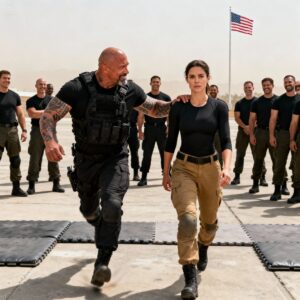
In a circle of 282 elite soldiers, two men decided to humiliate the quiet medic during a demonstration. They intended to break her spirit. Instead, in seven brutal seconds, they discovered a truth that broke them completely.
The wind that came off the Atlantic that morning had teeth. It wasn’t a breeze; it was a hard, scouring force that snapped across the open-air corridors of Naval Special Warfare Command Unit 7, carrying the briny scent of the…
End of content
No more pages to load