New Allegations Surface in Charlie Kirk Case as Eyewitness Claims FBI Suppressed Video Evidence
A high-profile investigation into the death of conservative activist Charlie Kirk has been thrown into turmoil by explosive allegations from an eyewitness who claims the Federal Bureau of Investigation (FBI) engaged in evidence suppression. The man, Ryne Simmons, asserts that he possesses video footage of the fatal shooting that challenges the official account of the incident and that federal agents subsequently pressured him to destroy this critical evidence.
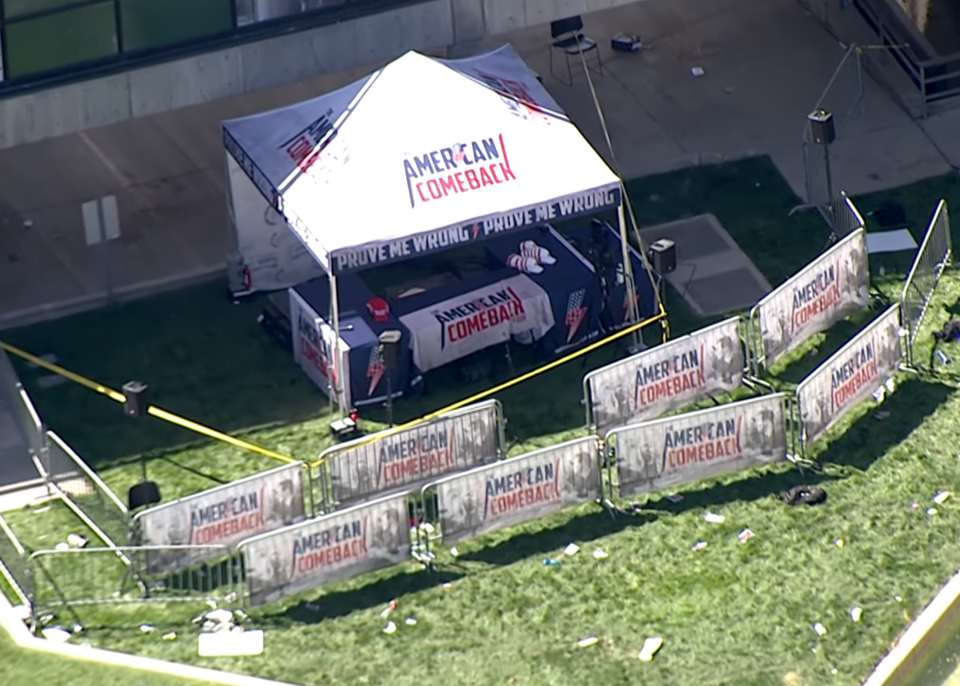
The controversy centers on events that unfolded at Utah Valley University, where Kirk was fatally shot. Simmons states that he recorded the moment of impact in high-definition. According to his public statements and accounts circulating online, this footage reveals the bullet striking Kirk from an angle inconsistent with the official conclusion that the shot originated from the front. This discrepancy alone could be enough to re-examine the entire case, but Simmons’s claims go further, painting a disturbing picture of alleged federal overreach.
An Eyewitness Account of Pressure and Vanishing Files
In the aftermath of the shooting, Simmons recounts a bewildering encounter with federal investigators. He alleges that after spending hours with FBI agents, he discovered that multiple files on his phone, including the crucial video, had become corrupted and inaccessible. He insists the footage was intact prior to his interaction with the authorities. In court transcripts and online posts, he has detailed how investigators repeatedly asked him to delete the files from his device. When he questioned the process and noted the disappearing evidence, he says the agents became evasive.
These claims have ignited a firestorm on social media and across various independent news platforms, sparking widespread debate and fueling theories about the integrity of the federal investigation. The FBI has, to date, refrained from issuing a public statement that directly confirms or denies the specific allegations made by Ryne Simmons regarding either the footage or the conduct of its agents. This silence has only intensified public scrutiny and calls for transparency.
The case, which initially seemed to be a straightforward criminal investigation, is now mired in a battle over its foundational facts. The official narrative, which pointed to a single shooter in a lone act of violence, is being directly challenged by an eyewitness who insists he has proof of a different version of events.
Scrutiny Shifts to Investigative Conduct
The death of Charlie Kirk was a national news story, prompting shock and extensive media coverage. The initial investigation relied on campus surveillance footage, security logs, and a collection of witness statements to build its case against a suspect who is currently in custody. However, the emergence of Simmons’s claims has fractured the seemingly clear picture that investigators first presented to the public.
Simmons’s account introduces the possibility that the investigation either overlooked or deliberately dismissed key evidence. His allegations suggest an alternate scenario where the shooter may have fired from a different position, or perhaps that other accomplices or factors were involved. While these claims remain unproven, they carry significant weight as they come from an individual who was present at the scene and maintains he recorded the event as it happened.
If the footage exists and is authenticated, the legal ramifications would be immense. It could not only lead to a complete re-evaluation of the criminal case against the suspect but also trigger a formal inquiry into the FBI’s investigative procedures. Any confirmation of an attempt to suppress evidence by a federal agency could result in severe legal and reputational consequences, undermining public trust in one of the nation’s premier law enforcement institutions.
The Viral Spread of a Contested Narrative
The rapid and widespread dissemination of Simmons’s story can be attributed to several powerful factors. First, the promise of unseen, raw footage of a pivotal moment creates a compelling draw for a public hungry for unfiltered information. Second, the allegations of a cover-up by a powerful government body tap into a growing and pre-existing skepticism of institutional authority.
Furthermore, Charlie Kirk’s status as a prominent figure in conservative circles ensures that the case elicits strong reactions from across the political spectrum, guaranteeing sustained interest. Finally, the dynamics of modern information flow, driven by social media users and independent outlets, allowed the story to bypass traditional media gatekeepers and reach a global audience with remarkable speed.
As it stands, the public is left in a state of uncertainty. The official investigation has not publicly validated Ryne Simmons’s version of events, the suspect in Kirk’s death remains in custody, and the alleged video evidence has not been released. The focus of the case has consequently shifted from solving a crime to a larger struggle over narrative control, institutional credibility, and the location of a potentially case-altering piece of footage. Observers are now watching closely for the next development, whether it be the release of the video by Simmons, an independent forensic analysis, or a full and transparent response from the FBI. The case is a stark reminder of the profound questions that arise when the institutions tasked with delivering justice are themselves called into question.
News
The gavel fell, sealing the one-armed veteran’s fate. But from the back of the courtroom, a single, mournful howl became the first shot in a new war—one fought by a dog who remembered everything they buried.
Courtroom 3 of the Hamilton District Court was a vessel of held breath. The morning light, strained through tall, dusty windows, seemed to congeal in the air, thick and heavy as the silence itself. On the polished wooden benches, people…
He went to an Alaskan cabin to silence the echoes of war. But in the heart of a blizzard, his dog sensed a secret the storm was sent to bury—a secret that would force him into one last fight.
The wilderness beyond Anchorage doesn’t ask for permission; it simply takes. It swallows roads, erases landmarks, and devours the faint, tinny signal of a cell phone until the only voice left is the wind. It was in this vast, unforgiving…
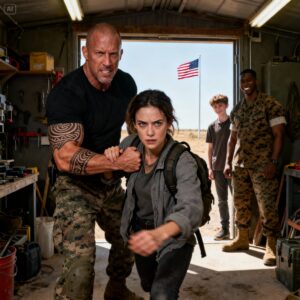
He told the quiet woman she didn’t belong on his elite sniper range. But when her backpack split open, a single photo fell out that made every decorated Marine in the room snap to a salute in shame.
The crack of a rifle shot was the only sound that made sense anymore. It split the dry California air over Marine Corps Base Camp Pendleton, a clean, percussive thunder that echoed off the brown hills and settled in your…
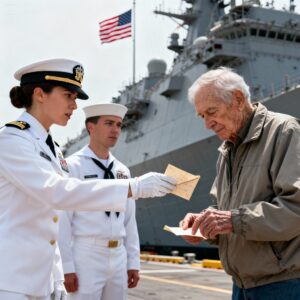
As the young officer moved to detain the 89-year-old man, she was blind to the truth. The very name of the warship she guarded was a whisper of the 70-year-old secret hidden on his faded patch.
The voice sliced through the humid air of the naval pier, a sharp tool meant to carve out immediate compliance. “Sir, I’m going to have to ask you to step away from the gangway. This area is for authorized personnel…
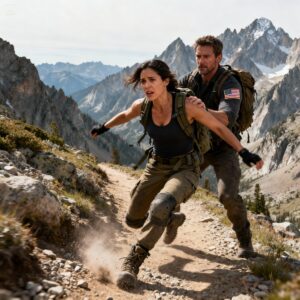
They chose a desolate mountain to be her grave, thinking a thousand-foot drop was the perfect, silent crime. But as she fell into the void, they made a fatal miscalculation about the kind of woman they just betrayed.
The mountain didn’t make a sound when it happened. There was no grand echo to mark the moment, no sympathetic rumble from the ancient stone. There was only the sharp, scattering kick of gravel, a sudden, violent silence where a…
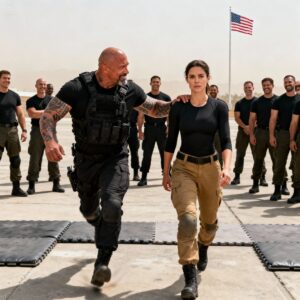
In a circle of 282 elite soldiers, two men decided to humiliate the quiet medic during a demonstration. They intended to break her spirit. Instead, in seven brutal seconds, they discovered a truth that broke them completely.
The wind that came off the Atlantic that morning had teeth. It wasn’t a breeze; it was a hard, scouring force that snapped across the open-air corridors of Naval Special Warfare Command Unit 7, carrying the briny scent of the…
End of content
No more pages to load