The $24.5 Million Handshake: Inside the Trump YouTube Settlement
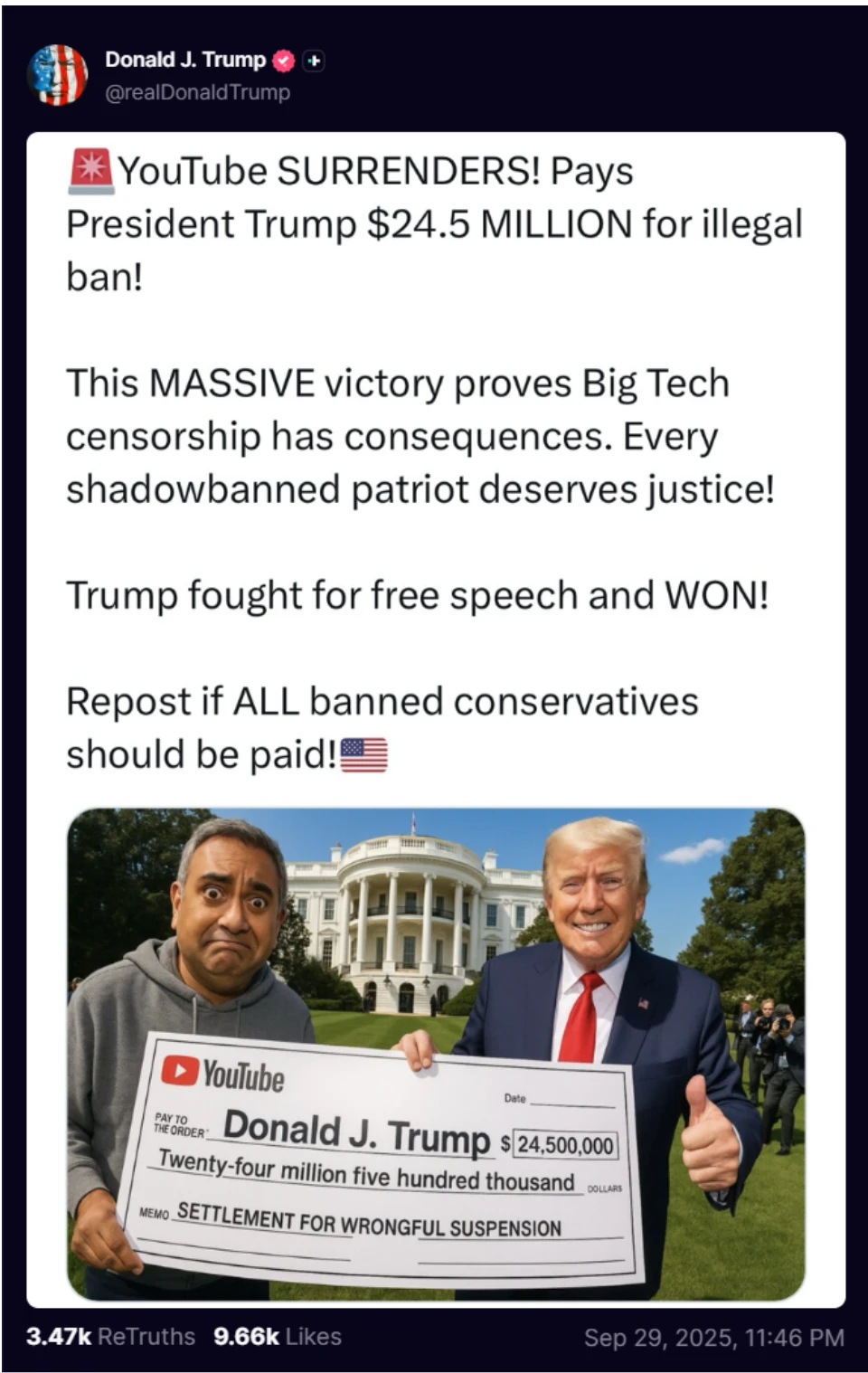
The digital battleground between Donald Trump and Big Tech has seen another dramatic turn, culminating in a moment perfectly crafted for the social media age. The former president took a victory lap on his Truth Social platform, sharing a triumphant meme that depicted a humbled YouTube executive handing him a giant check for $24.5 million. This image, which quickly circulated among his supporters, was Trump’s declaration of victory in his legal fight against the video-sharing giant. The celebration followed a court filing that revealed Alphabet, YouTube’s parent company, had agreed to a massive payout to resolve a lawsuit alleging politically motivated censorship. The core of the dispute traces back to the suspension of Trump’s YouTube channel in the wake of the January 6, 2021, attack on the U.S. Capitol, an action YouTube took citing its policy against inciting violence. For Trump and his followers, this settlement is vindication; for others, it’s a calculated business decision by a tech behemoth. This landmark Trump YouTube settlement raises more questions than it answers about the ongoing war over free speech, platform responsibility, and the immense power wielded by a handful of tech companies.

A Victory Lap in Pixels: Trump’s Viral Celebration
Late on a Monday evening, Donald Trump’s Truth Social account lit up with an image designed to convey total surrender by his opponent. The meme showed a man in a gray hoodie, presumably representing a chagrined tech executive like YouTube CEO Neal Mohan, sheepishly holding one end of an oversized novelty check. On the other end, a grinning Trump gives a confident thumbs-up. The check, made out to “Donald J. Trump” for the sum of “$24.5 million”, included a pointed memo line: “Settlement for Wrongful Suspension.”
The text layered over the image was just as explicit, framing the event as a monumental win in the culture war. “YouTube SURRENDERS! Pays President Trump $24.5 MILLION for illegal ban! This MASSIVE victory proves Big Tech censorship has consequences. Every shadowbanned patriot deserves justice!” The message continued with a call to action, “Trump fought for free speech and WON! Repost if ALL banned conservatives should be paid!” The post from Trump Truth Social was more than just an announcement; it was a rallying cry and a piece of digital propaganda meant to energize his base and cast his legal challenges as a crusade for every voice silenced by Silicon Valley.
Inside the $24.5 Million Agreement
While the meme painted a picture of absolute victory, the details of the settlement are more nuanced. The $24.5 million figure is accurate, but the agreement contains critical stipulations that tell a different story than the one circulating on social media. It was a resolution, but not an admission of guilt.
Where the Money is Going
Of the total amount, Alphabet will direct $22 million to Donald Trump. However, the former president has designated that these funds go toward two specific projects: the Trust for the National Mall and the construction of a new White House ballroom. The remaining $2.5 million from the settlement will be paid to other plaintiffs involved in the class-action lawsuit, including the American Conservative Union. This distribution ensures the funds are channeled toward public and conservative-aligned causes, further strengthening the narrative of a victory for a broader movement.
The Fine Print: What the Trump YouTube Settlement Doesn’t Say
Crucially, the court filings reveal that as part of the settlement, YouTube, Google, and their parent company Alphabet did not admit to any wrongdoing. Furthermore, they are not required to make any changes to their content moderation policies or products. This is a standard feature in many corporate legal settlements, allowing companies to mitigate the financial risk and public relations damage of a prolonged court battle without conceding that their original actions were improper. While Trump can claim a financial win, YouTube can maintain that its decision to suspend his channel was justified under its existing rules against inciting violence. This distinction lies at the heart of the free speech debate surrounding platform moderation.
The Legal Battle Over Platform Power
The lawsuit stems from the widespread deplatforming Trump faced after January 6th. Believing the major tech companies were colluding to silence him, he launched a legal offensive in July 2021, suing not only Google but also Meta (then Facebook) and Twitter. His core argument was that the suspension of his accounts represented an “unconstitutional” violation of his free-speech rights.
A Misunderstood First Amendment?
Legal experts were quick to point out a fundamental flaw in this argument: the First Amendment of the U.S. Constitution prohibits the government from restricting free speech; it does not apply to private companies. Platforms like YouTube, Facebook, and X (formerly Twitter) are private entities with their own terms of service, which users must agree to. They have the right to enforce those terms, including by suspending or banning users who violate them.
In its initial motion to dismiss the Alphabet lawsuit in December 2021, YouTube’s lawyers argued that Trump’s legal challenge “flip[ped] the First Amendment on its head.” They asserted that the lawsuit was an attempt “to try to override YouTube’s own choices about what material belongs on its service.” Despite this strong legal standing, Alphabet, like other corporations targeted by Trump, ultimately chose the path of negotiation, deciding a settlement was preferable to a drawn-out and costly legal fight.
A Pattern of Payouts: Trump vs. Corporate America
The Trump YouTube settlement is not an isolated event but the latest in a string of multi-million dollar payouts Trump has secured from major tech and media corporations. This pattern suggests a strategy of applying intense legal and public pressure until companies decide it is more expedient to pay than to fight.
In January 2025, Meta agreed to a $25 million settlement to resolve Trump’s lawsuit over his suspension from Facebook and Instagram. The following month, X, under the new ownership of Elon Musk, paid approximately $10 million. The trend extends beyond big tech censorship claims. Media companies have also settled. Paramount Global paid $16 million to settle a lawsuit concerning a “60 Minutes” segment, and Disney paid a total of $16 million to resolve a defamation suit against ABC News in December 2024. This string of financial victories has bolstered Trump’s image as a fighter who can successfully take on the world’s most powerful corporations.
A Changing Tide: Reinstatements and Shifting Policies
While the legal battles raged, the digital landscape was already shifting. One by one, the platforms that had banned Trump began to reverse their decisions. Elon Musk reinstated Trump’s account on X in November 2022. Meta followed suit, restoring his Facebook and Instagram accounts with “new guardrails in place to deter repeat offenses.”
YouTube lifted its own suspension in March 2023, explaining its decision as a balance between weighing the ongoing risks of violence and the public interest of letting voters “hear equally from major national candidates” ahead of an election. In a separate but related move, Alphabet also disclosed last week that YouTube will begin allowing creators back onto the platform who were previously banned under now-retired content policies, including those that prohibited misinformation about the 2020 U.S. election and COVID-19.
This complex and hard-fought Trump YouTube settlement ultimately leaves the central conflict unresolved. Donald Trump and his supporters can point to a $24.5 million check as undeniable proof of a victory against what they see as politically motivated big tech censorship. The celebratory meme, depicting a corporate giant brought to its knees, is a powerful symbol that resonates deeply with a base that feels marginalized by mainstream institutions. On the other hand, YouTube and its parent company, Alphabet, have managed to exit a potentially damaging lawsuit without admitting fault or altering their fundamental policies. They paid a significant sum, but it can be viewed as the cost of doing business in a hyper-polarized era. This outcome ensures that the fundamental questions at the heart of the free speech debate will persist: Where is the line between moderation and censorship? And who gets to draw it? As candidates and platforms navigate the road ahead, the aftershocks of this settlement will continue to shape the rules of online political discourse.
News

The gavel fell, sealing the one-armed veteran’s fate. But from the back of the courtroom, a single, mournful howl became the first shot in a new war—one fought by a dog who remembered everything they buried.
Courtroom 3 of the Hamilton District Court was a vessel of held breath. The morning light, strained through tall, dusty windows, seemed to congeal in the air, thick and heavy as the silence itself. On the polished wooden benches, people…

He went to an Alaskan cabin to silence the echoes of war. But in the heart of a blizzard, his dog sensed a secret the storm was sent to bury—a secret that would force him into one last fight.
The wilderness beyond Anchorage doesn’t ask for permission; it simply takes. It swallows roads, erases landmarks, and devours the faint, tinny signal of a cell phone until the only voice left is the wind. It was in this vast, unforgiving…

He told the quiet woman she didn’t belong on his elite sniper range. But when her backpack split open, a single photo fell out that made every decorated Marine in the room snap to a salute in shame.
The crack of a rifle shot was the only sound that made sense anymore. It split the dry California air over Marine Corps Base Camp Pendleton, a clean, percussive thunder that echoed off the brown hills and settled in your…

As the young officer moved to detain the 89-year-old man, she was blind to the truth. The very name of the warship she guarded was a whisper of the 70-year-old secret hidden on his faded patch.
The voice sliced through the humid air of the naval pier, a sharp tool meant to carve out immediate compliance. “Sir, I’m going to have to ask you to step away from the gangway. This area is for authorized personnel…

They chose a desolate mountain to be her grave, thinking a thousand-foot drop was the perfect, silent crime. But as she fell into the void, they made a fatal miscalculation about the kind of woman they just betrayed.
The mountain didn’t make a sound when it happened. There was no grand echo to mark the moment, no sympathetic rumble from the ancient stone. There was only the sharp, scattering kick of gravel, a sudden, violent silence where a…

In a circle of 282 elite soldiers, two men decided to humiliate the quiet medic during a demonstration. They intended to break her spirit. Instead, in seven brutal seconds, they discovered a truth that broke them completely.
The wind that came off the Atlantic that morning had teeth. It wasn’t a breeze; it was a hard, scouring force that snapped across the open-air corridors of Naval Special Warfare Command Unit 7, carrying the briny scent of the…
End of content
No more pages to load