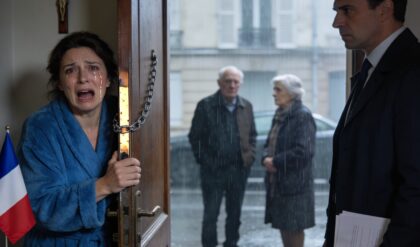
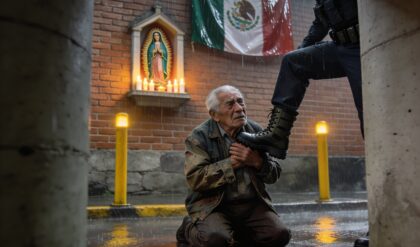
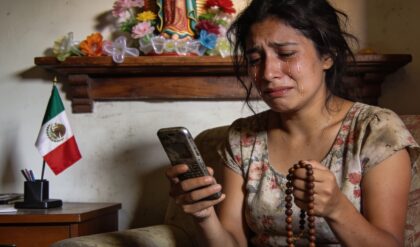
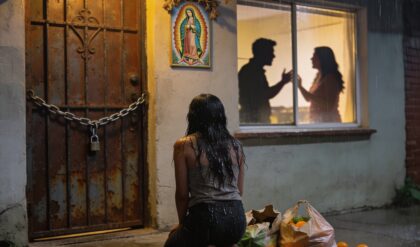
Elena woke that morning with a tightness in her chest she knew all too well. It wasn’t a physical pain; after so many years, she could distinguish that easily enough. This was the anguish that blossoms in the soul when you sense something terrible is about to happen. The house was silent, but it was a heavy silence, charged with an electric tension that made each breath feel like a struggle. Carlos still slept beside her, his breathing ragged from the heart problems that had become a constant worry.
Elena watched him for a moment, tracing the lines that time had etched into the face of the man she had loved for decades. It was a face marked by honest work, by sleepless nights when their children were sick, by smiles offered even when everything felt impossible.

“How did we get here, my love?” she murmured, gently stroking her husband’s gray hair. She rose slowly, each movement a battle against protesting joints. In the kitchen, she began preparing breakfast as she always did, though she knew it would be met with long faces and complaints about the cost of food.
“Mother, this waste again.” Patricia appeared at the kitchen door, still in her robe but wearing an expression that could chill blood. “Look how many eggs you’re frying. We don’t have money for these luxuries.”
Elena felt her heart clench. Three eggs. Just three eggs for four people. Where was the luxury in that? “Honey, I thought you’d want to eat something before heading to work.”
“I eat on the street. It’s cheaper than supporting this extravagance every day.” Patricia tossed a stack of medical bills onto the kitchen table with a sharp thud. “By the way, look what came yesterday. Another 500 pesos for Dad’s medicine. 500 pesos, Mother. That’s more than half of what I spend on myself in a month.”
Elena stared at the bills scattered across the table as if they were indictments. Every prescription, every test, every pill had become a point of contention—proof that they were an unbearable burden to their children.
“Patricia, darling. The doctor said those are essential for your father’s heart.”
“Essential?” Patricia let out a bitter laugh that sliced through the kitchen air. “You know what’s essential? That I can pay my own bills without having to support two people who no longer contribute anything to this house.”
The words struck Elena like invisible daggers. Contribute nothing. Is that what she had become in her own daughter’s eyes? A woman who had raised three children, sewn their clothes, cooked their meals, stayed up all night when they were ill, and washed other people’s laundry when money was tight. Now, she contributed nothing.
Carlos entered the kitchen, walking slowly through the morning dizziness that accompanied his blood pressure medication. His face still bore the creases from his pillow, but Elena saw in his eyes that he had heard the argument. “Good morning, daughter,” he said to Patricia, trying to smile as he always did, even when their world was crumbling.
Patricia didn’t even reply. She grabbed a slice of bread, spread a thin layer of margarine on it, and left the kitchen, chewing with a fury that seemed a protest against her parents’ very existence.
With trembling hands, Elena poured Carlos his coffee. They sat at the table in silence, eating slowly, each lost in thoughts too painful to share.
“She didn’t mean it,” Carlos murmured, but his voice lacked conviction.
“Yes, she did, my love. And she’s right.” Elena stared at her plate as if an answer might be found there. “We’ve become a burden to them.”
“Elena, don’t say that.”
“It’s the truth, Carlos. Look how we live here. Afraid to turn on an extra light, afraid to eat an extra egg, afraid to exist.”
The sound of the front door opening interrupted them. Miguel had arrived from his night shift, his suit wrinkled and his face etched with a permanent exhaustion. He walked into the kitchen, looked at his parents at the table, and sighed deeply, like someone bracing for another problem. “Dad, I need to talk to you.” His tone was formal, distant, a voice Elena no longer recognized. This wasn’t the boy she had comforted through nightmares.
“Of course, son. What is it?”
Miguel pulled out a chair and sat down heavily. “This situation can’t continue. Patricia is right when she says the medical expenses are becoming unsustainable.”
Elena felt the floor drop out from under her. Miguel had always been the most level-headed of the three, the one who tried to mediate their disputes. If even he…
“Son, we can try to cut back on the medication, talk to the doctor about cheaper options,” Carlos said, his voice cracking.
Miguel held up a hand to silence him. “It’s not just that, Dad. It’s everything. The food, the utilities, the space. This house can no longer accommodate five adults.”
Five adults. Elena chewed on those words. When had they stopped being parents and become just… adults to their own children?
“We’ve been thinking about a solution,” Miguel continued, avoiding his parents’ gaze. “A solution that would be better for everyone.”
“What kind of solution?” Elena asked, though she already knew she didn’t want the answer.
“There’s a place, a residence for seniors. It’s not one of the bad ones. It’s in a decent neighborhood. You’d have medical care, other people your age to talk to.”
“You want to put us in a home?” Carlos’s voice was a whisper.
“It’s not a home, Dad. It’s an opportunity for you to have a life more suited to your age.”
Elena felt hot tears burn her eyes. “Miguel, this house was built brick by brick by your father. Every corner holds our family’s history.”
“Mom, please, don’t make this harder. You know the situation has become impossible.”
Just then, Andrés appeared in the doorway, still in his pajamas though it was nearly noon. He lived with them but treated the house like a hotel where he was entitled to complain about the service. “Are you talking about the residence?” he asked, yawning. “It’s about time. I couldn’t sleep again last night because of Dad’s coughing, and Mom gets up every five minutes to use the bathroom.”
“It’s not a residence, Andrés,” Miguel tried to correct, but without much conviction.
“Whatever it’s called, it doesn’t matter. The important thing is to resolve this once and for all. My girlfriend doesn’t even want to come over anymore because she feels uncomfortable seeing you two everywhere.”
Andrés’s words were like precise stabs to Elena’s heart. Uncomfortable. Their mere existence made people uncomfortable.
Carlos rose slowly from the table, each movement demanding a superhuman effort. “I’m going for a walk,” he murmured. Elena knew he was going to cry where his children couldn’t see him. Carlos had always been like that, keeping his pain to himself, shielding others from his sorrow.
“Mom,” Miguel tried a softer tone. “We’re not doing this out of malice. It’s just that life has gotten very difficult for all of us.”
Elena looked at the son who had been her pride, the first to get a steady job, the one who had always brought his full paycheck home when he lived with them. Where was that responsible young man who promised to care for them when they grew old? “I understand, son. You have your lives, your commitments.”
“So you’ll agree to go to the residence?”
Elena remained silent for a long moment. Through the kitchen window, she could see Carlos in the small garden he tended with such love, despite his aching back. He was standing before the tomato plants he’d sown, his shoulders slumped under the weight of rejection. “We need to talk,” she finally said. “Let us think about it.”
“Don’t take too long.” Patricia reappeared, now dressed to go out. “I’ve already scheduled a visit for tomorrow. The sooner we resolve this, the better for everyone.”
Elena watched her three children leave the house—Miguel to sleep before his next shift, Patricia to work, Andrés to meet friends at the bar, as he did every afternoon. The house fell silent again, but now it was a different kind of silence. It was the silence of abandonment, approaching like a storm. She went out to the garden and found Carlos sitting on the small bench he had built years ago, back when their grandchildren still visited and played among the plants.
“Did you hear?” he asked without looking at her.
“I heard.”
“Decades of marriage, Elena. Three children raised with so much love.”
“I know, my love.”
“Did we fail? Were we terrible parents?”
Elena sat beside her husband and took his calloused hand. “We gave everything we had, Carlos. Everything we were.”
“And now we’re a burden.”
They sat there, hand in hand, looking at the garden that would soon no longer be theirs. The flowers Elena planted so carefully, the herbs she grew to flavor meals no one appreciated, the fruits Carlos harvested with pride—all of it would be left behind.
“Elena,” Carlos said quietly, “if we go to that place, it will be to die.”
She knew he was right. They knew others who had been put in homes by their children. Few lasted more than a year. It wasn’t the medical care; it was the broken hearts. “At least we’ll be together,” she whispered, squeezing his hand.
But deep in her chest, Elena felt something was about to shift. She didn’t know what or how. But there was a strange unease in the air, as if fate was preparing something none of them could possibly imagine. Inside Carlos’s old wallet, tucked between faded photographs of their children back when they still loved them, was a yellowed envelope he didn’t even know existed—an envelope that had arrived years ago, one Elena had put away unopened, thinking it was just junk mail from a bank.
Fate has its own designs, and sometimes, justice arrives when we least expect it, from the most unexpected places.
Weeks had passed since that conversation in the kitchen, and the atmosphere in the house had turned toxic, like poisoned air. Elena woke each morning with a knot in her stomach, as if sensing something terrible approaching with stealthy steps. Carlos could barely eat, and she knew it wasn’t just the heart medication. Their children’s behavior had changed completely. There were no more casual conversations, no good mornings or good nights. They came and went like resentful tenants who barely tolerated the presence of the landlords.
On that fateful morning, Elena was in the laundry room hanging clothes when she heard low voices coming from the living room. She immediately recognized the conspiratorial tone. It was the same one her children used as kids when they were plotting some mischief, but now, the mischief was aimed at them.
“Is everything ready?” It was Patricia’s voice, whispering as if planning a crime.
“Miguel already spoke with the people from the residence. They’re coming to get them this afternoon,” answered another voice Elena identified as Andrés’s.
Elena felt her legs tremble. This afternoon. They hadn’t even told them. The betrayal was being carried out in secret, like a premeditated murder.
“And what if they don’t want to go?” Andrés asked, and Elena could picture the sneer on her youngest son’s face.
“They’ll go,” Miguel replied with a firmness that chilled Elena’s blood. “Because they have no choice.”
“Did you explain that it’s temporary?” Patricia asked, but there was a strange hesitation in her voice that Elena couldn’t decipher.
“Of course it’s not temporary,” Andrés laughed quietly. “Do you know any old person who’s ever come back from a residence?”
Elena’s world collapsed in that instant. She leaned against the washing machine to keep from falling. They were talking about getting rid of their parents forever, like someone discarding old, useless furniture.
“We’ll tell them it’s just until they adjust,” Miguel continued. “Afterward, well, they’ll get used to it there.”
“And the house?” Patricia asked.
“We’ll finally have space to live like normal people,” Andrés answered with an excitement that sliced through Elena’s heart like a razor. “I’ve already thought about it. I can turn their room into my office. I’ve always wanted to work from home.”
Elena pressed her hands to her mouth to stifle the sob threatening to escape. The room where she and Carlos had shared decades of dreams, fears, joys, and sorrows would become an office for the son who had never held a real job in his life.
“When they get here, we’ll all be together,” Miguel instructed, like a general commanding a military operation. “It has to look like we’re doing this out of love, understand?”
“Out of love,” Patricia repeated, and Elena caught the venomous sarcasm in her daughter’s voice.
“Exactly. We’ll cry a little. Say it’s hard for us too, that we’ll visit every week.”
“Are we going to visit?” Andrés asked, and Elena heard the genuine surprise in his question.
“Obviously not,” Miguel chuckled softly. “But they don’t need to know that now.”
Elena stumbled out of the laundry room, feeling as if she’d been punched in the gut. She found Carlos in the garden, watering his tomatoes with mechanical movements, lost in thoughts she knew were as painful as her own.
“Carlos,” she whispered, grabbing his arm tightly. He turned and saw the desperation etched on her face. “What is it, my love?”
“They’re coming for us today. Today.”
Carlos dropped the hose. The water continued to run, soaking the earth around the tomato plants he would never see grow. “What do you mean?”
Elena told him everything she had overheard. Every poisoned word, every cruel plan. Carlos grew paler and paler, the color of old paper. “Without even telling us,” he murmured, his voice a wounded animal’s cry.
“Carlos, they don’t want us anymore. Truly, forever.”
They embraced right there in the middle of the garden, crying like two lost children. Decades of marriage, three children raised with unconditional love, a lifetime of work and dedication—and this was how it would all end.
An hour later, Elena was in their room packing a few clothes into an old suitcase when Patricia appeared in the doorway. “Mother, I need to talk to you.”
Elena didn’t answer. She continued folding clothes with automatic movements, as if preparing for an ordinary trip.
“Mother, listen to me.” Patricia entered the room with decisive steps. “Some people from the residence have arrived. They’ve come to get you.”
“I know.” Elena didn’t look up from the clothes.
“How do you know?”
“I heard you talking. I heard everything.”
Patricia had the decency to look ashamed for a moment. She glanced at her feet, wrung her hands, sighed deeply. But when she looked up again, her expression had hardened once more. “Then you know it’s for the best. For everyone’s good.”
“For our good, daughter, would be staying in the house we built with so much love.”
“Mother, please, don’t complicate things. The people are waiting downstairs.”
Elena finally looked at her daughter. Patricia was dressed in expensive clothes, her nails were manicured, her hair perfectly styled. She looked like an executive explaining an unavoidable layoff. “Patricia,” Elena said slowly, each word weighing a ton. “Do you remember when you were five and had pneumonia?”
“Mother…”
“Do you remember I spent two weeks without sleeping, taking care of you day and night?”
“That was a long time ago.”
“Do you remember when Miguel broke his arm and we had no money for a private doctor? I sold my wedding ring to pay for the hospital.”
Patricia looked away. “Things were different then.”
“Do you remember when Andrés lost his first job and was unemployed for six months, and we shared our food with him even though we were struggling?”
“Mother, stop it.”
“No, daughter, I won’t stop.” Elena stood up, and for the first time in months, Patricia saw strength in her mother’s posture. “Because now that it’s our turn to need you, you treat us like garbage.”
“We’re not treating anyone like garbage. We’re trying to find the best solution.”
“The best solution for whom, Patricia?”
Before Patricia could answer, Miguel appeared at the door. “Mom, the people from the residence are waiting. They have other appointments.”
Elena looked at her two children in the doorway. Miguel avoided her gaze, looking anywhere but at her. Patricia drummed her fingers on the doorframe, anxious to get it over with.
“Where’s Andrés?” Elena asked.
“He had to step out,” Miguel lied poorly. Elena knew Andrés hadn’t had the courage to even show up. The coward had fled to avoid witnessing the farewell.
“I’ll go get your father,” she said, closing the suitcase with a click that sounded like a final judgment.
Carlos was in the living room, sitting in a chair like a convict awaiting his sentence. Beside him, two uniformed women waited with the professional smiles of people trained to mask the sadness of the situation. “Mr. Carlos,” one of them said in a voice that was too sweet, too artificial. “You’re going to love our residence. It has a garden, other people your age, 24-hour medical care.”
Carlos didn’t answer, just stared at his hands as if they held the answer to this nightmare. “He’s not feeling well today,” Miguel explained to the women. “He’s a little confused because of his age.”
Elena came down the stairs and saw the scene: her husband, treated like a problem child; her children, anxious to be rid of the problem; the residence employees, pretending this was normal. “Let’s go, Carlos.” Elena held out her hand to her husband. “It seems our presence here is no longer wanted.”
“Mom, don’t talk like that,” Patricia attempted a conciliatory tone. “You know we love you.”
Elena stopped in the middle of the room and turned to her children. Miguel still avoided her eyes. Patricia feigned a sorrow she didn’t feel. Andrés remained absent, the coward he had always been.
“If you truly loved us,” Elena said, her voice cutting the air like a sharpened blade, “you never would have let it come to this.”
“If you truly loved us, you would have talked to us before scheduling this… this removal.”
“We’re talking now,” Miguel tried to argue.
“You’re communicating a decision you’ve already made. This isn’t a conversation, son. This is an eviction.”
One of the employees cleared her throat discreetly. “Excuse me for interrupting, but we really do have other appointments today.”
Elena took Carlos’s hand and squeezed it hard. He was trembling, and she knew it wasn’t just from the cold. “Alright,” she said finally. “Let’s go.”
The walk to the van was the longest of Elena’s life. Every step on the sidewalk she had swept thousands of times, every glance at the garden Carlos tended so lovingly, every breath of air in the house where they had been happy for so many years. Neighbors peeked from their windows during the argument, some with pity, others with morbid curiosity. Doña Mercedes, their 60-year-old neighbor, gave a sad wave. She knew what was happening. Everyone knew.
Miguel and Patricia walked them to the van, making an effort to look sad in front of the residence staff, but Elena saw through the cheap performance. “We’ll visit next week,” Patricia lied, placing a kiss on her mother’s cheek that burned like a hot iron.
“We’ll call tomorrow to see how you are,” Miguel added, piling another lie onto the collection.
Elena and Carlos got into the van without looking back. As the vehicle started to move, Elena saw through the rear window her two children hurrying back into the house, as if fleeing the scene of the crime they had just committed.
“Elena,” Carlos whispered, squeezing her hand. “How did we get here?”
“I don’t know, my love. I don’t know.”
The van drove down the street they knew by heart, past the bakery where they bought bread each morning, the pharmacy where they picked up medication, the park where they took their grandchildren to play when they were still welcome in their own children’s lives. Each block they left behind was a piece of their life, abandoned forever.
In Carlos’s old wallet, tucked between old documents, the yellowed envelope remained sealed. Inside, news that would change everything, but which would only be discovered when it was far too late for the children who had thrown away the purest love they would ever receive. Fate was preparing its own justice, and when it arrived, it would be relentless.
Two weeks at Villa Esperanza. Elena woke once again to the deafening chorus of fifteen elderly people coughing in unison in the communal dormitory. The smell of medicine mixed with disinfectant and urine had become part of the air she breathed, clinging to her skin like a brand of abandonment that no bath could wash away.
Carlos was in the bed next to hers, but he seemed to have shrunk by half since their arrival. His eyes, once bright even in sadness, were now as dull as fogged glass. He barely spoke, barely ate, barely moved. It was as if he were dying slowly, a little piece of him gone each day.
“Carlos,” she whispered, reaching her hand across the minimal space between their beds. “How did you sleep?”
He turned his head slowly, each movement seeming to require a superhuman effort. “I dreamed of our garden, Elena. I dreamed I was watering the tomatoes.”
Her eyes filled with tears. Two weeks, and their children hadn’t called once. Not a single call to see if they were still alive. The promise of weekly visits had evaporated like smoke, leaving only the bitter echo of well-rehearsed lies.
Nurse Beatriz, a middle-aged woman with the face of someone who had lost all patience with life, entered the dormitory, clapping her hands as if calling chickens. “Let’s go, let’s go, breakfast time! Anyone who doesn’t get up now goes hungry.”
Elena helped Carlos to his feet. He trembled like a leaf in the wind, and she knew it wasn’t just his age; it was a soul shattered into a thousand pieces. His hands, once strong and steady, could now barely hold a spoon without spilling its contents.
In the dining hall, they sat at their usual table with Doña Esperanza, who cried softly every morning, and Don Rodrigo, who kept calling out for children who never came. The table was an altar of accumulated sorrows, where each elderly resident carried their own story of abandonment.
“My daughter said she would visit yesterday,” Doña Esperanza mumbled as she stirred her oatmeal, which looked like glue. “Do you think she forgot where I am?”
Elena and Carlos exchanged a look. They knew Doña Esperanza’s daughter hadn’t forgotten. She simply no longer wanted to know about her mother, like so many other families who deposited their elders there and vanished. It was the same pattern, repeated over and over: broken promises, silent phones, empty chairs on visiting days.
“Doña Esperanza,” Elena said, taking the woman’s wrinkled hand. “We are here with you.” It was the only thing she could offer—the companionship of other broken hearts.
“Elena,” Carlos whispered, pushing his bowl of oatmeal away. “I can’t stand this place any longer.”
“I know, my love. Neither can I.” The food was bland, served without love or care. The staff treated the residents like numbers on a list, not people with histories, dreams, and dignity. Elena watched as some residents had lost all hope, sitting in wheelchairs, staring into space, waiting only for death.
“If we left, where could we go, Elena? Our children don’t want us. The house isn’t ours anymore.” Carlos fell silent, chewing on words too painful to speak. Elena saw in his eyes the same question that tormented her. How had they come to this? At what point had they become a burden to the people they loved most in the world?
Finally, he looked up, and Elena saw a determination in his eyes she hadn’t seen in weeks. “Elena, if we’re going to die anyway, let it be on the street, breathing fresh air, not in this place that reeks of death.”
A shiver ran down her spine. It wasn’t fear; it was something like hope—a desperate hope, but hope nonetheless. The idea of freedom, even if it was freedom to die, sounded better than this gilded cage. “Are you serious?”
“I’m serious. We can take our things and just leave. We’re not prisoners.”
“But Carlos, where would we go?”
“Anywhere that’s far from here. Anywhere we can die with dignity.”
That afternoon, as they walked the narrow hallways of the residence, Elena observed every detail with new eyes: the elderly, abandoned in their beds, some crying out the names of relatives who never came, others simply waiting for the end in silence. The yellowed walls, the flickering fluorescent lights, the perpetual odor of disinfectant that couldn’t quite cover other, less pleasant smells.
“See that couple?” one employee whispered to another, pointing at them discreetly. “They’ve been here two weeks, and their kids haven’t even called.”
“Typical.” The word struck Elena like a dagger. Typical. Their abandonment was so common it had become normal, expected, predictable.
That night, lying in their narrow beds, Elena and Carlos planned their escape in whispers. They had observed the staff’s routine. They knew that between five and six in the morning, only one nurse was on duty, and she always fell asleep at the reception desk.
“Tomorrow,” Carlos murmured. “Tomorrow, we will be free.”
Three days later, in the pre-dawn darkness, Elena lay awake, staring at the peeling ceiling of the dormitory. Beside her, Carlos breathed with difficulty, but she knew he wasn’t sleeping either. They had spent the last three days planning in whispers, like two prisoners plotting a breakout. Every detail had been considered: what clothes to wear, which documents to take, the best route to leave undetected.
The night nurse had dozed off in her chair at the reception desk, just as she always did around 5 a.m. It was the window of opportunity they had been waiting for. The soft snores coming from the front desk confirmed the moment had arrived.
“Now,” Carlos whispered.
They rose slowly, each movement calculated to make no sound. Elena grabbed the plastic bag where she kept her few clothes and important documents. Carlos put on his worn coat, his only protection against the early morning chill. His hands trembled as he dressed, not just from the cold, but from the thrill of reclaiming his freedom.
They tiptoed down the hallway that smelled of despair and abandonment. Each step was a declaration of independence, each breath an act of rebellion against a system that had reduced them to numbers in a file. They passed the reception desk where the nurse snored softly, her head tilted back in the chair, completely oblivious to the escape unfolding just feet away.
The main door was locked, but Carlos knew the way. For days, he had watched how the employees opened it in the morning, memorizing every motion. He turned the key slowly, the metal screeching like a muffled cry that threatened to wake the entire residence.
The pre-dawn air hit them like an icy slap, but it was the purest air they had breathed in weeks. Elena gripped Carlos’s hand tightly, as if he might disappear if she let go. For the first time in a long time, there was no smell of disinfectant, no cries of other residents, no pitying glances from tired employees.
“Now where?” she asked, looking at the empty street under the yellow glow of the streetlights.
“Away, Elena,” Carlos answered, his voice firmer than it had been in weeks. “As far away as possible.”
They began to walk along the cracked sidewalk, two figures stooped by age and suffering, carrying what was left of their lives in an old plastic bag. But there was something different in their steps now: purpose, determination, a reclaimed dignity. They were fugitives, but they were free.
The streets were deserted at that hour, save for a few early workers heading to their jobs, oblivious to the drama unfolding on the sidewalks. Elena thought how ironic it was. All those people had families waiting for them at home, while they were walking toward nothing, fleeing from the very people who should have loved them most.
Six hours later, on the highway, the sun was rising as they reached the thoroughfare that cut across the city. Elena felt her legs trembling with exhaustion, but she kept walking because she knew stopping meant surrender, and she wasn’t ready to give up yet. Each step took her further from that prison. Each meter covered was a small but significant victory.
Carlos stopped every few minutes, pressing a hand to his chest and breathing heavily. His heart was crying for help, but he pretended he was fine to avoid worrying Elena further. The medication he’d left behind at the residence was beginning to take its toll, but he preferred the physical pain to the emotional agony of abandonment.
“Let’s rest a little,” she said when she saw he was growing too pale.
They sat on the dry grass at the edge of the road. The traffic was heavy now, people rushing to work, to their organized lives, to families that loved them. Elena watched each car pass, wondering if those people valued what they had, if they knew how fortunate they were to have a place to call home.
“Elena,” Carlos said in a weak voice, “do you regret leaving?”
“Never.” She grasped his hand tightly. “I’d rather die free than live as a prisoner in that place.”
A truck blared its horn as it passed, kicking up a cloud of dust that made them cough. Elena wiped her watering eyes and saw that Carlos’s breathing was even more labored. His color had changed, taking on a grayish pallor she knew all too well. “My love, are you feeling unwell?”
“Just tired,” he lied. But Elena saw the cold sweat beading on his forehead, despite the cool morning.
They continued walking, each step a battle against exhaustion and despair. The road stretched endlessly before them, and Elena began to wonder if they had made the right choice. But when she looked back and saw the city shrinking in the distance, she knew she would a thousand times rather be here—free and lost—than imprisoned in that house of horrors. The sun climbed relentlessly, turning the asphalt into a searing griddle. They had no water, no food, no plan beyond walking until their strength gave out. But they had something they had lost in those two weeks of confinement: dignity.
By midday, under the scorching sun, Carlos stopped in the middle of the road. “Elena, I can’t go on.” His legs were trembling, his face as white as paper.
The noon sun beat down on them without mercy. They had no water, no food, and nowhere to go. They had walked for hours, but their elderly bodies could no longer handle the strain.
“Carlos, just hold on a little longer. There must be a place nearby where we can rest.” But she knew she was lying. There was nothing here. Just hot asphalt, dry grass, and infinite loneliness. They were in the middle of nowhere, two old people abandoned by their own family, walking toward nothing. The reality of their situation began to hit her with full force. They were two fugitives without a destination, without resources, without any real hope of survival.
Carlos leaned on her, the full weight of his years pressing down on Elena’s frail shoulders. She felt her own legs weaken but forced herself to support the man she had loved for decades. It was like holding a lifetime of memories, of shared joys, of sorrows comforted together.
“Elena, I think I’m going to faint.”
“No, Carlos, no, not now. We’re going to make it.” But even as she spoke, she could feel him growing heavier in her arms. His heart was failing. She could see it in his lips, which were starting to turn blue, in his ragged breathing, in the cold sweat that covered his forehead.
“Elena, I love you.”
“I love you too, my love. I’ve always loved you.”
They embraced right there in the middle of the desolate road, as the unforgiving sun punished their fragile bodies. Elena knew this could be the last embrace of their lives. Decades of marriage, of shared laughter and tears, of dreams built together, all converged in that moment under the merciless sun of a lost highway.
“My God,” she whispered, looking up at the empty blue sky. “If you have any mercy, please send someone to help us.”
As if her prayer had been heard, the roar of an engine approached. Elena lifted her head and saw an old car coming down the road. It was nothing fancy—a dented white vehicle, its paint peeling with age—but in that moment, it looked like the most beautiful chariot in the world.
The car slowed as the driver saw the two elderly people clinging to each other on the roadside. Elena waved her hand desperately, like a castaway signaling a rescue ship.
The car stopped. A young man of about thirty, dressed in simple work clothes, got out. He had kind eyes, the kind of person who still believed it was worthwhile to help a stranger. There was something in his expression that reminded Elena of values she thought the world had lost.
“Good heavens, what are you two doing out here all alone?” exclaimed Sebastián, running toward them, immediately seeing that Carlos was in a very bad way.
“Please,” Elena begged, her voice cracking. “My husband has a bad heart. He needs help.”
Sebastián didn’t hesitate for a second. “Come on, I’ll take you to the hospital right now.” He helped Carlos into the car, Elena getting in on the other side, clutching her husband’s hand as if it were a lifeline. Sebastián sped toward the nearest city, glancing in the rearview mirror to check on the old man. He didn’t ask unnecessary questions or demand explanations; he simply acted with an instinctive kindness Elena had almost forgotten existed.
“How did you end up out here?” he asked as he drove.
Elena didn’t know where to begin. How could she explain that they had been abandoned by their own children? How could she tell him they had fled a residence because they preferred to die free? “It’s a long story,” she murmured.
“You don’t have to tell it now,” Sebastián said gently. “The important thing is to get to the hospital.”
During the drive, Elena watched the young man who had stopped to save them. He had the calloused hands of someone who worked hard, simple but clean clothes, and most importantly, a kindness in his eyes she had nearly forgotten existed in the world. He was living proof that not all of humanity had lost its capacity to love a neighbor.
“What’s your name, son?” she asked.
“Sebastián. And you?”
“I’m Elena. He’s Carlos.”
“It’s a pleasure to meet you. And don’t worry, everything is going to be alright.”
Elena didn’t know why, but she believed him. For the first time in months, she felt that perhaps fate hadn’t forgotten them completely. In Carlos’s old wallet, the yellowed envelope remained tucked away. Inside it, an inheritance that would change everything. But in that moment, the only inheritance that mattered was the kindness of a stranger who chose to stop for two lost old people on the side of the road. Sometimes, angels drive old cars.
A week at San Rafael Hospital. Carlos opened his eyes slowly, blinking against the white light of the hospital room. For a moment, he didn’t know where he was. The smell of disinfectant made him fear he was back at the residence. But when he turned his head, he saw Elena sitting in a chair beside his bed, holding his hand tightly.
“You came back to me,” she whispered, and Carlos saw her eyes were red from crying.
“Elena, how long?”
“A whole week, my love. You had a massive heart attack. The doctors said it was a close call.”
Carlos tried to remember the highway, the scorching sun, the feeling that he was going to die right there, abandoned like an animal. And then an angel—a young man with kindness in his eyes who had saved them. “Where is he? The young man who brought us here?”
“Sebastián.” Elena smiled for the first time in days. “He’s right outside. He hasn’t left for a minute since we arrived. He’s been sleeping in the hallway every night.”
Carlos felt his eyes fill with tears. A stranger had done for them what their own children had not: cared whether they lived or died. The door opened softly, and Sebastián entered with a steaming cup of coffee. His eyes lit up when he saw Carlos awake. “Don Carlos! Thank God.” He set the coffee on a small table and approached the bed. “How are you feeling?”
“Alive,” Carlos answered, his voice hoarse but grateful. “Thanks to you.”
“Oh, please. I just did what anyone would do.”
Elena and Carlos looked at each other. No, it wasn’t what anyone would do. Their own children hadn’t done it. “Sebastián,” Elena said, her voice thick with emotion, “why did you stop? Why did you help us?”
The young man blushed, shuffled his feet, and looked at the floor. “Well, Doña Elena, you reminded me of my grandparents. They passed away when I was little, and I always thought that if I ever saw some grandparents who needed help, I couldn’t just…” He couldn’t finish the sentence.
Carlos extended a trembling hand, and Sebastián took it gently, as if holding something precious and fragile. “Son, what did we do to deserve your kindness?”
“You didn’t do anything. Sometimes you just find the right people at the right time.”
Three days later, Dr. Silva, a middle-aged man who had seen much suffering, handed Elena the discharge papers with a worried expression. “Doña Elena, I need to be frank. Your husband had a very serious heart attack. His heart can’t take any more strong emotions or physical exertion.”
Elena felt her chest tighten. Doctor, we have nowhere to go.
The doctor hesitated, looking from the papers to her. “Your family… do they know you’re here?”
“They no longer want to know about us, Doctor.”
Dr. Silva sighed deeply. He had seen many cases like this—elderly people abandoned by their children, dumped in hospitals like disposable trash. “Look, Doña Elena, I can’t officially recommend this, but,” he lowered his voice, “I have a social worker here who knows a family that takes in homeless seniors. Good-hearted people.”
“Do good people still exist in this world?”
“They do. And you’ve already met one of them.” He gestured toward Sebastián, who was in the hallway talking to a blonde woman in her forties. Elena looked through the room’s window and saw Sebastián gesturing animatedly, explaining something important. The woman listened intently, nodding.
“Who is she?”
“That’s Lucía, his wife. Sebastián called her yesterday, and, well… it’s better if he tells you himself.”
An hour later, Sebastián approached Elena in the hallway with a shy smile, accompanied by the blonde woman. “Doña Elena, this is my wife, Lucía.”
Lucía stepped forward and, to Elena’s surprise, hugged her as if they were old friends. “Elena, Sebastián told me everything about you. About what your children did, about how you escaped from that horrible place.”
Elena didn’t know what to say. Lucía spoke with a genuine indignation, as if their pain was her own.
“Lucía and I have talked a lot these past few days,” Sebastián continued, holding his wife’s hand. “And we’d like to make you a proposal.”
Elena’s heart raced. Were they going to offer her money? A job? She didn’t want to be treated like a charity case. “What kind of proposal?”
Lucía knelt to be at eye level with Elena, who was sitting in a wheelchair. “Elena, Sebastián and I have been married for ten years, and we were never able to have children. We always dreamed of having a big family, with grandparents, aunts, uncles, cousins.”
“And when I saw you on that highway,” Sebastián finished, “it was as if God had put the grandparents we never had in our path.”
Tears streamed down Elena’s face. “What are you saying?”
“We’re saying we want you to come live with us,” Lucía said firmly. “As family. As the parents we never had.”
“But you don’t know us.”
“We know enough,” Sebastián interrupted. “We know you are good people who were treated badly by your own family. And we know you deserve love and care.”
Elena sobbed so hard she couldn’t speak. It was too good to be true. After so much suffering, so much rejection, two angels appeared, offering not charity, but true love. “But what if we’re a burden? What if we get sick?”
Lucía held her hands firmly. “When you truly love someone, it isn’t a burden. It’s care.”
Two weeks later, Elena woke up in the small but cozy room that Sebastián and Lucía had prepared especially for them. The floral curtains let in a soft light, and she could hear Carlos breathing peacefully in the bed next to hers. For the first time in months, she had slept through the night without nightmares.
In the kitchen, Lucía was preparing breakfast, humming a cheerful tune. When she saw Elena, her face lit up. “Good morning, Mama Elena.”
Mama Elena. The two sweetest words she had heard in a long, long time. “Good morning, daughter. How did you sleep?”
“I slept well. And Papa Carlos?”
Elena smiled. Papa Carlos. Carlos had cried the first time Lucía called him that. “He’s still sleeping. The doctor said he needs a lot of rest.”
“Of course. And he’ll have all the time in the world to rest here.”
Sebastián entered the kitchen, dressed for work, and kissed Elena on the cheek as he did every morning. “Good morning, Mama. What’s for lunch today?”
“I was thinking of making that roast chicken you both liked so much yesterday.”
“Perfect. But if you’re feeling tired, you can let Lucía cook.”
“Nonsense, son. Cooking for you is a joy.” And it was true. After years of being treated like an inconvenience in her own kitchen, Elena had rediscovered the pleasure of cooking for people who were grateful, who praised her food, who asked for seconds.
Sebastián left for work with a smile, and Lucía sat down at the table with Elena for breakfast. “Elena, I need to tell you something.” Lucía’s serious tone worried her.
“What is it, daughter?”
“Yesterday, while you were resting, a mailman came by. He said he’d been looking for a Carlos Mendoza for weeks.”
Elena frowned. “Carlos Mendoza, that’s my husband’s full name.”
“I know. And he brought this.” Lucía took a thick, official-looking envelope from the top of the refrigerator. “He said it’s urgent.”
Elena took the envelope with trembling hands. It was heavy, official, bearing the seal of a law firm. “What could it be?”
“I don’t know, Mama, but I think we should wake Papa Carlos to open it together.”
Half an hour later, Carlos was sitting on the comfortable sofa, still in his pajamas, holding the envelope as if it were a bomb about to explode. Elena was beside him, with Lucía and Sebastián on chairs opposite, all wearing anxious expressions.
“Open it, Carlos,” Elena whispered. “Whatever it is, we’ll face it together.”
Carlos tore the envelope open slowly. Inside were several documents, all with official stamps and notary seals. His eyes scanned the lines, trying to decipher the complicated legal language. Suddenly, he turned as white as a sheet. “Elena… Elena, this can’t be right.”
“What is it? What does it say?”
Carlos shook his head, reread the document, and shook his head again. “It’s saying that… that my grandfather, old Esteban… he…”
“What about your grandfather, Carlos?”
“He… he owned properties. A lot of properties.”
“And now?”
“And now… they’re mine.”
Lucía and Sebastián exchanged a look. “What kind of properties, Papa?”
Carlos looked at the document one more time, as if the words might magically change. “Ten buildings in the city center, all rented out. And,” his voice failed him, “and a sum of money that’s been earning interest for twenty years.”
“How much money, Carlos?” Elena asked, her voice trembling.
Carlos turned the page, searching for the number that would change their lives forever. “15 million pesos, Elena. 15 million.”
The silence that followed was deafening. Lucía brought a hand to her mouth. Sebastián leaned back in his chair as if he’d been struck.
“15 million,” Elena repeated, unable to process the information.
“It says here they’ve been trying to locate me for years, that they sent letters to our old address.” Carlos paused, understanding dawning on him. “But… the letters must have arrived when we were already living with the kids. They must have intercepted everything.”
A dull rage began to smolder in Elena’s chest. Her children knew. They knew about the inheritance, and still, they had abandoned them to die.
“Carlos…” Elena looked at him, her eyes filled with tears. “We’re rich.”
After a lifetime of poverty, of humiliation, of contempt, they were rich. But instead of joy, Elena felt a profound sadness. What good was money now, when the children she loved most in the world had rejected her?
Lucía got up and hugged them both. “Papa, Mama, this is wonderful.”
“Yes,” Elena murmured, “but it came too late.”
Sebastián came over and placed a hand on Carlos’s shoulder. “It didn’t come too late, Papa. It came at exactly the right time. The time when you finally found a family that truly loves you.”
Elena looked at the two young people who had opened their hearts and their home to two abandoned elders. Sebastián was right. The money hadn’t come too late. It had arrived precisely when they needed it, when they finally had a real family to share their happiness with. But she knew that when her children found out about the inheritance, they would come crawling back, crying crocodile tears, begging for a forgiveness they didn’t feel. And this time, Elena knew exactly what she would say. A plan was beginning to form in her heart—a plan that would teach her ungrateful children the true value of love and reward those who truly deserved it. Divine justice is sometimes slow, but it always arrives, and when it does, it is perfect.
A month after the discovery of the inheritance, Elena was hanging laundry in the backyard when an icy chill ran down her spine. It was a sunny Saturday morning. Lucía was at the market, and Sebastián was fixing a leaky faucet. Everything was perfectly normal, but there was something in the air—an electric tension that made the hairs on her arms stand on end, like the feeling before a storm.
Carlos appeared at the back door, leaning on the cane his doctor had recommended. His face, which had regained its color and life in recent weeks, was now ashen. “Elena,” he whispered, his voice trembling. “There’s a black car that’s been parked on our street for twenty minutes.”
She dropped the damp clothes into the basket and ran inside, her heart pounding. Through the living room window, she could see the side of a new Mercedes, gleaming under the morning sun like a silent threat. “They’ve found us,” she murmured, the words a death sentence. “How? How did they manage?”
Elena didn’t answer because she knew the answer. Money. Money buys everything, even the location of two old people who just wanted to live in peace.
Fifteen minutes of silent torture later, the doors of the Mercedes opened in unison, as if they’d rehearsed the moment. Miguel got out of the driver’s side, adjusting his expensive tie with calculated movements. Patricia emerged from the passenger seat like a queen from her carriage, her high heels clacking on the pavement like hammers on a coffin. Andrés got out last, yawning and stretching as if waking before noon was an unbearable ordeal. The three of them walked toward the small house’s front door with the arrogance of those who know they hold power.
Elena watched through the curtain, her stomach twisting into a tight knot. Miguel had gained weight, a sign he was eating well. Patricia wore diamond earrings that sparkled so brightly they hurt the eyes. Andrés wore a shirt that cost more than a month’s electricity bill. “They’re living well,” she muttered bitterly. “Very well, with the money they saved by getting rid of us.”
The doorbell rang, a simple, common sound that on this morning tolled like a funeral bell.
Carlos stood up from the armchair where he’d been reading the paper, each movement seeming to require superhuman courage. “I’ll get it.”
“No.” Elena grabbed her husband’s arm. “We’ll open it together. They don’t deserve for one of us to face this humiliation alone.”
When Elena opened the door, her first thought was how strange her children looked. Not physically, but something in their eyes, their posture, made her feel as if she were facing three malicious strangers.
“Mother.” Miguel spoke first, but the word sounded mechanical, rehearsed. “Father.” Patricia nodded but made no move to hug them. Andrés just looked around with the expression of someone assessing a property for purchase.
“What do you want here?” Elena asked, surprised by the firmness in her own voice.
“What kind of question is that, Mother?” Miguel forced a smile. “We came to see how you are. We were worried.”
“Worried?” Carlos let out a bitter laugh that cut through the morning air. “Worried. After two months of absolute silence.”
Patricia stepped forward, trying to take control. “Father, we explained at the time that it was for your own good. The residence was the best place.”
“The ‘best place’ was hell on earth!” Carlos exploded, his voice echoing down the quiet street. “Did you know that when you abandoned us there?”
Neighbors began to peek out of their windows. Doña Carmen, the elderly woman next door, discreetly pulled back her curtain.
“Father, please, don’t talk like that,” Miguel said, glancing around nervously. “Let’s talk inside, like civilized people.”
“Oh, civilized people,” Elena said, a cold rage rising in her chest. “Civilized people don’t abandon their parents on a deserted highway.”
Andrés finally spoke, his tone impatient. “Look, can you just stop all this drama? We came here to resolve this situation once and for all.”
“What situation?” Carlos asked, though he already knew the answer.
Patricia and Miguel exchanged a quick glance. “The inheritance, Father,” Miguel said slowly, as if explaining math to a child. “Grandfather Esteban’s inheritance.”
The silence that followed was so profound Elena could hear her own heart thumping. “How… how do you know about that?”
“We’ve always known, Mother,” Patricia answered with a casualness that chilled Elena’s blood. “The letters from the law firm have been arriving at the house for years. We kept them all, waiting for the right moment.”
“The right moment for what?”
“To resolve the family’s situation once and for all,” Andrés replied, pulling out his phone.
Twenty minutes later, they were in the living room. Elena had let them in, not out of love, but because she knew this confrontation was inevitable. The three children settled onto the sofa as if they owned the place. Miguel crossed his legs, Patricia reapplied her blood-red lipstick, and Andrés scrolled through his phone, clearly bored. Elena and Carlos sat opposite them, maintaining a careful distance.
“So,” Miguel began, adopting an executive tone, “let’s get straight to the point. You inherited 15 million pesos and ten properties. That’s family money.”
“Our money,” Elena corrected, her voice sharp as glass. “An inheritance left to Carlos, not to you.”
“Mother, please.” Patricia sighed dramatically. “You’re in your seventies. What do you need so much money for?”
“What do we need it for?” Carlos struggled to his feet, leaning on his cane. “To live with dignity. To never again be treated like garbage.”
“No one treated you like garbage,” Andrés said without looking up from his phone. “We found the best solution for a difficult situation.”
“Solution?” Elena laughed, but there was no humor in it. “You threw us in a house of horrors and vanished from the face of the earth.”
“It was a decent place,” Patricia argued. “It had nurses, food, a roof.”
“It had the stench of death in every corner!” Carlos shouted, his hands trembling with rage. “It had old people crying for children who never visited. It had people dying of sadness!”
Miguel leaned forward, adopting a more aggressive posture. “Father, you’re being dramatic. The important thing is that now we have a solution for all our problems.”
“What solution?”
“You’ll come back home with us,” Patricia announced as if it were the most natural thing in the world. “We’ll take care of you, and the inheritance money stays in the family, where it always should have been.”
Elena felt the world spin. The audacity, the complete lack of shame, was staggering. “Home?” she whispered. “What home? The one where we were treated like obstacles? The one where we couldn’t breathe without bothering someone?”
“Mother, things were different then,” Miguel tried, his conciliatory tone ringing false. “Now that we know about the inheritance, everything can be different.”
“Ah, now everything can be different.” Elena stood up too. “Now that there’s money involved, you remember you have parents.”
At that moment, the front door opened, and Lucía walked in with groceries. She stopped, instantly sensing the tension. She saw Elena and Carlos, their faces etched with pain, and the three elegant strangers on her sofa. “Hello,” she said simply, but her voice was laced with ice.
The three children turned toward her like hawks spotting prey. Patricia sized her up from head to toe. “And you are?” she asked with an arrogance that made Lucía grip the bag handles tighter.
“I’m Lucía. Their daughter.”
The silence that followed was heavy enough to feel solid. Andrés finally looked up from his phone. Miguel straightened in his seat. Patricia arched a perfectly drawn eyebrow. “Daughter?” Andrés snickered. “How interesting. Our parents have been busy with adoptions.”
Lucía set the bags down with controlled movements, but Elena could see she was boiling with rage. “You don’t need an adoption when you earn parents who truly love you,” Lucía replied, looking Andrés straight in the eye. “And when you return that love instead of throwing them away like trash.”
The phrase cut the air like a whip. Miguel shot up from the sofa, his face red. “Listen here, miss. You know nothing about our family.”
“I know enough,” Lucía shot back, not yielding an inch. “I know I found them abandoned, sick, and heartbroken by the cruelty of their own children. I know they cried every night wondering what they did wrong to deserve so much contempt.”
Patricia tried a different tactic, forcing a maternal tone. “Lucía, is it? Look, Lucía, we appreciate you taking care of our parents during this difficult time. We can even compensate you financially for your trouble.”
“Trouble?” Lucía laughed, a humorless sound. “It was no trouble. I gained the wonderful parents I always dreamed of having.”
“How touching,” Andrés muttered, returning to his phone. “But playtime is over. Our parents are coming home with us.”
“Over my dead body.” Lucía stepped toward the sofa like a lioness protecting her cubs. “The only game here is you three pretending to be children after abandoning your parents to die on a highway.”
Elena watched it all unfold as if in a surreal film. On one side, three people from her own body whom she had loved unconditionally for decades. On the other, a young woman who had chosen to love them when they needed it most. She realized with painful clarity who truly deserved to be called family.
“Enough!” she said, her voice cutting through the argument. Everyone turned to her. Elena took a deep breath, looking at each of her children in turn. She saw Miguel’s corporate arrogance, Patricia’s calculated coldness, Andrés’s lazy disdain, and she felt a strange peace settle over her heart. She finally knew what she had to do.
“Do you want to know our decision?” she asked, her voice as firm as stone.
Miguel straightened up, confident money would speak louder than resentment. Patricia crossed her legs elegantly, already imagining how she would spend the inheritance. Andrés didn’t even look up.
“Our decision,” Elena continued, each word heavy with meaning, “is that you will leave our house now.”
“And never come back,” Carlos added, his voice stronger than it had been in months. Divine justice had begun its work, and this time, it would be implacable.
A spring morning, while Elena was watering the flowers Carlos could no longer tend to, a police car pulled up in front of the house. Her heart leaped, but this time it wasn’t fear—it was a premonition. A young officer got out and approached her. “Doña Elena Mendoza?”
“Yes, that’s me.”
“I’m Officer Ramírez. I need to speak with you about an investigation. It concerns a complaint of elder abandonment filed a few weeks ago.”
Elena felt the world stand still. Someone had filed the complaint she had never dared to make. “A complaint?”
“Yes, ma’am.”
After a few minutes of desperate pleading, Miguel stood up, his face red with indignation and panic. “Father, Mother, you can’t do this. That money belongs to the family. It’s our right.”
“Right?” Elena let out a laugh that sliced the air like a razor. “You lost any and all rights the moment you threw us away like trash.”
Patricia tried one last gambit, forcing tears that didn’t convince even herself. “Mother, please. We made a mistake. We admit it. But now we want to fix everything. We miss having you at home so much.”
Elena watched her daughter’s pathetic performance—the fake tears, the calculated gestures, the empty words. For decades, she had dried this woman’s real tears, soothed her real fears. Now she saw a stranger feigning emotions she did not feel.
“Fix things?” Lucía stepped forward, her fists clenched. “Or secure your access to the inheritance?”
Andrés exploded. “Listen here, you meddler! That money is ours by bloodright. You are nothing to them!”
“We are everything to them.” Sebastián appeared in the doorway, still in his work uniform but radiating an authority that made the three siblings instinctively recoil. “We are the family they chose when their blood family abandoned them.”
Miguel tried to intimidate him. “You have no legal right to our parents. We can take this to court.”
“You can?” Sebastián smiled, a humorless, chilling expression. “And you can explain to the judge how you abandoned two elderly people on a highway, how you forced them into a house of horrors, how you never visited, never called, and never cared if they were alive or dead.”
The threat hung in the air like a gunshot. The three children looked at each other, realizing they had lost.
“This isn’t over!” Patricia shrieked as she stalked toward the Mercedes. “You’ll regret this!”
“We already have regrets,” Elena called out from the porch, her voice calm. “We regret raising three heartless children.”
Patricia spun around one last time, her face contorted with pure hatred. “When you die, that money will be ours anyway, by law!”
“If you’re so sure of that,” Carlos said, leaning on Lucía and Sebastián as if they were his human crutches, “why don’t you just wait? Patiently.”
Miguel stormed into the car and peeled away, tires screeching. The black Mercedes vanished around the corner. Doña Carmen, the elderly neighbor, approached the gate. “Elena, my dear,” she said softly. “You did the right thing. I’ve seen many families like yours. The children only come back when they smell money. Those young people caring for you,” she said, gesturing to Sebastián and Lucía, “they are true family. The heart knows genuine love.”
The adrenaline left Elena’s body, leaving her exhausted. “It’s over,” she whispered.
“Yes, Mama Elena.” Lucía hugged her tightly. “And you were as brave as a lioness.”
A week later, at the office of Dr. Herrera, their lawyer, everything was settled. “The inheritance is officially transferred to you,” he explained. “As for your children, they have no legal claim to it while you are alive. And afterward,” Dr. Herrera smiled, “well, that will depend on the will you write.”
Elena and Carlos looked at each other. They knew exactly what they wanted to do. “Doctor,” Elena said firmly, “we’d like to draw up our will today.”
Two years later, Sebastián and Lucía’s simple house had transformed. With part of the inheritance, they had expanded it into a beautiful home, not just for Elena and Carlos, but for other abandoned elders. Doña Esperanza from Villa Esperanza, Don Rodrigo who they found sleeping in a park, Doña Carmen from next door—they had all found a family. The walls were covered with photos. The community was a testament to love and second chances.
“Grandma Elena!” a child’s voice called from the garden. Elena smiled. It was Sofía, the three-year-old daughter Lucía and Sebastián had, a gift she never expected.
Carlos came into the kitchen, looking healthier than he had in years. “A letter arrived, Elena.” She recognized Miguel’s handwriting. It was the fifth one in two years. The others she had burned unopened. “What do you want to do with this one?” Carlos asked.
Elena took the envelope, looked at it for a moment, and then dropped it straight into the trash. “The same thing they did with us,” she replied.
That afternoon, sitting on the porch surrounded by people who truly loved her, Elena watched the sunset paint the sky gold. Carlos held her hand. Lucía and Sebastián played with Sofía in the garden. This was what a family should be. Not blood, not obligation, but love, care, and choice. Elena closed her eyes and thanked God for the hardest and most valuable lesson of her life. Sometimes you have to lose the family you have to find the family you deserve.
But fate still had one more card to play. That spring morning when Officer Ramírez arrived, he explained the anonymous complaint. “It alleges you and your husband were abandoned by your children, interned against your will, and left on a highway. Is this true?”
Elena looked at her home, at her new, true family. She saw the light in the eyes of the other residents, the purpose in their days. “Officer,” she said, a smile gracing her lips for the first time in years, “it’s true we were abandoned. But it was the best thing that could have ever happened to us.”
The officer was confused. “I don’t understand, ma’am.”
“You see, Officer, when we were abandoned, we found something we had lost a long time ago: a family that truly loves us.”
“But ma’am, elder abandonment is a serious crime. Your children could face criminal charges.”
Elena considered his words. Her children, who had treated her like trash, intercepted her mail, lied, and manipulated, would finally face the consequences. “Officer,” she said at last, “I think it’s time my children learned that actions have consequences.”
At the station, Elena gave her full testimony. The story was corroborated by staff from the residence, doctors from the hospital, and neighbors. The lawyers confirmed that multiple letters regarding the inheritance had been sent to her old address over the years. Fraud was added to the charge of abandonment. Weeks later, the headlines broke: Three Siblings Accused of Elder Abuse and Fraud. Elena felt no satisfaction, only a deep sadness for the children she had lost long ago.
The legal process took eight long months. In the end, Miguel, Patricia, and Andrés were sentenced to three years of probation, mandatory community service in nursing homes, and were legally barred from contacting their parents. They also had to repay all the money they had spent.
That night at dinner, Carlos took her hand. “Elena, I have something to tell you.” The table fell silent. “My heart isn’t responding to the medication anymore. The doctor says I don’t have much time.”
It was a different kind of silence—not of despair, but of love preparing for farewell. “How long?” Elena whispered.
“Weeks, maybe days. But I want you to know,” Carlos said, his voice steady, “these last few years have been the happiest of my life. I found a family that loves me. I watched a beautiful granddaughter grow. I helped build a home filled with love. I’m not afraid.”
Three weeks later, Carlos passed away peacefully in his sleep, in Elena’s arms, surrounded by everyone who truly loved him. The small church at his funeral was packed. Miguel, Patricia, and Andrés stood at a distance, as required by law—three solitary figures who had chosen money over love and now had neither.
A week after, Dr. Herrera read the final will. The estate was divided: a large portion went to establishing the Carlos and Elena Foundation to support abandoned elders; Sebastián and Lucía received a significant sum in gratitude; and to Miguel, Patricia, and Andrés, Carlos left a symbolic one peso each, along with a letter.
To the children who abandoned me, I leave you the same thing you gave me when I needed you most: Nothing. May you learn that true love is not bought or inherited. It is earned.
Three years later, Elena woke in her cozy room, now shared with her best friend, Doña Esperanza. Through the window, she saw a beautiful sight. Sofía, now six, played in the garden with two new siblings, Carlitos and Elena María, named for their adoptive grandparents. The foundation was thriving, with five homes now operating across the country.
That morning, Patricia arrived. She was a widow now, raising two children alone. She had come not to ask for anything, but to apologize. “I understand now, Mother,” she said, her eyes filled with a humility Elena hadn’t seen in years. “I’m so sorry.”
Elena looked out at the garden, at her grandchildren playing under the watchful eye of Lucía. “Forgiveness isn’t something you ask for, Patricia,” she said softly. “It’s something you live. If you are truly sorry, prove it with your actions.”
Six months later, Patricia was working as a coordinator for the foundation. It was not the family Elena had once imagined, but it was the one she had built with love, patience, and second chances.
That evening, Sofía ran in from the garden. “Grandma Elena, tell me the story again! The one about how you and Grandpa Carlos found our family.”
Elena smiled, pulling the little girl onto her lap. “Come here, my love. I’ll tell you the most important story in the world. It’s about how we learned that a real family isn’t born. It’s made.”
And as the sun set over the garden where Carlos had planted seeds of love, Elena began to tell the story of how two grandparents, who thought they mattered to no one, discovered that true love is the only material that can build a family, and a home.
News

The gavel fell, sealing the one-armed veteran’s fate. But from the back of the courtroom, a single, mournful howl became the first shot in a new war—one fought by a dog who remembered everything they buried.
Courtroom 3 of the Hamilton District Court was a vessel of held breath. The morning light, strained through tall, dusty windows, seemed to congeal in the air, thick and heavy as the silence itself. On the polished wooden benches, people…

He went to an Alaskan cabin to silence the echoes of war. But in the heart of a blizzard, his dog sensed a secret the storm was sent to bury—a secret that would force him into one last fight.
The wilderness beyond Anchorage doesn’t ask for permission; it simply takes. It swallows roads, erases landmarks, and devours the faint, tinny signal of a cell phone until the only voice left is the wind. It was in this vast, unforgiving…

He told the quiet woman she didn’t belong on his elite sniper range. But when her backpack split open, a single photo fell out that made every decorated Marine in the room snap to a salute in shame.
The crack of a rifle shot was the only sound that made sense anymore. It split the dry California air over Marine Corps Base Camp Pendleton, a clean, percussive thunder that echoed off the brown hills and settled in your…

As the young officer moved to detain the 89-year-old man, she was blind to the truth. The very name of the warship she guarded was a whisper of the 70-year-old secret hidden on his faded patch.
The voice sliced through the humid air of the naval pier, a sharp tool meant to carve out immediate compliance. “Sir, I’m going to have to ask you to step away from the gangway. This area is for authorized personnel…

They chose a desolate mountain to be her grave, thinking a thousand-foot drop was the perfect, silent crime. But as she fell into the void, they made a fatal miscalculation about the kind of woman they just betrayed.
The mountain didn’t make a sound when it happened. There was no grand echo to mark the moment, no sympathetic rumble from the ancient stone. There was only the sharp, scattering kick of gravel, a sudden, violent silence where a…

In a circle of 282 elite soldiers, two men decided to humiliate the quiet medic during a demonstration. They intended to break her spirit. Instead, in seven brutal seconds, they discovered a truth that broke them completely.
The wind that came off the Atlantic that morning had teeth. It wasn’t a breeze; it was a hard, scouring force that snapped across the open-air corridors of Naval Special Warfare Command Unit 7, carrying the briny scent of the…
End of content
No more pages to load