Cheryl Reeve WNBA Fine: Coach Remains Defiant After Unprecedented Penalty
The world of professional sports is no stranger to heated moments, passionate outbursts, and the occasional clash between coaches and officials. Yet, every so often, an incident occurs that transcends the typical game-day drama and ignites a league-wide firestorm. This is precisely what happened in the WNBA, where a furious tirade from a decorated coach led to a historic penalty. The now-infamous Cheryl Reeve WNBA fine has become a flashpoint for conversations about officiating, player safety, and the very culture of the league. It all began during a high-stakes WNBA Semifinals game on September 26, when Minnesota Lynx head coach Cheryl Reeve was ejected after a controversial no-call. Her subsequent unfiltered comments didn’t just earn her a suspension; they resulted in the largest financial penalty in the history of the league. The aftermath has been a whirlwind of debate, but through it all, the four-time champion coach has remained unapologetic, framing her actions not as a loss of control, but as a principled stand for her players and the integrity of the game. Her defiance in the face of an “unprecedented” punishment has ensured this story is far from over.
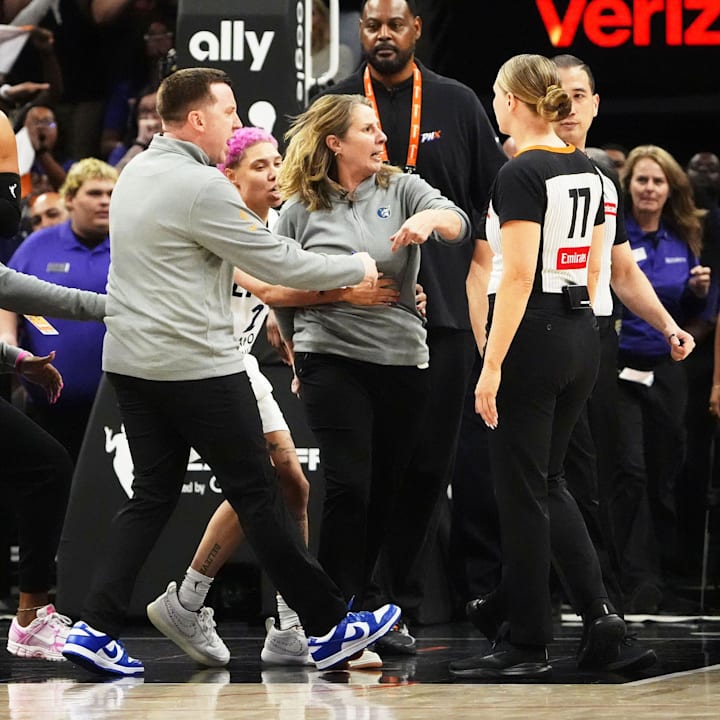
The Play That Ignited a Firestorm
It was a moment that could turn the tide of a pivotal playoff game. The Minnesota Lynx were battling the Phoenix Mercury, and every possession was critical. Lynx star player Napheesa Collier drove to the basket, a move seen countless times, but this one ended with a collision and no whistle. From the sideline, coach Cheryl Reeve exploded. Her fury was palpable as she confronted the referees, her protests growing more intense until she was ultimately ejected and escorted off the court. For fans watching, it was a dramatic display of a coach fiercely defending her player. For Reeve, it was the culmination of mounting frustration over what she perceived as dangerously inconsistent officiating that put players at risk. The ejection itself was a significant event, but it was what happened after the final buzzer that truly sent shockwaves through the league and set the stage for a major confrontation.
Reeve’s Post-Game Outburst: “F***ing Malpractice”
If the on-court tirade was the spark, Cheryl Reeve’s post-game press conference was the explosion. Rather than offering a tempered, diplomatic response, the veteran coach went scorched earth on the league’s officiating leadership. She didn’t mince words, connecting the physicality of the game to a lack of control from the referees, a concern she noted was shared by other coaches.
A Scathing Rebuke of WNBA Officiating
“We talked about how dangerous it can be. You’re hearing it from the other series. You’re hearing other coaches. You’re hearing Becky [Hammon] talk about, when you let the physicality happen, people get hurt, there’s fights, and this is the look that our league wants for some reason,” Reeve stated, painting a picture of a league-wide problem.
Her critique then became laser-focused and intensely personal toward the league’s leadership. In a quote that would quickly go viral, she delivered a stunning indictment. “I want to call for a change of leadership at the league level when it comes to officiating. It’s bad for the game,” Reeve declared. “The officiating crew that we had tonight, for the leadership to deem those three people semi-finals playoff worthy is f***ing malpractice.” The use of such strong, unfiltered language was a clear signal that Reeve was not just airing a grievance; she was challenging the very competency of those in charge of the game’s integrity.
The WNBA Drops the Hammer: A Historic WNBA Fine
The league’s response was swift and severe. On September 29, the WNBA announced its disciplinary action against Reeve. The punishment was twofold: a suspension for the Lynx’s next game and a staggering financial penalty. This wasn’t just any fine; it was a record-setter. As reported by Sabreena Merchant of The Athletic and confirmed by Bleacher Report, the Cheryl Reeve WNBA fine came in at $15,000, the largest single fine ever levied against an individual in the league’s history. The severity of the punishment sent a clear message: public critiques of officiating, especially those questioning the league’s leadership with such volatile language, would not be tolerated. The suspension had immediate consequences, as the Lynx lost their next game without their head coach, officially eliminating them from the playoffs. The league had made its point, but the question remained: How would Reeve respond to this unprecedented disciplinary action?
The Aftermath: Cheryl Reeve Stands Her Ground
In an exit interview on September 30, just days after the fine was announced, Cheryl Reeve had the opportunity to walk back her comments, apologize, or express regret. She did none of those things. Instead, the decorated Minnesota Lynx coach doubled down, reinforcing her stance and defending her actions as a matter of deep-seated principle. She acknowledged the difficulty of the situation but showed no signs of remorse for speaking out.
A Principled Stand for Player Safety
“Obviously, not easy. That’s probably an understatement,” Reeve said, reflecting on the whirlwind of events. “The leadership makes their decisions. An unprecedented response. Those are things you can’t anticipate in the moment.” She framed the league’s reaction as something beyond the norm, but her focus quickly shifted back to her own motivations.
“I think for me, being a principled person, there are things I care deeply about. And that’s my players’ health and safety. That’s the fairness to our organization. And when those things are challenged, if I’m not going to speak up, who’s going to?” she continued. With these words, Reeve transformed her outburst from a moment of anger into a calculated act of leadership. She positioned herself as the necessary voice for her players, including Napheesa Collier, implying that the financial and professional consequences were a price she was willing to pay to protect them. “So I feel a great responsibility to that end. I wish I was with the team in the last game, but obviously not. So it was hard. Really hard.”
The Broader Debate Sparked by the Cheryl Reeve WNBA Fine
This incident has become much more than a story about one coach’s anger. The Cheryl Reeve WNBA fine has become a catalyst for a much larger conversation about the state of WNBA officiating. Fans, media, and even other figures within the sport have weighed in, with opinions split. Some argue that Reeve’s conduct was unprofessional and that the league was justified in issuing a historic WNBA fine to maintain order and respect for officials. They believe there are proper channels for expressing grievances and that her public condemnation crossed a line. Others, however, see Reeve as a hero who had the courage to say what many were thinking. They point to a growing sentiment that officiating across the league has become inconsistent and that player safety is sometimes compromised by “let them play” philosophies that go too far. This single event has forced a public reckoning, pressuring the league to address whether there is a systemic problem with its officiating standards and how it handles feedback from its most prominent coaches.
In conclusion, the saga of Cheryl Reeve’s ejection, tirade, and subsequent punishment is a multifaceted drama that has captivated the sports world. What began with a single no-call on the court has spiraled into a league-defining moment, raising critical questions about authority, accountability, and a coach’s ultimate responsibility. The record-breaking Cheryl Reeve WNBA fine of $15,000 was intended to be a powerful deterrent, a clear line drawn in the sand by the league office. Yet, Reeve’s defiant and principled response has arguably made her a more powerful advocate for her cause. By refusing to back down, she has ensured that the conversation about officiating quality and player safety will not fade away with the end of the season. This clash between a passionate coach and the league she has helped build will be remembered not just for the unprecedented penalty, but for the crucial debate it forced into the open. The long-term impact on the WNBA’s relationship with its coaches and its approach to officiating remains to be seen, but one thing is certain: Cheryl Reeve made her voice heard, and the league is now forced to listen.
News

The gavel fell, sealing the one-armed veteran’s fate. But from the back of the courtroom, a single, mournful howl became the first shot in a new war—one fought by a dog who remembered everything they buried.
Courtroom 3 of the Hamilton District Court was a vessel of held breath. The morning light, strained through tall, dusty windows, seemed to congeal in the air, thick and heavy as the silence itself. On the polished wooden benches, people…

He went to an Alaskan cabin to silence the echoes of war. But in the heart of a blizzard, his dog sensed a secret the storm was sent to bury—a secret that would force him into one last fight.
The wilderness beyond Anchorage doesn’t ask for permission; it simply takes. It swallows roads, erases landmarks, and devours the faint, tinny signal of a cell phone until the only voice left is the wind. It was in this vast, unforgiving…

He told the quiet woman she didn’t belong on his elite sniper range. But when her backpack split open, a single photo fell out that made every decorated Marine in the room snap to a salute in shame.
The crack of a rifle shot was the only sound that made sense anymore. It split the dry California air over Marine Corps Base Camp Pendleton, a clean, percussive thunder that echoed off the brown hills and settled in your…

As the young officer moved to detain the 89-year-old man, she was blind to the truth. The very name of the warship she guarded was a whisper of the 70-year-old secret hidden on his faded patch.
The voice sliced through the humid air of the naval pier, a sharp tool meant to carve out immediate compliance. “Sir, I’m going to have to ask you to step away from the gangway. This area is for authorized personnel…

They chose a desolate mountain to be her grave, thinking a thousand-foot drop was the perfect, silent crime. But as she fell into the void, they made a fatal miscalculation about the kind of woman they just betrayed.
The mountain didn’t make a sound when it happened. There was no grand echo to mark the moment, no sympathetic rumble from the ancient stone. There was only the sharp, scattering kick of gravel, a sudden, violent silence where a…

In a circle of 282 elite soldiers, two men decided to humiliate the quiet medic during a demonstration. They intended to break her spirit. Instead, in seven brutal seconds, they discovered a truth that broke them completely.
The wind that came off the Atlantic that morning had teeth. It wasn’t a breeze; it was a hard, scouring force that snapped across the open-air corridors of Naval Special Warfare Command Unit 7, carrying the briny scent of the…
End of content
No more pages to load