The December wind screamed around the small wooden church in Cedar Ridge, a mournful sound that echoed the hollowness in Margaret Sullivan’s chest. At twenty-two, she stood frozen at an altar meant for a wedding, her gown now a repository for the fine dust of snow that gusted through the open doors. In her arms, she clutched her three-month-old daughter, Emma, a fragile warmth wrapped in a thin woolen blanket.
The congregation was long gone, their whispers trailing them out into the storm. Harold Jameson ain’t coming, old Mrs. Whitmore had declared, the words delivered with a grim shake of her graying head. Left on a morning train to California, they say. Took his belongings and never looked back.
Beside her, Margaret’s father, Thomas Sullivan, stood with his jaw clenched so tight the muscle jumped in his cheek. A proud man, the owner of the town’s general store, he had orchestrated this marriage to Harold, certain it would secure his daughter’s future and lend legitimacy to his granddaughter. Now, shame burned in him like a hot coal.
“Margaret,” he said, his voice a low rumble, nearly lost to the gale. “We need to go home.”
But Margaret’s feet were rooted to the floorboards. The reality of her ruin descended like a physical blow. In the Montana Territory of 1883, an unmarried mother was a pariah, a woman barely a step above outcast. She had no income, no prospects, and now, no husband to provide for little Emma. The modest inheritance left by her mother would scarcely see them through the winter.
Pastor Williams approached, his weathered face a mask of concern. “Miss Sullivan, you and the child are welcome to take shelter here tonight if the storm worsens.”

Margaret could only offer a numb nod, her mind struggling to grasp how her life had disintegrated in a single afternoon. Emma stirred, making soft, cooing sounds that felt strangely peaceful against the chaos of the moment.
It was then that the church doors groaned open once more. A tall figure stepped through the threshold, shaking snow from a dark, heavy coat. He was broad-shouldered and lean, with weathered hands and quiet gray eyes that seemed to absorb the entire scene in a single glance. This was Jacob McKinnon, thirty-five years old, the owner of the Double M Ranch that lay ten miles outside of town. He had come for supplies just as the storm had rolled in, taking refuge in Murphy’s Saloon across the street where he’d heard the commotion about the wedding that wasn’t.
Seeing Margaret standing there, a solitary figure in white holding her baby, stirred something protective in his chest he hadn’t felt in years. He’d known of her since she was a girl, though they had rarely exchanged words. She had always been a ray of light in the dreary frontier town, helping her father at the store with a smile that warmed everyone she met. From a distance, Jacob had watched her grow into a beautiful woman, but he had never found the courage to speak his mind. A rough rancher like him had no business courting the refined daughter of the town’s most respected merchant.
“Miss Sullivan,” Jacob said, his deep voice cutting through the wind’s howl. He pulled off his hat, revealing thick, dark hair touched with an early silvering at the temples. “I couldn’t help but overhear your situation.”
Margaret looked up, her vision blurred by unshed tears. She knew who Jacob McKinnon was, of course. Everyone in Cedar Ridge knew the quiet rancher who lived alone on his sprawling land, working his cattle and keeping to himself. Whispers said he’d lost someone dear years ago, a tragedy that had shaped his solitary nature.
“Mr. McKinnon,” she breathed, her voice barely a whisper.
Jacob’s gaze flickered to Thomas Sullivan before returning to her. “I have a proposal, if you’ll hear me out.” He paused, weighing his words with care. “My ranch has plenty of room, and I could use some help with the housekeeping and the cooking. Winter’s coming on hard. It’s no time for a woman and a child to be without shelter.”
Thomas stepped forward, his merchant’s instincts flaring with suspicion. “What exactly are you suggesting, McKinnon?”
“I’m suggesting marriage,” Jacob stated simply, his gray eyes never leaving Margaret’s face. “A practical arrangement. Miss Sullivan needs a home and security for her daughter. I need a wife to help run my household. It would be a benefit to us both.”
The church fell into a profound silence, broken only by the shrieking wind. Margaret felt her heart hammer against her ribs. Marriage. To a man who was all but a stranger. And yet, what other choice did she have? The alternative was a return to her father’s house in disgrace, a lifetime of dependence on his charity while the town’s whispers followed her like a shadow.
“I…” Margaret began, but her voice failed her. At that moment, Emma let out a small, insistent cry, as if to remind her mother that practical needs must now outweigh romantic dreams.
“Mr. McKinnon,” Margaret said slowly, finding her resolve. “You don’t even know me. And Emma… she’s not your child. Why would you take on such a burden?”
Jacob’s stern expression softened. “Every child deserves a chance in this world, Miss Sullivan. And as for knowing you… well, I’ve seen you in town these many years. I’ve seen how kindly you treat folks, how you help your father. I’ve seen how you light up a room just by walking into it. I reckon there are worse foundations for a marriage than mutual respect and practical need.”
Thomas’s frown deepened. His instinct was to protect his daughter, but he also knew Jacob McKinnon by his reputation: an honest, hardworking man who had built his ranch from nothing through sheer will. More importantly, he was offering Margaret a respectable escape from a desperate situation.
“Margaret,” Thomas said quietly, “the decision is yours.”
She looked down at Emma, who had drifted back to sleep. Her daughter’s entire future was balanced on this moment: a life of poverty and social shame, or a chance at a respectable life with this kind, if reserved, man.
“Mr. McKinnon,” she said, her voice steady now, “if I were to accept your proposal, what would you expect of me?”
“Honesty,” Jacob replied without hesitation. “Hard work. Help with the house and the meals. And in time, perhaps we might find companionship in each other’s company.” He paused. “I won’t pretend this is a love match, Miss Sullivan. But I believe we could build something good together, given time.”
Margaret studied his weathered face, searching for any sign of cruelty or deceit. She found none. All she saw was a lonely man making a sensible offer that could save her and her child from ruin.
“I accept,” she said, the words quiet but firm.
Pastor Williams stepped forward, his expression bewildered by the rapid turn of events. “Are you certain, my dear? Marriage is a sacred bond, not something to be entered into lightly.”
“I’m certain, Pastor,” Margaret replied, though her voice trembled. “If Mr. McKinnon is willing, I’d like to proceed.”
Jacob gave a solemn nod. “I’m willing.”
And so, as the snow continued to blanket the world outside, Margaret Sullivan became Margaret McKinnon. The simple ceremony was witnessed only by her father, the pastor, and the howling Montana wind. Jacob’s wedding band, a plain gold ring that had belonged to his mother, fit her slender finger as if it were made for her.
After the brief service, Jacob helped Margaret and Emma into his sturdy wagon, already laden with supplies. He wrapped them in several thick blankets, positioning them on the most sheltered side of the seat. “It’s about an hour’s ride to the ranch,” he told her as he climbed up beside them. “The storm’s getting worse, but the horses know the way.”
The journey through the blizzard was a harrowing ordeal. Snow lashed across the prairie in blinding sheets, and the temperature plummeted. Margaret held Emma tight, shielding the baby from the cold while fighting her own violent shivers. Jacob drove with a steady confidence, his hands sure on the reins, occasionally reaching over to adjust the blankets around his new wife and the child he had already, in his mind, claimed as his daughter. The moment he’d made the proposal, he had committed himself fully. It wasn’t in his nature to do anything by halves.
“Tell me about your ranch,” Margaret said during a brief lull in the wind, desperate for a distraction from the biting cold.
“It’s not much to look at,” Jacob replied, his breath a white plume in the frigid air. “Built the house myself five years ago. Got about five hundred head of cattle. Some horses, a few chickens. The nearest neighbor is eight miles south.”
The isolation didn’t frighten her as it once might have. In that moment, the promise of a warm house and safety felt like paradise itself.
“Do you have help with the work?” she asked.
“Got two hands who help during calving season and roundup. Otherwise, I manage alone.” He glanced at her. “Gets mighty quiet out there, especially in winter. Hope you don’t mind your own company.”
“I think I’d welcome the peace,” Margaret admitted. The past few months had been a torment of whispers, judgment, and the gnawing anxiety of an uncertain future. Quiet sounded wonderful.
When they finally reached the Double M Ranch, the buildings were faint shapes against the swirling snow. Jacob guided the wagon to a modest two-story house with a wide front porch, its shuttered windows glowing with the warm promise of lamplight.
“I lit a fire before I left for town,” he explained, helping her down. “Figured I’d be coming back to a cold house.” He’d had no idea he’d be returning with a wife and a baby.
The house was simple but solidly built, with thick walls that muted the wind and a large stone fireplace radiating a blessed warmth. The main room held a wooden table and chairs, a few comfortable-looking armchairs near the hearth, and shelves lined with books. A staircase led up to what she assumed were the bedrooms.
“Kitchen’s through there,” Jacob said, gesturing to a doorway. “There’s a room off the kitchen that might work well for the baby. And upstairs… well, there are two bedrooms.” The unspoken meaning hung between them. This was a marriage of convenience, and Jacob was a gentleman.
“Thank you,” Margaret said softly. “For everything.”

He gave a slight nod and began unloading his supplies. “I’ll get your things and see to the horses. There’s stew on the stove if you’re hungry.”
As Margaret explored her new home with Emma cradled in her arms, she felt a swirl of relief and apprehension. It was clearly a bachelor’s dwelling, yet it was clean and well-kept. The kitchen was equipped with a good stove and shelves stocked with provisions. The small room off the kitchen was indeed perfect for Emma, with a window facing east and enough space for a cradle. She would have to improvise for now, but she was grateful beyond words for a warm, secure place to call home.
When Jacob returned from the stables, he found Margaret in the kitchen, ladling stew into bowls. She had settled Emma into a wooden crate padded with blankets near the warmth of the stove.
“Smells good,” he said, though she realized she knew nothing of his cooking.
“It’s just beef and vegetables,” he replied, washing his hands at the basin. “Nothing fancy.”
They ate in a comfortable silence, both drained by the day’s extraordinary events. Emma slept peacefully in her makeshift bed, her small sounds a gentle counterpoint to the storm.
“She’s a good baby,” Jacob observed.
“Most of the time,” Margaret agreed with a small smile. “She has her moments, though. I hope her crying won’t disturb you.”
“I’m a heavy sleeper,” he assured her. “And I’ve been around enough newborn calves to know that babies need tending at all hours.”
After dinner, he showed her upstairs. The larger bedroom was clearly his, with a big bed and a dresser. The smaller room contained a single bed and a washstand. “This can be yours,” he said, indicating the smaller room. “I can help you move the baby’s things up here tomorrow, or you can keep her downstairs if that works better.”
“Downstairs might be easier for now,” Margaret said. “Closer to the kitchen for warming milk.”
Jacob nodded. “Whatever works best.” They stood in the quiet hall, the awkwardness of their situation palpable. Married but strangers, sharing a roof but not yet a life.
“Margaret,” he said finally, “I want you to know I meant what I said in the church. This doesn’t have to be anything more than a practical arrangement. You’ll have your space, and I’ll have mine. No expectations beyond what we agreed to.”
She felt a flutter of something she couldn’t name—relief, or perhaps disappointment. “Thank you for being clear about that.”
“And about Emma,” Jacob continued, his voice softening. “I meant what I said about that, too. Far as I’m concerned, she’s my daughter now. Anyone asks, that’s what they’ll be told.”
Tears welled in Margaret’s eyes at his unexpected kindness. “Jacob, I don’t know how to thank you.”
“No need for thanks,” he said gruffly. “We both got something we needed from this.”
That night, as Margaret lay in the unfamiliar bed with Emma sleeping peacefully beside her, she contemplated the incredible turn her life had taken. That morning, she had expected to become Mrs. Harold Jameson. Tonight, she was Mrs. Jacob McKinnon, wife to a rancher she barely knew, in a home ten miles from everything she’d ever known. Downstairs, Jacob sat by the dying fire, lost in similar thoughts. For five years he had lived alone, content with his cattle and his solitude. Now, a wife and a baby daughter slept upstairs. The house already felt different—warmer, more alive. He thought of Margaret’s smile and the genuine gratitude in her voice. He thought of little Emma, so small and helpless, now depending on him for her future. The responsibility was both terrifying and strangely satisfying.
The next few days were a whirlwind of adjustment. The blizzard raged for three days, keeping them snowbound and forcing them into a rapid acquaintance. Margaret revealed herself to be an excellent cook and an efficient housekeeper, quickly transforming Jacob’s bachelor quarters into a true home. For his part, Jacob was unfailingly patient with Emma. He fashioned a proper cradle from pine boards and kept the fire stoked in the small room off the kitchen to ensure it stayed warm for the baby. Margaret was touched by his quiet thoughtfulness, especially when she saw the gentle way he spoke to Emma when he thought no one was watching.
“You’re good with her,” she observed one morning as he held the baby while she prepared breakfast.
“She’s easy to please,” he replied, letting Emma’s tiny hand curl around his finger. “Feed her, keep her warm, and she’s happy.”
“If only all of life’s problems were so simple,” Margaret said with a laugh.
“Maybe they are,” Jacob said thoughtfully. “Maybe we just make them more complicated than they need to be.” She paused, looking at him. There was a profound truth in his simple words, one that spoke directly to the complicated mess her life had become before she found refuge here.
When the storm finally broke, Jacob prepared to ride out and check on his cattle. “I’ll be gone most of the day,” he told her. “There’s a rifle over the mantle if you need it, though I don’t expect any trouble. The nearest neighbors are the Hendersons to the south. Good people, if you ever need help.”
Margaret nodded, trying to hide her nervousness at being left alone so far from town. “We’ll be fine.”
“I know you will,” Jacob said with a quiet confidence that bolstered her own. “You’re stronger than you think, Margaret McKinnon.” The sound of her new name still startled her, but she was beginning to like the way it sounded on his lips.
After he left, Margaret settled into her new routine. She organized the kitchen, did laundry, and wrote to her father, assuring him she was well. She omitted the part about it being a marriage in name only; he had enough to worry about. Emma, fascinated by her new surroundings, watched everything with bright, curious eyes. Margaret talked to her constantly, describing their new home and the man who had become her father. “He’s a good man, Emma,” she murmured while feeding her by the window. “Quiet, but kind. We’re lucky he found us.”
When Jacob returned that evening, weary and cold from a day spent digging cattle out of snowdrifts, he was greeted by the scent of baking bread and Margaret humming softly in the kitchen. Emma sat in her cradle, happily playing with a wooden spoon.
“How was your day?” Margaret asked, helping him with his coat.
“Lost two head to the storm, but the rest are fine,” he reported. “The hands will be by tomorrow to help move the herd to better shelter.”
Margaret had prepared a hearty meal of roast beef and potatoes. As they ate, Jacob told her about his ranch, his plans for the spring, and his hopes for the herd. She found herself genuinely interested, asking thoughtful questions.
“You really listen,” he observed. “Most folks just nod when I talk about cattle.”
“It’s your livelihood,” she replied. “And now it’s mine, too, in a way. I want to understand it.”
After dinner, they sat by the fire while Emma played on a blanket between them. The domestic scene felt surprisingly natural, as if they’d been a family for years.
“Margaret,” Jacob said after a long silence. “Can I ask you something?”
“Of course.”
“What happened with Harold? If you don’t mind talking about it.”
She stared into the flames for a long moment. “I thought I loved him,” she said finally. “He was charming, said all the right things. When I found out I was expecting Emma, he promised to marry me.” She paused, her voice hardening slightly. “I believed him. About a week before the wedding, he started making excuses, talking about California. I could see the fear in his eyes when he looked at Emma. He was a coward. He couldn’t face the responsibility.”
Jacob nodded. “His loss,” he said simply.
Margaret looked at him, surprised.
“His loss,” he repeated. “Emma’s going to grow up to be something special. And you… you’re the kind of woman a man would be proud to call his wife. Harold’s loss is my gain.”
The words hung between them, more intimate than anything they had yet shared. Margaret felt a warmth spread across her cheeks and quickly looked away. “Thank you,” she whispered.
As winter deepened, their routine solidified. Jacob rose before dawn to tend to the animals. Margaret would have a hot breakfast waiting when he returned. They spent the long evenings by the fire, Jacob reading while Margaret sewed, often talking quietly about their pasts and their hopes.
One evening in late January, Jacob looked up from his book. “You haven’t been to town since we married,” he observed.
“I haven’t needed anything,” she replied, though the real reason was her fear of the town’s gossip.
“People will talk no matter what,” he said, as if reading her mind. “Better to face them on your own terms. I’m saying we should go to town together. Let folks see that we’re a family.”
The idea both thrilled and terrified her. “What if they ask about our arrangement?”
Jacob set down his book and looked at her, his expression serious. “What arrangement would that be, Mrs. McKinnon? I see a man, his wife, and their daughter. Don’t you?”
A warmth unfurled in her chest. “Yes,” she said softly. “I do.”
The following Saturday, they made the trip to Cedar Ridge. Their first stop was her father’s store. Thomas Sullivan embraced his daughter, relieved to see her looking healthy and happy. “You look good, Margaret,” he said, then turned to Jacob. “McKinnon, I want to thank you again.”
“No thanks needed,” Jacob replied firmly. “Margaret and Emma are family now.”
Throughout their visit, customers offered polite congratulations. If there were whispers, they were silenced by Jacob’s steady presence. He kept a protective hand on her back as they walked, introducing her to everyone as his wife. His quiet pride seemed to quell any potential gossip before it could begin.
On the ride home, Margaret found herself stealing glances at his strong profile. She had come to appreciate his quiet strength, his dry humor, and his gentle way with Emma. What had begun as a practical arrangement was starting to feel like something more.
That night, she found the courage to ask him something that had been on her mind. “Jacob… why haven’t you married before now?”
He set down the harness he was mending and stared into the fire. “There was someone once,” he said finally. “Her name was Sarah. We were engaged.”
“What happened?”
“Fever took her the winter before our wedding, back in ’78.” His voice was quiet, but she could hear the old pain beneath it.
“I’m sorry,” she said softly.
He nodded. “After that, I just focused on the ranch. Didn’t see much point in looking for someone else.” He met her eyes across the firelight. “Now I’ve got you and Emma. Didn’t go looking for a family, but sometimes what you need finds you when you least expect it.”
Margaret’s heart skipped a beat. There was something in his voice, in his gaze, that suggested his feelings about their arrangement were evolving, just as hers were.
February brought a fierce cold snap that kept them housebound for a week. During those long days, they grew closer than ever. Jacob learned of her secret dream to one day teach children, and she was touched when he told her she’d be good at it. “I watch you with Emma,” he said. “You’re always talking to her, explaining things. A baby might not understand the words, but she hears the love in your voice.”
One evening, Emma became fussy and feverish. Margaret, frantic with worry, was calmed by Jacob’s steady competence. He prepared a cool bath and brewed willow bark tea, his knowledge gleaned from years of tending sick calves. Emma’s fever broke before dawn. When Margaret awoke, she found Jacob asleep in the rocking chair by the fire, still holding their daughter. The sight of her husband—for she was beginning to think of him as her real husband—cradling their child with such tenderness made her heart clench with an emotion she wasn’t quite ready to name.
March brought the thaw and the return of Jacob’s ranch hands, Tom and Pete. They were initially surprised by their boss’s new family but quickly warmed to Margaret’s excellent cooking. “Best meals we’ve had in years, Mrs. McKinnon,” Tom declared.
During calving season, Jacob was often out all night. Margaret would wait up, keeping food warm and coffee ready for his exhausted return. “You don’t need to stay up for me,” he told her one night.
“I know,” she replied, helping him out of his muddy coat. “But I want to.” Their eyes met, and she saw a new warmth in his expression, something that went far beyond gratitude.
One evening in late March, after the hands had retired and Emma was asleep, Jacob spoke of adding on to the house. “Maybe a proper nursery for Emma, and a larger kitchen. You’ve been making do.”
“The house is fine,” she protested.
“It’s not about fine,” he said. “It’s about making it right for our family.”
The word—our family—sent a flutter through her. “Jacob,” she began carefully, “what are we doing here? What is this between us?”
He was quiet for a long moment. “I don’t know what you’d call it,” he said, his voice thoughtful. “All I know is that when I come home, I look forward to seeing you and Emma. When you smile, it makes everything seem brighter. When Emma laughs, it fills up something in my chest I didn’t even know was empty.” He paused. “I’m not good with words, Margaret. Never have been. But what I feel for you and Emma… it’s not just practical anymore. Hasn’t been for a while.”
She set down her mending. “What you feel?”
He met her gaze. “Love,” he said simply. “I love you, Margaret. Both of you.”
Tears of joy and relief sprang to her eyes. “I love you, too,” she whispered. “I didn’t expect to, but I do.”
He crossed the room and knelt beside her chair, taking her hands in his. “Are you sure?”
She silenced him with a gentle kiss, her first real kiss, soft and full of promise. “I’m sure,” she said against his lips. “I love you, Jacob McKinnon.”
They held each other, finally acknowledging the love that had grown between them through the long winter. “So, what happens now?” she asked.
“Now we stop pretending this is just an arrangement,” he said with a smile. “Now we build a real marriage. A real family.”
That night, for the first time, they shared a bed as husband and wife in truth as well as in name.
April brought new life to the ranch. Jacob began the additions to the house, and Margaret helped where she could. “I never imagined my life would turn out like this,” she said one evening.
“Better or worse than you expected?” he asked.
“So much better,” she said without hesitation.
In May, they took another trip to town. “You made a good choice, daughter,” her father told her privately. “Jacob McKinnon is a good man.”
On the way home, Jacob took a detour to a small rise overlooking their land. The entire Double M spread out below them. “It’s ours,” he said simply. “Yours, mine, and Emma’s.” He shared his dreams for the ranch, and she shared hers for teaching, and he promised her, “Whatever you want to do, we’ll find a way.”
Emma’s first birthday in June was a celebration with all their neighbors. As Margaret watched the gathering, she marveled at how much her life had changed in a year. She was no longer the frightened, abandoned woman at the altar, but a beloved wife and mother, surrounded by friends.
“Penny for your thoughts,” Jacob said, appearing at her side.
“Just thinking about how much can change in a year,” she replied.
“Good changes?” he asked, already knowing the answer.
“The best changes,” she confirmed, kissing his cheek.
That evening, as they sat on the porch watching the sunset, Margaret took his hand and placed it on her still-flat stomach. “I have something to tell you,” she said, her voice a mix of excitement and nerves. “We’re going to have another baby.”
His eyes widened, then filled with a profound joy. He pulled her into his arms, spinning her around in a circle. “Happy?” she asked.
“Happy?” he said, cupping her face. “Margaret, I’m over the moon. A year ago, I was a lonely bachelor. Now I’m going to be the father of two children with the most wonderful woman in Montana.”
That October, their happiness was threatened. Sheriff Coleman rode out with troubling news. “It’s about Harold Jameson,” he said gravely. “Seems he’s been writing letters, asking about Margaret and claiming he wants to reclaim his family.”
The blood drained from her face. “Reclaim us? He abandoned us.”
“Legally speaking, he is Emma’s father,” the sheriff said gently.
“Over my dead body,” Jacob said, his voice quiet but laced with steel.
The sheriff warned them that Harold had fallen on hard times and might return to cause trouble. The thought filled Margaret with terror. “What can we do?”
“You’re legally married to Jacob now,” the sheriff explained. “And Jacob’s been acting as Emma’s father for nearly a year. That counts for something.”
That night, Jacob made a promise. “He won’t tear our family apart. I won’t let him.”
November brought the first snow and a stranger asking questions about them. Jacob sent him away, his jaw tight with anger. “I think Harold’s having people scout around,” he said. The waiting was agony. Every unfamiliar sound made Margaret jump.
Two days before Christmas, Harold Jameson appeared. Margaret saw him from the kitchen window, looking thinner and more desperate than she remembered.
“I want to see my daughter,” he was saying to Jacob.
“She’s not your daughter,” Jacob replied evenly. “You gave up any claim to her when you abandoned Margaret.”
Harold’s brazen lies about being called away on “urgent business” made her gasp. He saw her at the window. “Margaret! Come out here!”
“You’ll talk to me,” Jacob said, blocking the view.
Margaret scooped up Emma and moved to the back of the house, her heart pounding. The men’s voices rose, ending with a scuffle on the porch. “This isn’t over, McKinnon!” Harold shouted as he rode away.
That evening, Jacob learned Harold had been in town for days, spinning a story of being a wronged husband. Though most people didn’t believe him, the threat was real.
Christmas Day was tense and subdued until Sheriff Coleman arrived with two deputies. “I’m afraid I have some difficult news,” he began. “Harold Jameson was found dead this morning in his hotel room. Looks like his heart gave out.”
Margaret felt the world tilt. Dead. The threat was gone.
“Far as the law is concerned,” the sheriff concluded, “Emma’s your daughter, Jacob. Always has been.”
In the stunned silence that followed, Margaret felt only a profound sense of relief. “He made his choices,” Jacob said gently. “And in the end, they caught up with him.”
The winter passed peacefully. In February of 1885, on the second anniversary of their wedding, their son was born. They named him Thomas, after her father.
“He’s perfect,” Jacob said, holding his son for the first time.
“Thank you,” Margaret said to Jacob as they stood together, watching their children. “For saving us.”
“You saved me, too,” he replied. “This house was just a building before you and Emma filled it with love. Now it’s a home.”
Years passed. The Double M Ranch thrived. By their fifth anniversary in 1888, Emma was nearly five, and Thomas was a toddler filling the house with joyful chaos.
“Do you ever regret it?” Margaret asked him one evening. “Marrying me so impulsively?”
“Margaret McKinnon, that’s the most foolish question you’ve ever asked,” he said with amazement. “You and Emma walking into my life was the best thing that ever happened to me. We built our love on daily kindness and shared work. That’s stronger than any foundation built on romance alone.”
As Montana prepared for statehood in 1889, new opportunities arose. Jacob was approached about expanding his business, and Margaret was formally asked to become Cedar Ridge’s first schoolteacher. They faced the decisions together.
In the spring, Margaret opened the one-room schoolhouse, her own daughter among her first students. Jacob focused on improving the quality of his herd, earning a reputation for the finest cattle in the territory.
One evening that December, as they celebrated their sixth anniversary, Margaret thought back to that snowy day in the church.
“Penny for your thoughts,” Jacob said, his familiar, gentle phrase.
“Just thinking about beginnings,” she replied. “How sometimes what looks like an ending is really a new beginning in disguise.”
“Like being left at the altar,” he said.
“Exactly like that. If Harold hadn’t abandoned me, none of this wonderful life would have happened.”
Emma, now six, looked up from the book she was sharing with four-year-old Thomas. “Papa, Mama, what are you talking about?”
“We’re talking about how much we love our family,” Jacob said, opening his arms to them.
“Tell us the story again,” Emma requested. “About how you and Mama met.”
Jacob and Margaret exchanged an amused glance. “Well,” he began, settling Emma on his lap, “it was a very snowy winter day, and your mama needed someone to help take care of you…”
As he told their story, Margaret looked at her family, gathered close in the warm light. Outside, snow was beginning to fall, just as it had six years ago when her old life had ended and her real one had begun. She had been left at the altar, alone and desperate. But then the silent rancher had walked in and taken them home as his own, giving them everything that truly mattered. Some stories, she reflected, have the most beautiful endings precisely because they start with what feels like the worst possible beginning.
News

The gavel fell, sealing the one-armed veteran’s fate. But from the back of the courtroom, a single, mournful howl became the first shot in a new war—one fought by a dog who remembered everything they buried.
Courtroom 3 of the Hamilton District Court was a vessel of held breath. The morning light, strained through tall, dusty windows, seemed to congeal in the air, thick and heavy as the silence itself. On the polished wooden benches, people…
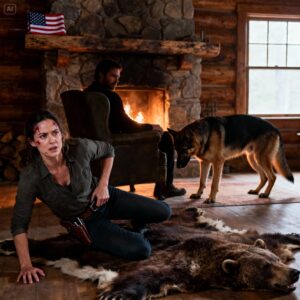
He went to an Alaskan cabin to silence the echoes of war. But in the heart of a blizzard, his dog sensed a secret the storm was sent to bury—a secret that would force him into one last fight.
The wilderness beyond Anchorage doesn’t ask for permission; it simply takes. It swallows roads, erases landmarks, and devours the faint, tinny signal of a cell phone until the only voice left is the wind. It was in this vast, unforgiving…

He told the quiet woman she didn’t belong on his elite sniper range. But when her backpack split open, a single photo fell out that made every decorated Marine in the room snap to a salute in shame.
The crack of a rifle shot was the only sound that made sense anymore. It split the dry California air over Marine Corps Base Camp Pendleton, a clean, percussive thunder that echoed off the brown hills and settled in your…
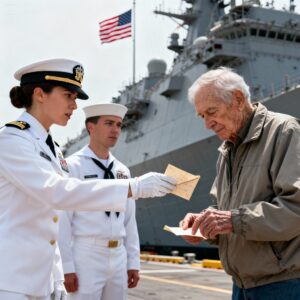
As the young officer moved to detain the 89-year-old man, she was blind to the truth. The very name of the warship she guarded was a whisper of the 70-year-old secret hidden on his faded patch.
The voice sliced through the humid air of the naval pier, a sharp tool meant to carve out immediate compliance. “Sir, I’m going to have to ask you to step away from the gangway. This area is for authorized personnel…

They chose a desolate mountain to be her grave, thinking a thousand-foot drop was the perfect, silent crime. But as she fell into the void, they made a fatal miscalculation about the kind of woman they just betrayed.
The mountain didn’t make a sound when it happened. There was no grand echo to mark the moment, no sympathetic rumble from the ancient stone. There was only the sharp, scattering kick of gravel, a sudden, violent silence where a…

In a circle of 282 elite soldiers, two men decided to humiliate the quiet medic during a demonstration. They intended to break her spirit. Instead, in seven brutal seconds, they discovered a truth that broke them completely.
The wind that came off the Atlantic that morning had teeth. It wasn’t a breeze; it was a hard, scouring force that snapped across the open-air corridors of Naval Special Warfare Command Unit 7, carrying the briny scent of the…
End of content
No more pages to load