The fluorescent lights of Miller’s Market bled across the asphalt, casting the parking lot in a sterile, unforgiving glare as Jack Thompson sank into the security booth for another twelve-hour shift. He was only twenty-five, but his shoulders slumped with the specific gravity of a man twice his age. The plastic chair groaned under his weight. For the fifteenth time in the last hour, he checked his phone.
An urgent notification from Memorial Hospital stared back at him: Payment required: $2,847. His thumb hovered over the message before swiping it away, a futile gesture, as if dismissing the alert could make the debt itself vanish. Jack’s hand instinctively found his wallet, his fingers tracing the geography of its worn leather. Inside, a lone twenty-dollar bill and a handful of coins rattled, a sound like broken promises. It was supposed to cover next week’s rent, his mother’s prescriptions, and the gas to get to and from the hospital. No matter how he arranged the numbers in his head, the math remained stubbornly, impossibly broken.
“Thompson, you sleeping in there?” Derek’s voice, sharp and abrasive, crackled through the radio. His coworker, a heavy-set man with a scowl that seemed etched into his features, was posted by the exit barrier.
“Just checking the schedule,” Jack lied, forcing a neutral tone. With Derek, everything felt like an accusation.
“Yeah, well, stay alert. Corporate’s been breathing down our necks about ‘customer experience.’” Jack could practically see Derek making air quotes through the speaker.
Through the smudged glass of the booth, Jack watched the evening rush unfold. It was 6:00 p.m., and a steady procession of vehicles snaked toward the automated payment system. He was lost in a fog of anxiety when his phone buzzed again. Reminder: Your mother’s post-surgical care continues only with immediate payment. He squeezed his eyes shut, the image of the pale hospital room flooding his mind: the rhythmic beep of the monitors, his mother’s fragile smile when he’d promised her, three days ago, that everything would be okay. The hospital had given him until tomorrow morning. The real number wasn’t $2,847; it was the $2,367 that stood between him and utter failure.
Suddenly, a shrill alarm cut through the evening air. The automated voice from the exit barrier boomed across the lot: “PAYMENT REQUIRED. PLEASE INSERT TICKET AND PAYMENT.”
Jack looked up. A silver Mercedes idled at the gate, its engine a low hum beneath the insistent alarm. A line of cars was already forming behind it. The driver’s door opened and an elderly man, perhaps in his seventies, emerged. Despite the luxury vehicle, he was dressed in a simple flannel shirt and worn khakis. He moved with a careful, deliberate slowness, his hands patting his pockets in a frantic search.
The car behind the Mercedes let out an impatient honk. Then another.
Jack saw Derek start walking toward the commotion, his customary scowl already fixed in place. The old man was checking his pockets, then his car, his distress mounting with every blare of the horn. “Come on, old man, move it!” a voice shouted from a few cars back.
Derek arrived, planting his hands on his hips in a stance of pure confrontation. “Sir, you’re holding up the line. Either pay or move your vehicle.”
The man’s weathered face flushed crimson. “I’m so sorry,” he stammered, his voice thin with embarrassment. “I seem to have… I’ve forgotten my wallet at home.”
The symphony of horns grew louder. Someone yelled an obscenity.
“You forgot your wallet?” Derek’s voice dripped with sarcasm, carrying easily across the lot. “Driving a Mercedes and you forgot your wallet. That’s convenient.”
“It’s not like that, I genuinely—” George began, his dignity crumbling under the dual assault of the horns and Derek’s contempt.
“Yeah, sure it isn’t,” Derek scoffed, crossing his arms. “I’ve seen this scam a hundred times. Rich guys trying to weasel out of a parking fee. Like four bucks is going to break you.”
The line was now eight cars deep. Jack couldn’t stand it. He pushed open the booth door and jogged toward the escalating chaos. “What’s the situation here?” he asked, aiming for a tone of authority.
“This ‘gentleman,’” Derek said, making the word an insult, “claims he forgot his wallet. Convenient.”
George turned to Jack, desperation and humiliation warring in his eyes. “Young man, I honestly did. I live just twenty minutes from here. If you could just let me go home, I’ll come right back.”
“Oh, give me a break,” Derek snapped. “The barrier won’t open until it’s paid. You’re blocking the entire exit.”
The cars were now honking in a unified, angry rhythm. A man got out of his vehicle, shouting about being late. Jack saw the panic blooming in the old man’s eyes. It was the same look he’d seen on his mother’s face when the bills arrived—the look of someone trapped.
“How much is it?” Jack asked quietly.
“Four dollars and fifty cents,” the machine announced.
Derek let out a harsh laugh. “Don’t even think about it, Thompson. This old codger is playing you.”
Ignoring him, Jack addressed the man directly. “Sir, I can cover it for you.”
George’s eyes widened, a film of moisture gathering in them. “I couldn’t possibly ask you to do that.”
“You’re not asking. I’m offering.”
“Jesus Christ, Thompson,” Derek hissed, stepping between them. “Are you really falling for this? Look at his car. He’s got more money in the glove box than we make in a month.”
Jack pulled out his wallet. His brain screamed at him to stop. That money was for dinner. That money was for his mother. But the incessant horns, the old man’s shaking hands, and Derek’s cruel smirk solidified his resolve. He inserted his own ticket and fed a five-dollar bill into the machine.
PAYMENT ACCEPTED. THANK YOU. The barrier lifted with a mechanical whir.
“Unbelievable,” Derek muttered, shaking his head. “You just got played.”
George stood frozen for a moment. “I don’t know what to say.”
“Just drive through, sir,” Jack said gently. “You’re holding up traffic.”
The cars behind them immediately started blaring again. George fumbled in his pocket, produced a business card, and pressed it firmly into Jack’s hand. “Please, I’ll pay you back. I’ll bring it tomorrow.”
“Go, sir, before it closes again,” Jack urged.
George squeezed his hand, his grip trembling. “Thank you. Truly. You have no idea.” He hurried back to his Mercedes and sped through the gate. The line of cars surged forward like water through a broken dam.
“You’re a special kind of stupid, Thompson,” Derek said, his voice laced with disgust. “That old grifter just scammed you out of five bucks.”
Jack glanced at the card. Plain white stock, elegant lettering: George Miller. An address and a phone number. Nothing more.
“Maybe,” Jack said softly. “Or maybe he just needed help.”
“Yeah, well, don’t come crying to me when you can’t afford lunch tomorrow.” Derek stalked away, still muttering about bleeding hearts and suckers.
Back in his booth, Jack opened his wallet. Eighteen dollars and sixty-seven cents remained. His phone buzzed—another hospital reminder. He stared at the business card, at his nearly empty wallet, and at the glowing notification on his screen.
“At least I did the right thing,” he whispered into the silence. But as he watched his relief arrive and prepared for another sleepless night, the words felt hollow. Somewhere, George Miller was driving home in his Mercedes, likely forgetting the whole incident. And tomorrow, Jack would have to tell his mother that he had failed her. He tucked the card into his wallet, a small rectangle of paper that felt meaningless next to the mountain of his problems.
The Honda sputtered to life on the third try, the gas gauge hovering just above empty. Eighteen dollars to last until Friday. Zero dollars to save his mother. But an old man had made it home, his dignity intact, because Jack had chosen kindness over self-preservation. That had to count for something. In his chest, where hope used to live before medical bills had suffocated it, a tiny ember flickered. Maybe it didn’t change his situation. But maybe, just maybe, it had changed him.
The hours crawled by. Jack had found a few packets of stale crackers in the breakroom, their taste a perfect match for the cardboard feeling in his stomach. At 11 p.m., he finally forced himself to make the call. The hospital’s billing department, of course, had a 24-hour line.
“Memorial Hospital billing, this is Patricia. How can I help you?”
Jack cleared his throat. “Hi, this is Jack Thompson, regarding the account for Eleanor Thompson. I’m calling about the payment due tomorrow.”
A flurry of keyboard clicks echoed down the line. “Yes, Mr. Thompson. The outstanding balance is $2,847. We’ll need that payment by 9 a.m. to continue your mother’s post-operative care.”
“I know,” he said, the lie tasting like ash in his mouth. “I just need a few more days. I’m working extra shifts, I have money coming.”
Patricia’s voice softened with practiced sympathy, which only made it worse. “We’ve already extended the deadline twice, Mr. Thompson. Hospital policy requires—”
“She just had surgery,” Jack’s voice cracked. “She needs those therapy sessions. The doctor said they’re crucial. Without them, she could have permanent damage.”
“I understand this is difficult.”
“Do you?” The words tumbled out, a torrent of frustration and despair. “Do you really? Because I’m working 12-hour shifts for minimum wage, and I just gave away the last five dollars I had because some old man was being humiliated at the exit gate, and now you’re telling me my mother might not walk properly again because I don’t have three thousand dollars?”
A long silence stretched between them. “Mr. Thompson,” she said finally, “I truly am sorry. Without payment, we will have to discharge your mother and refer her to county services.”
Jack’s free hand balled into a fist. “County services has a six-month waiting list.”
“I know. The payment is due at 9 a.m. I’m sorry.” The line went dead. He sat in the darkness, the dial tone buzzing in his ear like an indifferent insect.
Across town, George Miller’s hands were still trembling on the steering wheel as he pulled through the smooth, silent gates of his estate. No barrier, no angry horns, no public humiliation. He sat in the eight-car garage, engine off, the scene replaying in his mind: Derek’s cruel assumptions and then Jack, the young man with kind eyes and an almost empty wallet, stepping forward without a second thought.
He’d seen the thinness of that wallet, the way the young man’s hand shook as he fed the bill into the machine. He’d seen him tuck away the business card as if it held some value, though they both knew it could have been a fake. Except George Miller wasn’t a fake.
Inside his mansion, he poured a glass of thirty-year-old bourbon and went to his study. On the wall hung a portrait of him as CEO of the supermarket empire he’d built. But his eyes went to a smaller photograph on his desk—his first wife, Annie, who had stood by him when they had nothing.
“Annie,” he whispered. “I met someone today who reminded me of us.”
He picked up his phone. He knew Robert Channing would answer, even at this hour. “Robert, it’s George. First thing tomorrow, I need you to find a young man named Jack Thompson. He works security at our Westfield location. Bring him in for an interview for the corporate security position.”
“Sir, that position requires—”
“I know what it requires,” George cut in. “And I know character when I see it. This young man gave me his last five dollars tonight when your payment system wouldn’t let me leave. His coworker mocked him for it. He did it anyway.”
“The exit barrier incident…” Robert sounded baffled.
“You don’t need to understand. Just get him here. Make the offer very competitive. And call Harrison at legal. There’s a woman at Memorial Hospital, Eleanor Thompson. I want her medical bills paid. All of them. Tonight.”
“Yes, sir. And… the other security guard?”
George’s jaw tightened. “Derek Morrison. I want his file on my desk in the morning.”
After the call, he opened an old journal. Tonight, he wrote, I was trapped, exposed, and helpless. A young man named Jack Thompson, who had every reason not to, saved me. He didn’t know who I was. He helped because I needed help. That’s not foolishness. That’s grace. And tomorrow, I will repay that grace a thousandfold.
Jack’s alarm blared at 7 a.m., but he’d been awake for hours, staring at the hospital’s number. In two hours, his failure would become official. Before he could dial, his phone rang. Unknown number.
“Is this Jack Thompson?” a crisp, professional voice asked.
“Yeah, that’s me.”
“This is Robert Channing, HR Director for Miller’s Market corporate. We’d like you to come in for an interview this afternoon for a position in our corporate security division. The role includes a substantial salary increase and full benefits.”
Jack sat bolt upright. “Is this a prank?”
“I assure you, it’s quite serious. Would 2 p.m. work for you?”
“I… I don’t understand. How do you even know who I am?”
“Your work ethic and character have been noted. Can you make 3 p.m.?”
“Yes,” Jack stammered. “I can do that.”
The line went dead. He was still staring at his phone, wondering if he’d imagined it, when it rang again. Memorial Hospital. His stomach plummeted.
“Mr. Thompson, this is Patricia from billing,” she said, her voice bright and excited. “There’s been an unexpected development. Your mother’s account… it’s been paid in full.”
Jack stopped breathing. “What?”
“The entire balance, plus projected physical therapy for the next three months. It was paid this morning by an anonymous charitable foundation. There’s no mistake. Your mother’s care will continue uninterrupted.”
He couldn’t speak. An anonymous foundation? A mysterious job offer? The puzzle pieces began clicking into place: the flannel shirt, the Mercedes, the grateful handshake. No, he whispered. It couldn’t be.
At 2:45 p.m., Jack stood in the gleaming lobby of Commerce Plaza, sweating in his only suit. The morning at the hospital had been a dream of relief and joyful tears. This, however, felt like he’d walked into someone else’s life.
On the 14th floor, Robert Channing got straight to the point. “We’re offering you the position of Corporate Security Coordinator. Starting salary is $65,000 per year, full health benefits, three weeks paid vacation. You’d start Monday.”
Jack’s mind reeled. “But… you haven’t even asked me anything.”
Robert smiled. “Let me ask you this. Last night, an elderly man needed help. What did you do?”
The blood drained from Jack’s face. “I helped him.”
“Why?”
“Because he needed help. And because someone was treating him terribly.”
“You gave him money you desperately needed,” Robert stated. “That man you helped was George Miller, the founder and CEO of this company. Your actions demonstrated exactly the kind of character we need.”
The hospital payment… it was all becoming clear. “Do you accept the offer?” Robert asked.
Thinking of his mother, of the endless shifts, of Derek’s misery, Jack whispered, “Yes. I accept.”
“Excellent,” Robert said. “Before we proceed, you should know that Derek Morrison’s employment was terminated this morning. His pattern of behavior violated our company values. He is responsible for his termination, not you.”
Before Jack could absorb this, a side door opened. George Miller walked in, wearing the same flannel shirt. “Hello again, Jack.”
Jack shot to his feet. “Mr. Miller… I don’t know what to say.”
“Sit, please,” George said, taking the chair beside him. “Forty-one years ago, my father died in a hospital because I couldn’t afford his care. A stranger helped me then, anonymously, and it changed everything. I built all this to make sure I’d never be that helpless again. But last night, you reminded me what true character is. It isn’t about money. It’s about kindness.”
He handed Jack a card with his private number. “I want you to promise me something. When you are in a position to help someone, you do it. You pay it forward.”
“I promise,” Jack vowed.
“Welcome to the team, son,” George said, extending his hand.
Three months later, Jack watched movers carry the last of his mother’s furniture into their new two-bedroom apartment. She finally had her own room with a real bed and a window with a view. His phone rang. It was George.
“Jack, I wanted to give you a heads-up. A story is running tomorrow about that night. Tastefully done. About kindness.” He paused. “Also, the board approved that employee assistance fund you suggested. They’re calling it the ‘Thompson Initiative.’ You inspired it. We’ve already helped five families.”
After the call, Jack helped his mother settle in. “You could have kept that money,” she said, tears in her eyes. “But you didn’t. I taught you kindness, and kindness changed our lives.”
Later, Jack drove to his old workplace. In the breakroom, a new sign hung on the wall: Pay it Forward, the Thompson Way. His phone buzzed. A text from an unknown number. Mr. Thompson… my name is Sarah. My daughter needs surgery and I don’t know where to turn. Maria said you might understand.
Jack smiled. Meet me at the coffee shop across the street in 20 minutes, he texted back. We’ll figure this out together.
As he walked out, his phone rang one last time. It was George. “One more thing. Derek Morrison sent me a letter. Apologizing. Said losing his job was the wakeup call he needed. He’s in therapy. He wants to volunteer for the Pay it Forward program. To learn to be more like you.”
Jack sat in his car, watching a young mother with worry etched on her face pull into the lot. He knew that desperation. But he also knew something else now. Kindness wasn’t a resource you spent; it was a force that multiplied when you gave it away. He got out of his car and walked toward Sarah, his hand extended and his heart open.
“Hi, I’m Jack. Let’s talk about how we can help your daughter.”
News

The gavel fell, sealing the one-armed veteran’s fate. But from the back of the courtroom, a single, mournful howl became the first shot in a new war—one fought by a dog who remembered everything they buried.
Courtroom 3 of the Hamilton District Court was a vessel of held breath. The morning light, strained through tall, dusty windows, seemed to congeal in the air, thick and heavy as the silence itself. On the polished wooden benches, people…

He went to an Alaskan cabin to silence the echoes of war. But in the heart of a blizzard, his dog sensed a secret the storm was sent to bury—a secret that would force him into one last fight.
The wilderness beyond Anchorage doesn’t ask for permission; it simply takes. It swallows roads, erases landmarks, and devours the faint, tinny signal of a cell phone until the only voice left is the wind. It was in this vast, unforgiving…

He told the quiet woman she didn’t belong on his elite sniper range. But when her backpack split open, a single photo fell out that made every decorated Marine in the room snap to a salute in shame.
The crack of a rifle shot was the only sound that made sense anymore. It split the dry California air over Marine Corps Base Camp Pendleton, a clean, percussive thunder that echoed off the brown hills and settled in your…
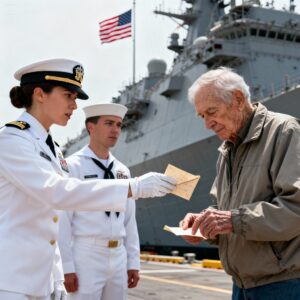
As the young officer moved to detain the 89-year-old man, she was blind to the truth. The very name of the warship she guarded was a whisper of the 70-year-old secret hidden on his faded patch.
The voice sliced through the humid air of the naval pier, a sharp tool meant to carve out immediate compliance. “Sir, I’m going to have to ask you to step away from the gangway. This area is for authorized personnel…

They chose a desolate mountain to be her grave, thinking a thousand-foot drop was the perfect, silent crime. But as she fell into the void, they made a fatal miscalculation about the kind of woman they just betrayed.
The mountain didn’t make a sound when it happened. There was no grand echo to mark the moment, no sympathetic rumble from the ancient stone. There was only the sharp, scattering kick of gravel, a sudden, violent silence where a…

In a circle of 282 elite soldiers, two men decided to humiliate the quiet medic during a demonstration. They intended to break her spirit. Instead, in seven brutal seconds, they discovered a truth that broke them completely.
The wind that came off the Atlantic that morning had teeth. It wasn’t a breeze; it was a hard, scouring force that snapped across the open-air corridors of Naval Special Warfare Command Unit 7, carrying the briny scent of the…
End of content
No more pages to load