
A Late-Night Veteran Offers A Stark Glimpse Into The Future Of Television

An awards ceremony is typically a place for reflection, a comfortable look backward at a career’s high points. But when Conan O’Brien stepped onto the stage to accept his induction into the Television Academy Hall of Fame, he wasn’t interested in nostalgia. Instead, he seized the moment to deliver a startlingly frank and forward-looking assessment of the industry that had defined his life for three decades. Before a room of his peers, O’Brien, the elder statesman of a vanishing art form, acted as both its historian and its prophet, delivering a eulogy for what was and a vision for what is to come.

The atmosphere was one of celebration, but O’Brien quickly injected a dose of reality that has been the undercurrent of every industry conversation for years. “The life we’ve all known for almost 80 years is undergoing seismic change,” he stated, setting a serious tone. This wasn’t just idle chatter; it was a direct acknowledgment of the anxieties swirling around the recent news that “The Late Show with Stephen Colbert,” a cornerstone of the modern late-night landscape, would be concluding in 2026. The ground is shifting beneath everyone’s feet, and O’Brien, a man who has experienced his own career earthquakes, felt compelled to address it head-on.

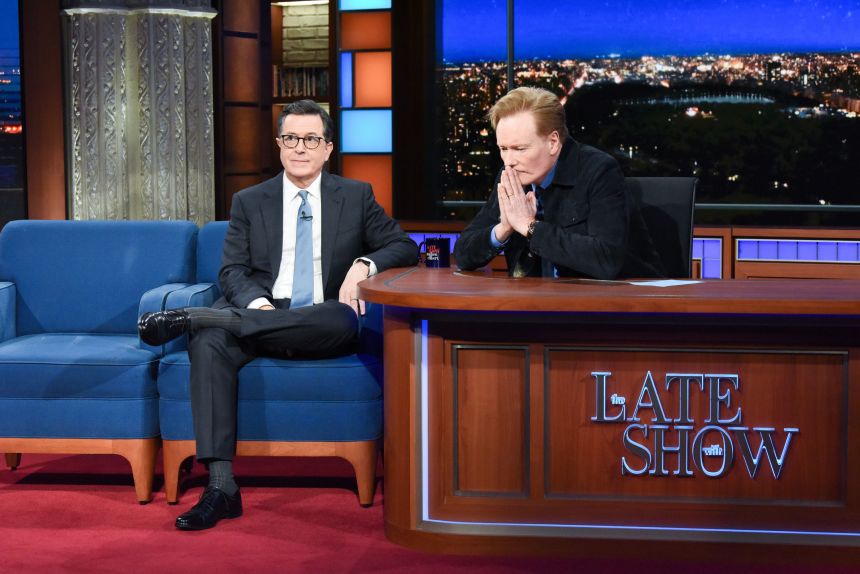
Stephen Colbert and Conan O'Brien in 2019.v

He then delivered the line that would be quoted in every major publication the next day: “Late-night television, as we have known it since around 1950, is going to disappear.” The statement was definitive, devoid of the usual comedic deflection that has been his trademark. It was a recognition that the model itself—a host behind a desk, a nightly monologue, a parade of celebrity guests—was a product of a media monoculture that no longer exists. In an era of infinite choice, streaming platforms, and social media immediacy, the nightly appointment viewing that sustained generations of hosts from Jack Paar to Johnny Carson is fading into memory.

Yet, O’Brien’s message was crucially, and perhaps surprisingly, not one of despair. He drew a sharp distinction between the “pipeline” and the “content.” The pipeline—the network television model—may be breaking down, but the creative spirit that flows through it remains as vital as ever. “I choose not to mourn what is lost,” he explained, “because I think in the most essential way, what we have is not changing at all.” The core of the experience, he argued, is the connection between an authentic, brave performer and an audience that trusts them. That connection is not dependent on a time slot.

This philosophy was perfectly encapsulated in his powerful tribute to Stephen Colbert. In a business known for its sharp elbows and competitive nature, O’Brien’s words were a remarkable display of public camaraderie and respect. He held up Colbert as the prime example of why the end of a show does not mean the end of a voice. “People like Stephen Colbert,” O’Brien said with unwavering certainty, “are too talented and too essential to go away.”

This wasn’t just a compliment; it was the central thesis of his entire speech. O’Brien was making the case that the most valuable asset in entertainment is not the platform, but the singular talent that can command an audience’s attention regardless of where they are found. He spoke from a place of deep personal experience. After his infamous and painful exit from NBC’s “The Tonight Show,” many wondered if his career could recover. But he didn’t just recover; he reinvented. He moved to cable with “Conan” on TBS, and then, in a move that proved his point perfectly, he launched the wildly successful podcast “Conan O’Brien Needs a Friend” and a series of acclaimed travel specials on the streaming service Max. He had become his own pipeline.

He predicted a similar, and even brighter, future for Colbert. “Stephen is going to evolve and shine brighter than ever in a new format that he controls completely,” O’Brien stated. This vision of creative autonomy is the silver lining in the cloud of industry disruption. As the old gatekeepers lose their power, artists have an unprecedented opportunity to build their own platforms, connect directly with their fans, and create content on their own terms.

Throughout his speech, O’Brien balanced his stark predictions with a fundamental belief in the enduring power of storytelling. He quipped about a dystopian future where all content is consumed in a “high-protein, chewable, vanilla-flavored capsule,” only to pivot back to his core belief: “It still won’t matter, if the stories are good, if the performances are honest and inspired, if the people making it are brave and of goodwill.”

In the end, Conan O’Brien used his Hall of Fame induction to do what he has always done best: read the room. But this time, the room was the entire television industry. He gave voice to its deepest fears while simultaneously offering a clear and hopeful path forward. He acknowledged the end of an era with respect but without sentimentality, championing the idea that true talent is fluid, adaptable, and, above all, essential. His speech was a passing of the torch, not from one host to another, but from an old way of thinking to a new one.

Related Posts

Our Privacy policy

https://topnewsaz.com - © 2025 News