Nathan Crawford sat at the corner table of the Riverside Cafe, nervously adjusting the cuff of his shirt. At thirty-two, he’d agreed to this blind date mostly to get his sister, Sarah, off his back. She’d been insisting for months that he needed to get out more, meet someone, stop burying himself in his work as a corporate lawyer.
He was successful by any measure. Dark hair styled perfectly, a charcoal suit that spoke of careful attention to detail, a gold watch that had been his father’s. On paper, his life looked impressive. In reality, he felt like he was going through the motions. The cafe was warm and inviting, with exposed brick walls and soft lighting that made everyone look better than they probably did in daylight.
Nathan had arrived fifteen minutes early, a habit from years of never wanting to be the one who kept people waiting. He was scrolling through his phone, feigning importance, when he heard her voice.
“Nathan?”
He looked up and felt his breath catch. She was beautiful, standing by the table with a hesitant smile. She looked to be around thirty, with long blonde hair that caught the light, and was dressed simply in a cream-colored blouse that somehow looked elegant in its simplicity.
But it was her eyes that held him. They were studying him with an intensity that made him uncomfortable, like she could see right through his carefully constructed facade.
“Yes, hi. You must be Clare,” he said, standing quickly and offering his hand.
She took it. Her grip was firm, her smile polite but guarded. “Thank you for agreeing to this. I know blind dates can be… awkward.”
“No, it’s fine, really,” he said, pulling out her chair. “My sister speaks very highly of you.”
They sat down. A server came by to take their order. Nathan suggested the house specialty coffee, and Clare agreed. The first few minutes passed in the typical, stilted small talk that accompanies any first meeting between strangers.
Clare asked about his work. He gave his practiced explanation of corporate law, making mergers and acquisitions sound more interesting than they usually felt. She listened attentively, asking thoughtful questions that suggested she was genuinely engaged rather than just being polite.
“And what about you?” Nathan asked. “My sister mentioned you work in education.”
“I’m a high school teacher. English literature.” She smiled, a small, genuine expression. “It doesn’t pay much, but I love it. Watching kids discover books that change how they see the world… that’s pretty special.”
“That sounds rewarding,” Nathan said, and meant it. “What made you choose teaching?”
Clare’s expression shifted slightly, became more guarded. “I had a teacher once who saw me when I felt invisible. Who believed in me when I didn’t believe in myself. I wanted to be that person for someone else.”
There was a weight behind her words, a story she wasn’t telling. Nathan found himself curious, wanting to know more. But before he could ask, Clare leaned forward slightly, her eyes searching his face.
“Can I ask you something?”
“Of course.”
“You don’t remember me, do you?”
The question landed like a stone dropped in still water. Nathan felt confusion ripple through him. He studied her face more carefully, looking for something familiar, some trigger of recognition, but there was nothing. He was certain he’d never met this woman before.
“I’m sorry,” he said, his voice hesitant. “I don’t understand. Have we… have we met?”
Clare’s smile was sad, knowing. “Fifteen years ago. We went to the same high school. Westfield Academy.”
Nathan’s mind raced back. Westfield Academy. He’d gone there for his junior and senior years after his family moved to the city, but that was a lifetime ago. He’d been a different person then. Popular, confident, captain of the debate team, dating the head cheerleader. Those two years had been some of the best of his life.
“I was there,” he said carefully. “But I’m sorry, I don’t… I don’t remember you. Were we in classes together?”
“A few,” she said, stirring her untouched coffee. “But we weren’t exactly in the same social circles. You were Nathan Crawford, Golden Boy. I was Clare Morrison, the scholarship kid who sat in the back and tried not to be noticed.”
Clare Morrison.
Nathan searched his memory but came up empty. He felt a growing sense of discomfort, sensing this conversation was heading somewhere he wasn’t prepared for. “I’m sorry,” he said again, honestly. “There were a lot of people at that school.”
“There were. And most of them made sure I knew I didn’t belong. The girl with the secondhand clothes and the free lunch vouchers. The one whose dad was the janitor at the school.”
Nathan’s stomach tightened. He remembered now, vaguely, that there had been a janitor with a daughter who attended. He remembered jokes. Cruel jokes, made by his friends. Jokes he’d laughed at, or at least hadn’t stopped. He felt a hot flush of shame. He hadn’t just “not stopped” them; he’d participated. He’d laughed along because it was easier than not.
“Clare, I…”
“Let me finish,” she said gently, not unkindly. “I need to say this. When your sister set this up, when she told me your name, I almost said no. Because fifteen years ago, you were part of a group that made my life hell. Not directly, maybe. You never threw things at me or wrote cruel things on my locker. But you stood by and watched. You laughed at the jokes. And once… just once… you did something that I’ve never forgotten.”
Nathan wanted to leave, to escape this confrontation with a past he’d barely thought about. But something kept him in his seat. Maybe it was the way Clare was looking at him, not with anger, but with something more complicated. Sadness, perhaps, or maybe just the need to be heard.
“It was spring of your senior year,” Clare continued, her voice quiet. “There was a big party at Jessica Winter’s house. Her parents were away. Everyone who was anyone was going. I wasn’t invited, obviously, but I had to work that night anyway, cleaning offices downtown with my dad. We needed the money.”
Nathan remembered that party. It had been legendary. The kind of night that felt monumental when you’re seventeen and everything feels like it matters more than it actually does.
“I was walking home from the bus stop around midnight. Still in my cleaning uniform. I passed by Jessica’s house. The party was still going, and there you were, sitting on the front steps by yourself. You looked… upset about something. Your girlfriend, probably. I remember hearing you’d broken up that week.”
A memory flickered, sharp and sudden. Jessica Winters. A fight about… God, about nothing. About which college he’d written on an application. He did remember sitting on those steps, stewing in the self-important misery only a seventeen-year-old can muster.
“I walked past, trying to be invisible like always. But you looked up and saw me. I thought you’d say something cruel, or call your friends to come laugh at the ‘janitor’s kid’ in her cleaning uniform. But you didn’t.”
Clare’s voice softened. “You asked if I was okay, if it was safe for me to be walking alone that late. I said I was fine, that I lived nearby. And then you did something that confused me so much. You pulled a twenty-dollar bill from your wallet and tried to give it to me. You said, ‘Take a cab home. It’s not safe.'”
Nathan had no memory of this. None at all. But he could picture himself doing it. Drunk and emotional, trying to feel like a good person.
“I didn’t take it,” Clare said. “I was too proud, too angry at you and everyone like you. I said I didn’t need your charity. And you know what you said?”
Nathan shook his head, afraid to hear it.
“You said, ‘It’s not charity. It’s just one human being looking out for another. Please. It would make me feel better.’ And you looked so genuine, so… concerned… that I took it. I took the cab home, and I cried the whole way. Because I couldn’t reconcile the boy who’d stood by while his friends mocked me with the boy who’d just shown me unexpected kindness.”
The cafe felt too warm. Nathan’s collar felt too tight. He didn’t know what to say.
“Why… why are you telling me this?” he asked quietly.
Clare took a sip of her coffee, which had long since grown cold. “Because when your sister told me about you, described you as this successful lawyer who seemed lost, who worked too hard and never let anyone in, I wondered if you remembered that night. If you remembered me. And when I saw you sitting here, looking so perfectly put together and so completely alone, I knew you didn’t.”
“I’m sorry,” Nathan said, and he meant it, deeply. “I’m sorry I don’t remember. I’m sorry I was part of something that hurt you. I was seventeen and stupid and… and thought being popular mattered more than being kind.”
“I know,” Clare said simply. “We all were, in our own way. But here’s the thing, Nathan. That moment on those steps… that small act of kindness from someone I’d written off as just another privileged kid who didn’t care… it stayed with me. It made me realize that people are more complicated than the boxes we put them in. That everyone is capable of kindness, even people who’ve been cruel. It’s part of why I became a teacher. To see the complicated humans behind the facades.”
Nathan felt something crack open inside him, something he hadn’t realized was sealed shut.
“Your sister didn’t tell you who I was, did she?”
“Oh, she did,” Clare said, a small spark in her eye. “That’s why I agreed to come. I wanted to see who you’d become. If that boy who told me it wasn’t charity, just one human being looking out for another… if he was still in there somewhere.”
And then Clare smiled, and this time it reached her eyes, warm and bright. “I think he is. Buried under expensive suits and seventy-hour work weeks, but he’s there. Looking tired, and lonely, and like he forgot somewhere along the way that success and happiness aren’t the same thing.”
Nathan laughed, a real, sudden laugh that surprised him. “You’re not pulling any punches, are you?”
“Life’s too short,” she said. “I spent too many years being invisible. Now I say what I mean.”
They talked for three more hours. Really talked. Nathan found himself telling Clare things he hadn’t told anyone. About the crushing pressure he felt to live up to his father’s legacy. About how he’d built this perfect life that felt hollow. He talked about the partners at his firm, men he’d admired from afar who now just seemed… tired. He admitted he couldn’t remember the last time he’d done something just because it made him happy.
Clare told him about her father, who’d passed away five years ago; about how hard he’d worked to give her opportunities. She told him about the students she’d taught who’d overcome impossible odds, and about the specific triumph of a student who finally understood The Great Gatsby. She described her small apartment, full of books and plants, and the life she’d built that wasn’t glamorous but felt real.
When the cafe staff started putting chairs on tables, they realized they’d been the last customers for over an hour.
Outside, the night air was cool and fresh. They stood on the sidewalk, neither one quite ready to say goodbye.
“I should confess something,” Nathan said, rubbing the back of his neck. “I almost canceled tonight. Told my sister I was too busy with a case. It would have been a lie, but a convenient one.”
“I’m glad you didn’t,” Clare said softly.
“Me, too.” He hesitated, then took the plunge. “Would you… maybe… want to do this again? Not a setup. Just us. I’d like to get to know the woman who remembered me better than I remembered myself.”
Clare studied him for a long moment. “On one condition.”
“What’s that?”
“Next time, we skip the expensive cafe. There’s a diner near my school that serves the best pie in the city. Nothing fancy, but it’s real. Can you handle that?”
Nathan smiled, feeling lighter than he had in years. “I think the ‘expensive cafe’ version of me needs to meet the ‘diner’ version of you. It might do him some good.”
“Might do both of us some good,” she replied.
They went on that second date. And a third. And somewhere around the tenth, Nathan realized he was falling in love with a woman who’d been invisible to him when it would have cost him nothing to see her.
Clare taught him to slow down, to find joy in simple things, to measure success by different metrics. Nathan helped Clare see that her past didn’t define her, that she’d built something beautiful from difficult circumstances.
A year later, Nathan left his corporate firm to start a nonprofit providing legal services to low-income families. It paid a fraction of what he’d made before, but he couldn’t remember ever feeling more fulfilled.
Two years after that, he proposed. Not at an expensive restaurant, but in a booth at that diner Clare loved, over pie and coffee.
“You know what I think about sometimes?” he said as he slipped the simple, perfect ring on her finger while she cried happy tears. “That seventeen-year-old kid sitting on those steps. If I could go back and talk to him, I’d tell him that the moment he thought was insignificant, just a small gesture to make himself feel better, would lead him to the love of his life. That kindness is never wasted, even when we don’t remember giving it.”
“And I’d tell seventeen-year-old me,” Clare replied, lacing her fingers through his, “that the girl who felt invisible would one day be seen, truly seen, by someone who learned to look past surfaces. That our stories aren’t finished just because we had hard chapters.”
They were married six months later. It was a small ceremony, with close friends and family, nothing fancy. Clare’s students came and formed an honor guard, holding up copies of their favorite books instead of swords. It was perfect.
Years later, they’d tell the story of their first date to their own children. About a blind date that wasn’t blind at all, but a second chance neither of them knew they needed. About how we’re all more than our worst moments and our best moments, just complicated humans trying to find our way.
And sometimes, if we’re very lucky, we find someone who remembers us better than we remember ourselves. Someone who sees not just who we are, but who we could be. Someone who gives us the gift of being truly known.
That’s not charity. That’s just one human being looking out for another.
And sometimes, it’s everything.
News
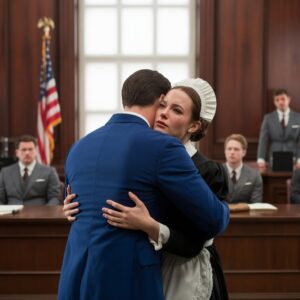
‘Wait!’ he shouted. ‘She didn’t do it!’ The Maid Framed by a Millionaire Appeared in Court Without a Lawyer
The courtroom was silent except for the hum of the fluorescent lights. Maria Torres stood at the defendant’s table, her trembling hands clutching a worn purse. She had no lawyer — only the public defender who’d withdrawn that morning, claiming…

The Meltdown Millions Witnessed: How Greg Gutfeld’s Takedown Exposed Sunny Hostin’s World of Contradictions
In the polished, often predictable world of daytime television, genuine moments of unscripted drama are rare gems that can captivate a nation. Recently, audiences of “The View” witnessed such a moment—a raw, unfiltered confrontation that felt less like a debate…

“Treasonous” Plot Alleged: Whistleblower Claims Adam Schiff Approved Classified Leaks to Indict Trump
In a move that has sent shockwaves through the American political landscape, the White House has amplified a stunning whistleblower allegation that threatens to reframe the narrative of one of the most contentious periods in recent history. A newly declassified…

The Silencing of Stephen Colbert: How a Secret Pact with Jon Stewart Could Topple CBS
In the cutthroat world of late-night television, endings are rarely gentle. They are usually meticulously planned, drawn-out affairs filled with tribute reels, tearful goodbyes, and a parade of A-list guests. But for Stephen Colbert, the end came not with a…

The Great Un-Canceling: How Gutfeld and a New Wave of Anti-Woke Culture Are Making America Fun Again
In an era defined by digital outrage and cultural battle lines, a seismic shift is rumbling through the American landscape, shaking the very foundations of entertainment, comedy, and politics. For years, a progressive, “woke” orthodoxy has seemingly dictated the terms…

The Rebellion You Didn’t See Coming: Jon Stewart and Lesley Stahl Rumored to Be Building a Newsroom That Has the Media Elite Terrified
In the polished, high-stakes world of broadcast news, where every word is focus-grouped and every segment is designed for maximum engagement, a tremor of genuine fear is running through the executive suites. The source isn’t a drop in ratings or…
End of content
No more pages to load